
&w=3840&q=75)
&w=3840&q=75)
&w=3840&q=75)
&w=3840&q=75)
&w=3840&q=75)
&w=3840&q=75)
&w=3840&q=75)
&w=3840&q=75)


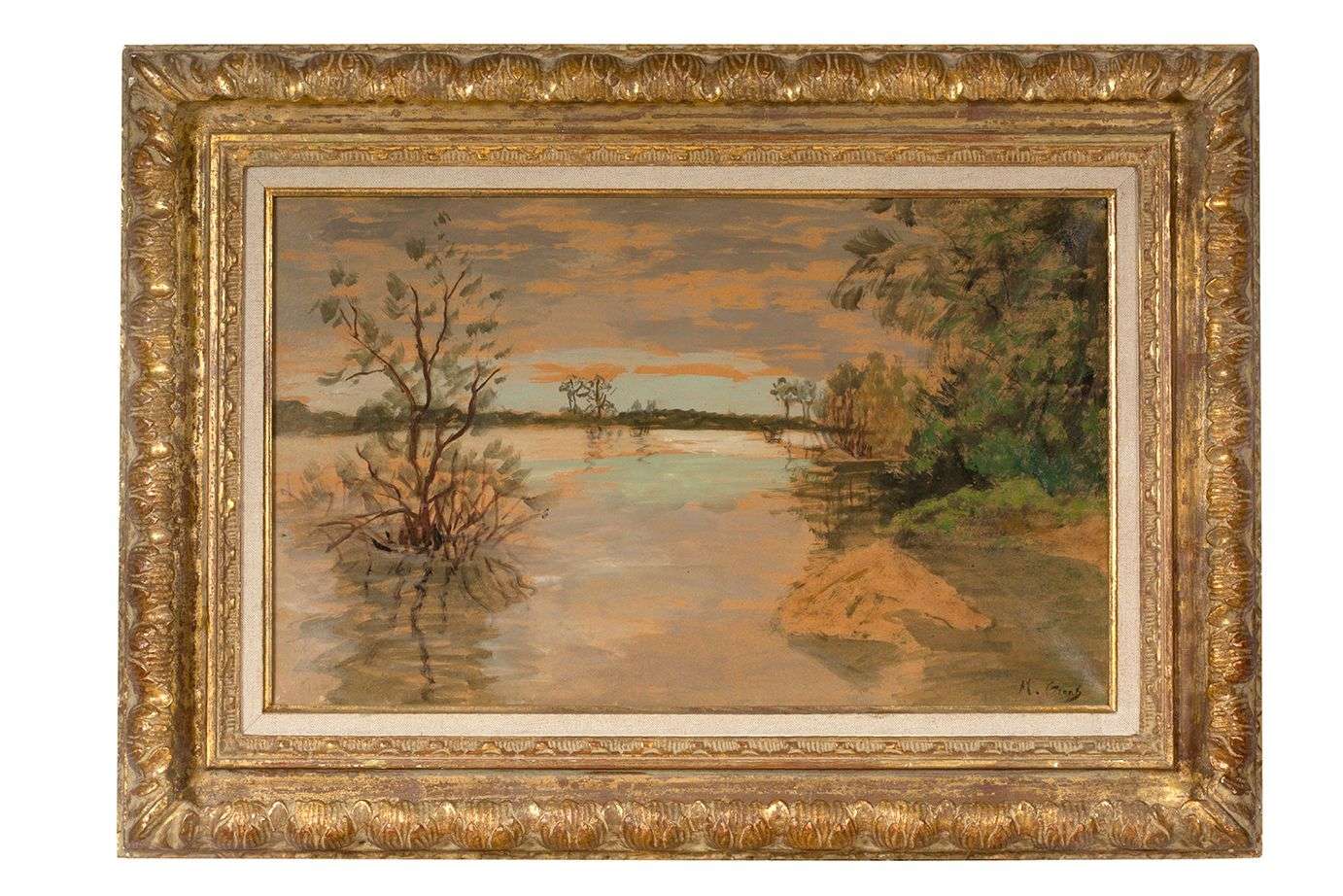
MARTHE ORANT (1874-1957)
Banks of the Loire in flood
Tempera on paper mounted on canvas
Signed lower right
Geneviève Meunier-Warmont/Atelier/Marthe Orant' stamp on back
Tempera on paper laid on canvas, signed lower right, stamped with the 'Geneviève Meunier-Warmont/Atelier/Marthe Orant' mark on the reverse
36,5 x 59,5 cm - 14 3/8 x 23 3/8 in.
Provenance
- Sale, Atelier Marthe Orant, Estate of Madame X... [Geneviève Meunier-Warmont], Me Bondu, Paris, Hôtel Drouot, February 9, 1990
- Private collection, France (acquired at previous sale, then by descent)
Note
Marthe Orant was a French painter born in Poissy on June 3, 1874. Like all young girls from good families during the Belle Époque, she learned the rudiments of painting at a convent", but her drawings show her to have been permanently marked by the fact that she left the convent to find her father, who had become blind. Marthe Orant's next teachers were Marcel Baschet, Maurice Bompard and Henri Royer, before she moved closer to the Nabis and received advice from Édouard Vuillard and Pierre Bonnard. Gérald Schurr, in evoking "a painting that trembles with vigilant emotion under the guise of happiness, not unlike Bonnard's poetic fêtes in the way it integrates forms into composition", nevertheless resituates it as a happy respite from a daily existence that was not, where we see Marthe Orant "always helpless in the face of small problems": "life is nothing but disorder", she herself confides repeatedly in her correspondence. "Perpetually in search of new ways to approach and transpose her favorite Parisian subjects" - public gardens, working-class neighborhoods, bustling streets, not to mention numerous still lifes and bouquets of flowers - her work, which is thus made up of "the rarest nuances in a sometimes exuberant layout", which is "an art of intuition that she never ceases to deepen in order to clarify the language of strokes and tones", nonetheless reflects "that raw, flayed sensibility, that instability, that very anguish that forms the fabric of an existence that will end at Sainte-Anne". Étienne Sassi, for his part, similarly evokes a joyless life - overwhelmed with grief at the death of her parents, financially ruined by the investment of her inheritance in the Russian loan, with a physical appearance that seems graceless and that she herself does not like, banishing all photographs that would have allowed her face to be known to us - and does not fail to think "of Van Gogh and his obsessions. Marthe Orant, in the midst of horror, creates charm. But this marvellous impression of serenity reflected in each painting was born in the most terrifying solitude and constant drama, and this is undoubtedly the origin of the power of shock that embraces us in front of these works, built to restore the pleasure of living. In her canvases, she has imagined the spaces where she could have lived happily, waiting for her forever in the bright light of her dreams". She lived at 103, rue de Vaugirard in Paris from 1930. She died at the Hôpital Sainte-Anne in Paris on August 27, 1957.
Banks of the Loire in flood
Tempera on paper mounted on canvas
Signed lower right
Geneviève Meunier-Warmont/Atelier/Marthe Orant' stamp on back
Tempera on paper laid on canvas, signed lower right, stamped with the 'Geneviève Meunier-Warmont/Atelier/Marthe Orant' mark on the reverse
36,5 x 59,5 cm - 14 3/8 x 23 3/8 in.
Provenance
- Sale, Atelier Marthe Orant, Estate of Madame X... [Geneviève Meunier-Warmont], Me Bondu, Paris, Hôtel Drouot, February 9, 1990
- Private collection, France (acquired at previous sale, then by descent)
Note
Marthe Orant was a French painter born in Poissy on June 3, 1874. Like all young girls from good families during the Belle Époque, she learned the rudiments of painting at a convent", but her drawings show her to have been permanently marked by the fact that she left the convent to find her father, who had become blind. Marthe Orant's next teachers were Marcel Baschet, Maurice Bompard and Henri Royer, before she moved closer to the Nabis and received advice from Édouard Vuillard and Pierre Bonnard. Gérald Schurr, in evoking "a painting that trembles with vigilant emotion under the guise of happiness, not unlike Bonnard's poetic fêtes in the way it integrates forms into composition", nevertheless resituates it as a happy respite from a daily existence that was not, where we see Marthe Orant "always helpless in the face of small problems": "life is nothing but disorder", she herself confides repeatedly in her correspondence. "Perpetually in search of new ways to approach and transpose her favorite Parisian subjects" - public gardens, working-class neighborhoods, bustling streets, not to mention numerous still lifes and bouquets of flowers - her work, which is thus made up of "the rarest nuances in a sometimes exuberant layout", which is "an art of intuition that she never ceases to deepen in order to clarify the language of strokes and tones", nonetheless reflects "that raw, flayed sensibility, that instability, that very anguish that forms the fabric of an existence that will end at Sainte-Anne". Étienne Sassi, for his part, similarly evokes a joyless life - overwhelmed with grief at the death of her parents, financially ruined by the investment of her inheritance in the Russian loan, with a physical appearance that seems graceless and that she herself does not like, banishing all photographs that would have allowed her face to be known to us - and does not fail to think "of Van Gogh and his obsessions. Marthe Orant, in the midst of horror, creates charm. But this marvellous impression of serenity reflected in each painting was born in the most terrifying solitude and constant drama, and this is undoubtedly the origin of the power of shock that embraces us in front of these works, built to restore the pleasure of living. In her canvases, she has imagined the spaces where she could have lived happily, waiting for her forever in the bright light of her dreams". She lived at 103, rue de Vaugirard in Paris from 1930. She died at the Hôpital Sainte-Anne in Paris on August 27, 1957.