
&w=3840&q=75)
&w=3840&q=75)
&w=3840&q=75)
&w=3840&q=75)
&w=3840&q=75)
&w=3840&q=75)
&w=3840&q=75)
&w=3840&q=75)


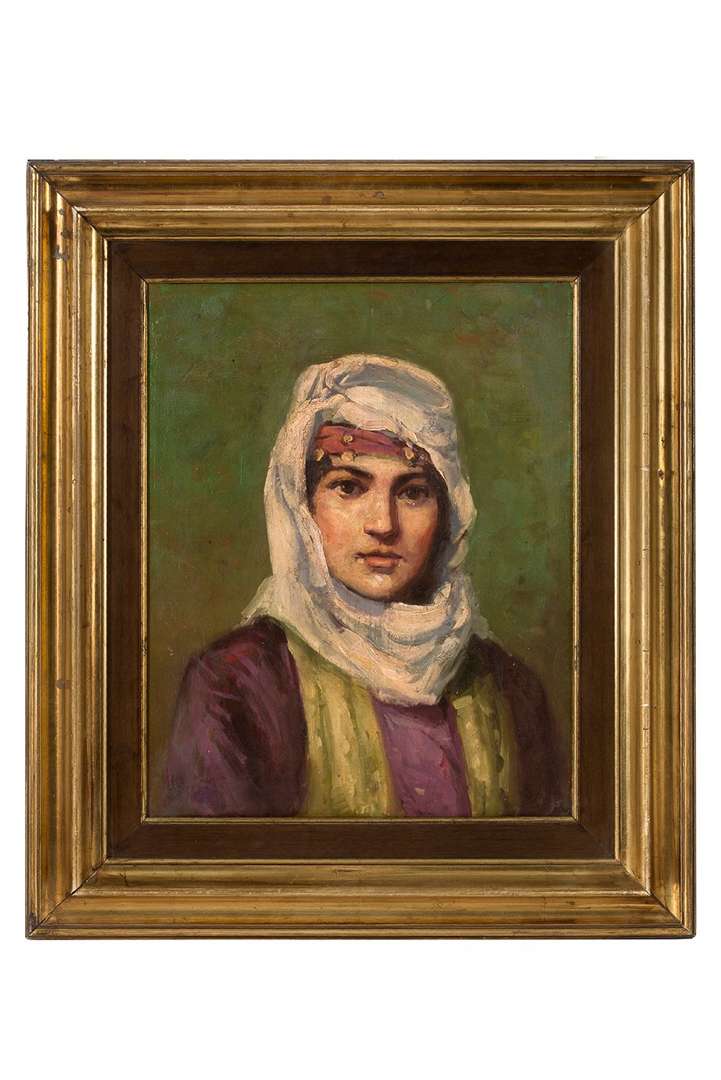
ATTRIBUTED TO HABIB SROUR
The beautiful Bedouin
Oil on panel
Trace of a signature lower left
Oil on panel, trace of a signature lower left
45 x 36 cm - 17 3/4 x 14 1/8 in.
Provenance
Private collection, Belgium
Note
Habib Srour (Beirut 1863-Beirut 1938) wasn't aiming for a fundamental society, because he was in the minority in 19th-century Beirut, where representation was split along socio-cultural lines. He lived in Rome until 1882, when, for health reasons, he moved to Naples. From there, he went to Egypt, where he found a more lively and stable social environment than Beirut, but where he was only one painter among many. Like all the artists of his generation, Srour remained faithful to the classical formula, but did not shy away from the narrow confines of formalism, allowing himself a certain freedom in the choice and development of his subjects. On his return to Lebanon in 1908, he opened a portrait studio with the help of patrons and sponsors, and later became a drawing teacher at the Ottoman school in Beirut. Under the French Mandant, the era and milieu were no longer his own. He was just an aging painter with a typically Italian brio in his approach to subject matter. Busy supplying commissioned canvases with religious themes, he occasionally indulged in painting a portrait or a still life. He was a painter in a country where the beginnings of art did not ask the questions of painting, but the illusion of rendering these questions: representation, influences and, for him, style, a brand-new notion, a kind of addition he made to technique to say that art is not made of craftsmanship, but of its neurotic meticulousness, which goes beyond resemblance. He was well aware that this was a false perspective, but it was the only one that guaranteed his demand for individuality in the face of the world, and the need for an order to be preserved to prevent him from descending into inner chaos. How conscious was he of his art? Mourani saw him as an Ottoman painter, and even he thought himself more sensitive to the Maronite and urban background, where Giusti, Corm and Spiridon seemed to him more at home than Srour, the bearer of anxieties and doubts, but also of pictorial qualities. Was he less established than Corm in Lebanese painting and society? Srour was marked by the taste of his masters, the academic apprenticeship in Italy that locked generations of Lebanese painters into the difficulty of finding a cultural answer. When the first Lebanese painters returned from Italy, with a profession in which brilliance prevailed over everything else, they often reduced reality to its mere literal copy, images, canvases and reproductions. Passive copying of which Orientalism, an attempt to characterize Oriental reality at the opposite extreme, was unable to transcend the travesty. This is not to criticize them for their lack of modernity: they were contemporary painters of their time, and that meant they were better suited to it, as craftsmen of reproduction, in a society where reproduction was a social product ensuring identity and guaranteeing genealogy. The painter's place was precisely defined, and he didn't play the role we seem to want to assign to them. Being a painter meant standing in front of his easel every day. While playing with the most rhetorical Italian devices, Srour was careful not to let them fool him. If he had an illusion to render, it was without illusion. In a way, one could say that this rejection of illusionism, false play and juggling is a moral issue. Srour had his period of meticulous precision in portraiture, attempting to bring the real into painting through a magical operation of translation. Srour never forced this reality. The perfect example of this is a painting and a subject: the Bedouin, where the doubling with Corm poses the problem of sensitivity. At other times, all that stood between him, reality and painting was a total lack of interest in the subject, a lassitude, chromo, and this only in the copy, i.e. the subject, but even in the pictorial treatment. In this kind of painting, all singularity is excluded, and the distant echo of the style's claim to fame unravels in the craftsmanship destined for the wilayet. The way in which Srour inscribes himself in a history of art is the way in which he inscribes this history in painting, what he traces and influences and what he would like to elaborate: the junction of a technique and a style.
The beautiful Bedouin
Oil on panel
Trace of a signature lower left
Oil on panel, trace of a signature lower left
45 x 36 cm - 17 3/4 x 14 1/8 in.
Provenance
Private collection, Belgium
Note
Habib Srour (Beirut 1863-Beirut 1938) wasn't aiming for a fundamental society, because he was in the minority in 19th-century Beirut, where representation was split along socio-cultural lines. He lived in Rome until 1882, when, for health reasons, he moved to Naples. From there, he went to Egypt, where he found a more lively and stable social environment than Beirut, but where he was only one painter among many. Like all the artists of his generation, Srour remained faithful to the classical formula, but did not shy away from the narrow confines of formalism, allowing himself a certain freedom in the choice and development of his subjects. On his return to Lebanon in 1908, he opened a portrait studio with the help of patrons and sponsors, and later became a drawing teacher at the Ottoman school in Beirut. Under the French Mandant, the era and milieu were no longer his own. He was just an aging painter with a typically Italian brio in his approach to subject matter. Busy supplying commissioned canvases with religious themes, he occasionally indulged in painting a portrait or a still life. He was a painter in a country where the beginnings of art did not ask the questions of painting, but the illusion of rendering these questions: representation, influences and, for him, style, a brand-new notion, a kind of addition he made to technique to say that art is not made of craftsmanship, but of its neurotic meticulousness, which goes beyond resemblance. He was well aware that this was a false perspective, but it was the only one that guaranteed his demand for individuality in the face of the world, and the need for an order to be preserved to prevent him from descending into inner chaos. How conscious was he of his art? Mourani saw him as an Ottoman painter, and even he thought himself more sensitive to the Maronite and urban background, where Giusti, Corm and Spiridon seemed to him more at home than Srour, the bearer of anxieties and doubts, but also of pictorial qualities. Was he less established than Corm in Lebanese painting and society? Srour was marked by the taste of his masters, the academic apprenticeship in Italy that locked generations of Lebanese painters into the difficulty of finding a cultural answer. When the first Lebanese painters returned from Italy, with a profession in which brilliance prevailed over everything else, they often reduced reality to its mere literal copy, images, canvases and reproductions. Passive copying of which Orientalism, an attempt to characterize Oriental reality at the opposite extreme, was unable to transcend the travesty. This is not to criticize them for their lack of modernity: they were contemporary painters of their time, and that meant they were better suited to it, as craftsmen of reproduction, in a society where reproduction was a social product ensuring identity and guaranteeing genealogy. The painter's place was precisely defined, and he didn't play the role we seem to want to assign to them. Being a painter meant standing in front of his easel every day. While playing with the most rhetorical Italian devices, Srour was careful not to let them fool him. If he had an illusion to render, it was without illusion. In a way, one could say that this rejection of illusionism, false play and juggling is a moral issue. Srour had his period of meticulous precision in portraiture, attempting to bring the real into painting through a magical operation of translation. Srour never forced this reality. The perfect example of this is a painting and a subject: the Bedouin, where the doubling with Corm poses the problem of sensitivity. At other times, all that stood between him, reality and painting was a total lack of interest in the subject, a lassitude, chromo, and this only in the copy, i.e. the subject, but even in the pictorial treatment. In this kind of painting, all singularity is excluded, and the distant echo of the style's claim to fame unravels in the craftsmanship destined for the wilayet. The way in which Srour inscribes himself in a history of art is the way in which he inscribes this history in painting, what he traces and influences and what he would like to elaborate: the junction of a technique and a style.