
&w=3840&q=75)
&w=3840&q=75)
&w=3840&q=75)
&w=3840&q=75)
&w=3840&q=75)
&w=3840&q=75)
&w=3840&q=75)
&w=3840&q=75)


99
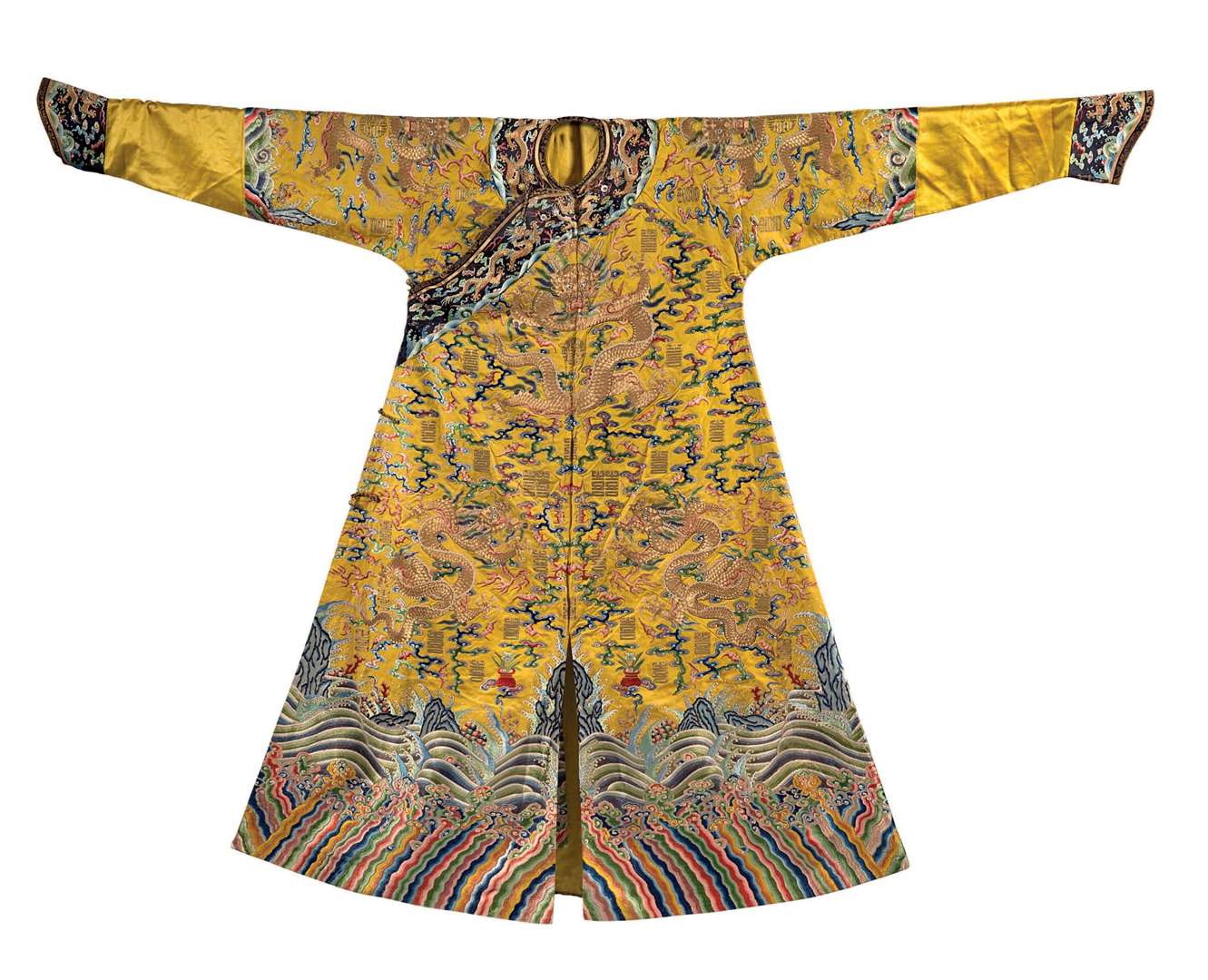
CHINE DYNASTIE QING, ÉPOQUE YONGZHENG (1722-1735)
The item was sold for 84 500 €
Fees include commission and taxes.
CHINE DYNASTIE QING, ÉPOQUE YONGZHENG (1722-1735)
= Exceptional semi-formal emperor's robe (longpao) in yellow silk decorated with nine imperial dragons chasing the pearl among the clouds. The robe is embroidered with polychrome silk threads and gold thread overlay, on an imperial yellow ground, with eight five-clawed dragons, bats, Shou and Xi characters amid cloudy scrolls in shades of green, blue and red, above a short band of lishui and tumultuous waves from which sacred peaks and precious objects emerge. The ninth dragon embroidered on the dress' inner flap.
Lined with yellow silk.
Size 145 x 204.5 cm
PROVENANCE
Private collection of a French military attaché stationed in China from 1919 to 1925, then by descent.
Very few examples of imperial robes from the early Qing dynasty are in private hands. The majority of these court dresses are held in public collections, notably those of the Palace Museum, Beijing.
A Yongzheng-period dress illustrated in "Stately Demeanour. Costumes of Qing Emperors and Empress from the Collection of the Palace
Museum", Macau, 2020, cat. no. 22, pp. 68-69.
Another Yongzheng-period dress illustrated in "The Splendors of Imperial Costume. Qing
Court Attire from the Beijing Palace Museum",
Beijing, 2008, pl. 29 (accession. no. 45188).
Among the comparison pieces listed, the closest example is a longpao in the collections of the Saint Louis Art
Museum (no. 97:1978). It is very similar in composition and style. There are a few minor iconographic differences, notably the presence of a flaming pearl instead of the longevity character associated with the central dragon. Similarly, its background is strewn with bats and longevity peaches, whereas the present dress is embroidered with bats and Xi characters.
There were 5 categories of official Qing court clothing: formal (chaofu), semi-formal (jifu), informal (changfu), travel (xinfu) and military.
The dress we are presenting is a longpao (literally "dragon dress"). It belongs to the category of semi-formal garments (jifu), worn for important court occasions (weddings, banquets, feasts, military inspections, etc.).
Longpao decoration is subject to strict codification, in terms of the type and number of dragons depicted on the dress, as well as its color. Thus, only the emperor, empress, crown prince, empress dowager and a few high-ranking concubines are authorized to wear five-clawed dragons on their robes. The codification of dress colors is even stricter, reserving the wearing of imperial yellow (minghuang) to the emperor, empress, empress dowager and first concubine. The crown prince is authorized to wear a variation of yellow, apricot yellow (xinghuang), while other princes of the blood must wear golden yellow (jinhuang).
The presence of a slit on the front of our longpao indicates that it is a male wardrobe garment. The combination of minghuang yellow and the nine five-clawed dragons suggests that the robe was intended for the emperor himself, the only man authorized to wear minghuang yellow.
It is interesting to note that this emperor's robe is not decorated with the "Twelve
Emblems". The reintroduction of these motifs into the official Qing wardrobe was formalized by the clothing regulation laws enacted in 1759 by Emperor Qianlong in the Huangchao liqi tushi ("The Illustrated Precedents of the Attirail
Imperial Court Ritual"). Indeed, Huang
Taiji, the first Qing emperor, had rejected the use of the "Twelve Symbols" that had adorned the ritual and official vestments of Chinese sovereigns since the Zhou dynasty (1046-256 BC).
The absence of the "Twelve Symbols" suggests a date prior to Qianlong's reign. Likewise, the sinuous, slender style of the clouds, delicately embroidered in shading, evoking wisps of smoke, is characteristic of Yongzheng period production.
From the early years of the Qing dynasty (1644 - 1911), court costume was an essential component of imperial power. For the Manchu elites, it was a matter of asserting their difference from traditional Chinese culture, while embracing certain codes of the preceding dynasties in a bid to reinforce their new power. Court costume synthesized the various influences that permeated the Qing dynasty.
Qing dynasty, torn between its nomadic origins and the need to sinicize.
Manchu officials adapted the traditional dragon dress by integrating elements linked to the cultural background and nomadic origins of their people. The d
= Exceptional semi-formal emperor's robe (longpao) in yellow silk decorated with nine imperial dragons chasing the pearl among the clouds. The robe is embroidered with polychrome silk threads and gold thread overlay, on an imperial yellow ground, with eight five-clawed dragons, bats, Shou and Xi characters amid cloudy scrolls in shades of green, blue and red, above a short band of lishui and tumultuous waves from which sacred peaks and precious objects emerge. The ninth dragon embroidered on the dress' inner flap.
Lined with yellow silk.
Size 145 x 204.5 cm
PROVENANCE
Private collection of a French military attaché stationed in China from 1919 to 1925, then by descent.
Very few examples of imperial robes from the early Qing dynasty are in private hands. The majority of these court dresses are held in public collections, notably those of the Palace Museum, Beijing.
A Yongzheng-period dress illustrated in "Stately Demeanour. Costumes of Qing Emperors and Empress from the Collection of the Palace
Museum", Macau, 2020, cat. no. 22, pp. 68-69.
Another Yongzheng-period dress illustrated in "The Splendors of Imperial Costume. Qing
Court Attire from the Beijing Palace Museum",
Beijing, 2008, pl. 29 (accession. no. 45188).
Among the comparison pieces listed, the closest example is a longpao in the collections of the Saint Louis Art
Museum (no. 97:1978). It is very similar in composition and style. There are a few minor iconographic differences, notably the presence of a flaming pearl instead of the longevity character associated with the central dragon. Similarly, its background is strewn with bats and longevity peaches, whereas the present dress is embroidered with bats and Xi characters.
There were 5 categories of official Qing court clothing: formal (chaofu), semi-formal (jifu), informal (changfu), travel (xinfu) and military.
The dress we are presenting is a longpao (literally "dragon dress"). It belongs to the category of semi-formal garments (jifu), worn for important court occasions (weddings, banquets, feasts, military inspections, etc.).
Longpao decoration is subject to strict codification, in terms of the type and number of dragons depicted on the dress, as well as its color. Thus, only the emperor, empress, crown prince, empress dowager and a few high-ranking concubines are authorized to wear five-clawed dragons on their robes. The codification of dress colors is even stricter, reserving the wearing of imperial yellow (minghuang) to the emperor, empress, empress dowager and first concubine. The crown prince is authorized to wear a variation of yellow, apricot yellow (xinghuang), while other princes of the blood must wear golden yellow (jinhuang).
The presence of a slit on the front of our longpao indicates that it is a male wardrobe garment. The combination of minghuang yellow and the nine five-clawed dragons suggests that the robe was intended for the emperor himself, the only man authorized to wear minghuang yellow.
It is interesting to note that this emperor's robe is not decorated with the "Twelve
Emblems". The reintroduction of these motifs into the official Qing wardrobe was formalized by the clothing regulation laws enacted in 1759 by Emperor Qianlong in the Huangchao liqi tushi ("The Illustrated Precedents of the Attirail
Imperial Court Ritual"). Indeed, Huang
Taiji, the first Qing emperor, had rejected the use of the "Twelve Symbols" that had adorned the ritual and official vestments of Chinese sovereigns since the Zhou dynasty (1046-256 BC).
The absence of the "Twelve Symbols" suggests a date prior to Qianlong's reign. Likewise, the sinuous, slender style of the clouds, delicately embroidered in shading, evoking wisps of smoke, is characteristic of Yongzheng period production.
From the early years of the Qing dynasty (1644 - 1911), court costume was an essential component of imperial power. For the Manchu elites, it was a matter of asserting their difference from traditional Chinese culture, while embracing certain codes of the preceding dynasties in a bid to reinforce their new power. Court costume synthesized the various influences that permeated the Qing dynasty.
Qing dynasty, torn between its nomadic origins and the need to sinicize.
Manchu officials adapted the traditional dragon dress by integrating elements linked to the cultural background and nomadic origins of their people. The d