
&w=3840&q=75)
&w=3840&q=75)
&w=3840&q=75)
&w=3840&q=75)
&w=3840&q=75)
&w=3840&q=75)
&w=3840&q=75)
&w=3840&q=75)


88
CHINE DYNASTIE MING, MARQUE ET PÉRIODE WANLI (1575 - 1620)
The item was sold for 52 000 €
Fees include commission and taxes.
CHINE DYNASTIE MING, MARQUE ET PÉRIODE WANLI (1575 - 1620)
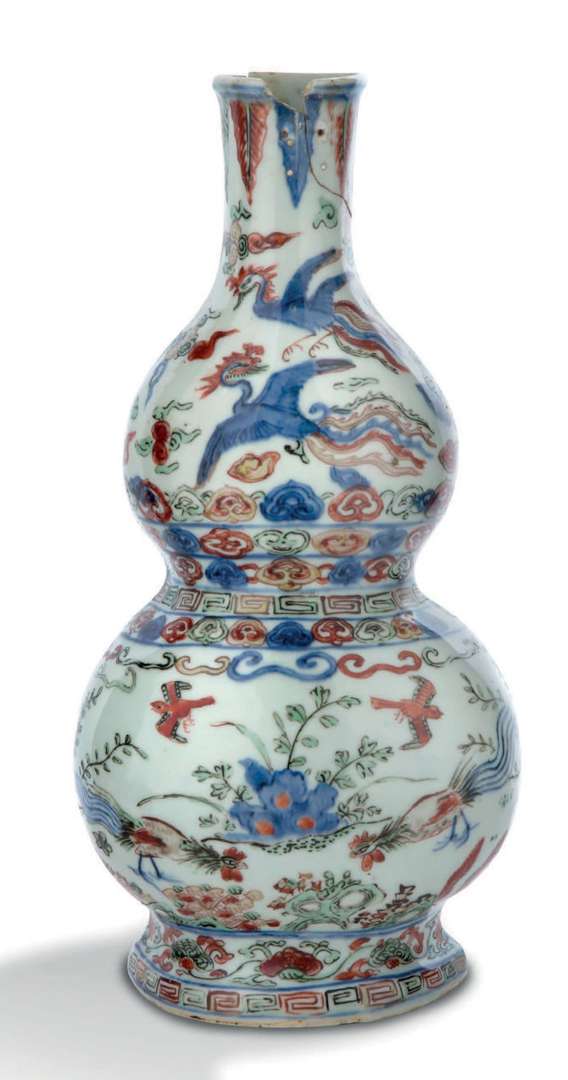
= A rare and important double-gourd wall vase in wucai enamel porcelain, decorated with phoenixes and roosters. The vase has a flat back, resting on a short foot decorated with a frieze of Greek and floral scrolls, the lower part adorned with two roosters facing each other among flowers and rocks.
The narrow waist is glazed with several superimposed ruyi head friezes. The upper part features two phoenixes among clouds.
The lip emphasized by banana leaf motifs. The reverse with a
Wanli six-character kaishu mark in blue underglaze in a cartouche enclosed between a flower and a lotus leaf.
H. 30.9 cm
PROVENANCE
Victor Segalen collection, then by descent.
NOTE
Although the origin of sconce vases dates back to the Ming dynasty, there are very few pieces of this type from this period, and even fewer bearing an imperial mark, like the piece we are presenting today. The few known examples are held in prestigious public and private collections. A close example is in the Baur Collection, Geneva, illustrated in AYERS John, "Chinese Ceramics in the Baur
Collection, Geneva", 1999, vol. 1, pl. 101, another sconce vase in the collections of the Tianjin
City Art Museum published in "Zhongguo taoci quanji", vol. 13, Shanghai, 2000, pl. 110. The piece closest in style and iconography to the present vase is in the collections of the Palace Museum, Beijing, illustrated in "Porcelains in Polychrome and Contrasting Colours
Contrasting Colours: The Complete Collection of
Treasures of the Palace Museum", Hong Kong, 1999, pl. 30, p. 33.
Victor Segalen personal collection
Lots 88 to 90
An astonishing traveler, Victor Segalen (1878-1919) never ceased to explore faraway lands, be they Polynesian, Chinese, poetic or literary. He lived a thousand lives, first as a naval doctor, then as an archaeologist-poet who unearthed the great Han tombs, and above all as a novelist of far-off lands.
Far from his home port of Brest, Segalen found his first inspiration in 1903 in the Marquesas Islands and Tahiti. He drew on this antipodean experience to write several essays and novels. In 1908, he studied Chinese under the great sinologist Édouard Chavannes. Having obtained a posting to China, he settled in Peking with his family. Two major archaeological expeditions and numerous writings were born of this Chinese sojourn. The Great War and its upheavals brought to a halt the work he had been pursuing since his arrival in 1909. Back in France, he was drafted for a time, then devoted himself to writing and medicine.
The year 1917 offered him the opportunity of a final archaeological mission in China before his untimely death in 1919.
During his stay in Peking from 1909 to 1914, Victor Segalen collected paintings, jades, prints and porcelain to decorate his office. This collection reflects his inner encounter with the Chinese aesthetic tradition.
The pieces we present from his personal collection are a fragment of the "Chinese genius" he dreamed of showing the world, a new vision of Chinese art, far removed from the presuppositions of his time.
= A rare and important double-gourd wall vase in wucai enamel porcelain, decorated with phoenixes and roosters. The vase has a flat back, resting on a short foot decorated with a frieze of Greek and floral scrolls, the lower part adorned with two roosters facing each other among flowers and rocks.
The narrow waist is glazed with several superimposed ruyi head friezes. The upper part features two phoenixes among clouds.
The lip emphasized by banana leaf motifs. The reverse with a
Wanli six-character kaishu mark in blue underglaze in a cartouche enclosed between a flower and a lotus leaf.
H. 30.9 cm
PROVENANCE
Victor Segalen collection, then by descent.
NOTE
Although the origin of sconce vases dates back to the Ming dynasty, there are very few pieces of this type from this period, and even fewer bearing an imperial mark, like the piece we are presenting today. The few known examples are held in prestigious public and private collections. A close example is in the Baur Collection, Geneva, illustrated in AYERS John, "Chinese Ceramics in the Baur
Collection, Geneva", 1999, vol. 1, pl. 101, another sconce vase in the collections of the Tianjin
City Art Museum published in "Zhongguo taoci quanji", vol. 13, Shanghai, 2000, pl. 110. The piece closest in style and iconography to the present vase is in the collections of the Palace Museum, Beijing, illustrated in "Porcelains in Polychrome and Contrasting Colours
Contrasting Colours: The Complete Collection of
Treasures of the Palace Museum", Hong Kong, 1999, pl. 30, p. 33.
Victor Segalen personal collection
Lots 88 to 90
An astonishing traveler, Victor Segalen (1878-1919) never ceased to explore faraway lands, be they Polynesian, Chinese, poetic or literary. He lived a thousand lives, first as a naval doctor, then as an archaeologist-poet who unearthed the great Han tombs, and above all as a novelist of far-off lands.
Far from his home port of Brest, Segalen found his first inspiration in 1903 in the Marquesas Islands and Tahiti. He drew on this antipodean experience to write several essays and novels. In 1908, he studied Chinese under the great sinologist Édouard Chavannes. Having obtained a posting to China, he settled in Peking with his family. Two major archaeological expeditions and numerous writings were born of this Chinese sojourn. The Great War and its upheavals brought to a halt the work he had been pursuing since his arrival in 1909. Back in France, he was drafted for a time, then devoted himself to writing and medicine.
The year 1917 offered him the opportunity of a final archaeological mission in China before his untimely death in 1919.
During his stay in Peking from 1909 to 1914, Victor Segalen collected paintings, jades, prints and porcelain to decorate his office. This collection reflects his inner encounter with the Chinese aesthetic tradition.
The pieces we present from his personal collection are a fragment of the "Chinese genius" he dreamed of showing the world, a new vision of Chinese art, far removed from the presuppositions of his time.