
&w=3840&q=75)
&w=3840&q=75)
&w=3840&q=75)
&w=3840&q=75)
&w=3840&q=75)
&w=3840&q=75)
&w=3840&q=75)
&w=3840&q=75)


19BIS
MAI TRUNG THỨ (1906-1980)
The item was sold for 175 500 €
Fees include commission and taxes.
MAI TRUNG THỨ (1906-1980)
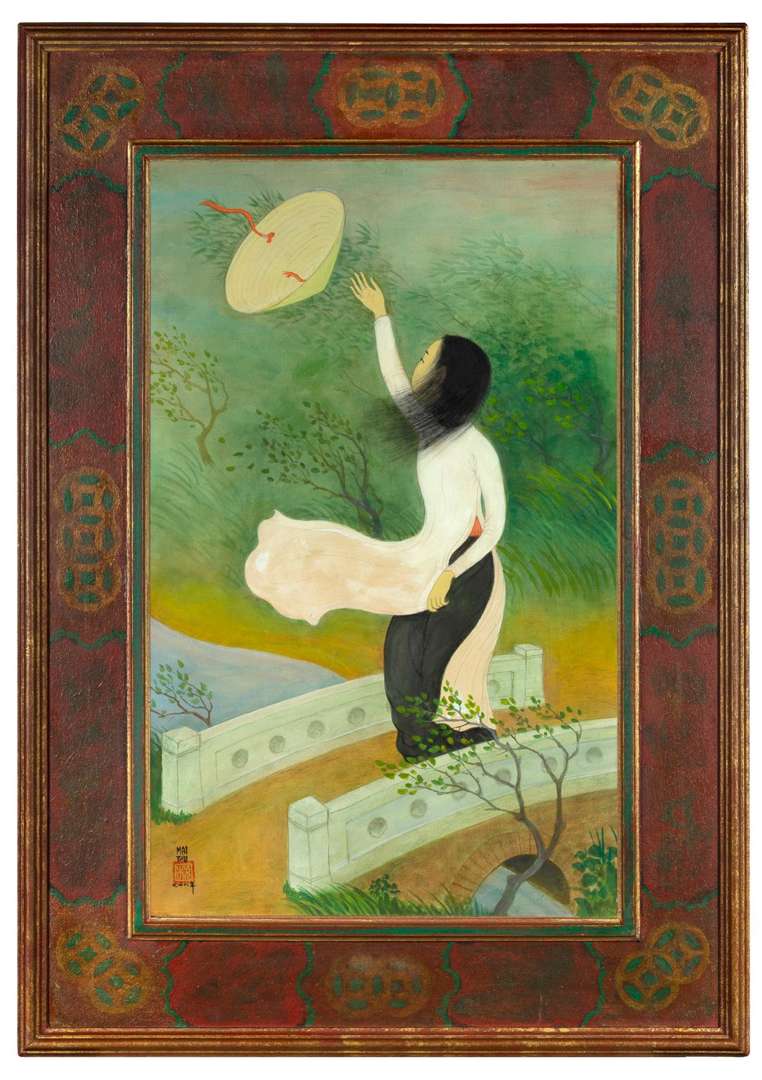
Le coup de vent, 1978
Ink and color on silk, signed and dated lower left. In its original frame made by the artist
60,6 x 38 cm - 23 7/8 x 15 in.
Le coup de vent enables the artist to offer an enchanting vision of his native country, while demonstrating his talent for the representation of movement.
Mai Trung Thứ pays tribute to the beauty of the women of his country. Here, his model reflects the Asian canons: lanky figure, ebony-black hair, porcelain complexion. With her right hand, she tries to catch a conical hat in flight. This tradi-tional hat, known as the nón lá, dates back to the Bronze Age, in the 1st millennium BC. The hat is made entirely by hand from latana leaves. A silk ribbon ties the two ends together. Originally used by peasants to protect themselves from the sun and rain while working in the fields, it has since become a fashion accessory in the city, worn over an áo dài.
Born in 1906 near Haiphong, Mai Trung Thứ attended the French high-school in Hanoi. Like Lê Phổ, Vũ Cao Đàm and Lê Văn Đệ, he was in the first year of students at the École des Beaux-Arts d’Indochine, founded and directed by the painter Victor Tardieu. Invited to take part in the 1931 Paris Colonial Exhibition, Mai Trung Thứ discovered and fell in love with France, where he settled in the late 30’s and stayed until he died.
Although strongly influenced by the teachings of Tardieu and Joseph Inguimberty, he is the one of his comrades who retained the deepest-rooted sense of Vietnamese identity. He soon aban-doned oils for gouache and ink on silk: typical Asian techniques that enabled him to develop a style richly reminiscent of traditional Chinese and Vietnamese art. Although an independent artist, he remained politically committed and concerned about the future of his country.
Mai Trung Thứ and the sweetness of the maternal home.
Painter of fleeting, idealized moments in his native Vietnam
“He will be a credit to the Hanoi School of Fine Arts and the Annamite School.” Yvonne Schultz, 1929
Le coup de vent, 1978
Ink and color on silk, signed and dated lower left. In its original frame made by the artist
60,6 x 38 cm - 23 7/8 x 15 in.
Le coup de vent enables the artist to offer an enchanting vision of his native country, while demonstrating his talent for the representation of movement.
Mai Trung Thứ pays tribute to the beauty of the women of his country. Here, his model reflects the Asian canons: lanky figure, ebony-black hair, porcelain complexion. With her right hand, she tries to catch a conical hat in flight. This tradi-tional hat, known as the nón lá, dates back to the Bronze Age, in the 1st millennium BC. The hat is made entirely by hand from latana leaves. A silk ribbon ties the two ends together. Originally used by peasants to protect themselves from the sun and rain while working in the fields, it has since become a fashion accessory in the city, worn over an áo dài.
Born in 1906 near Haiphong, Mai Trung Thứ attended the French high-school in Hanoi. Like Lê Phổ, Vũ Cao Đàm and Lê Văn Đệ, he was in the first year of students at the École des Beaux-Arts d’Indochine, founded and directed by the painter Victor Tardieu. Invited to take part in the 1931 Paris Colonial Exhibition, Mai Trung Thứ discovered and fell in love with France, where he settled in the late 30’s and stayed until he died.
Although strongly influenced by the teachings of Tardieu and Joseph Inguimberty, he is the one of his comrades who retained the deepest-rooted sense of Vietnamese identity. He soon aban-doned oils for gouache and ink on silk: typical Asian techniques that enabled him to develop a style richly reminiscent of traditional Chinese and Vietnamese art. Although an independent artist, he remained politically committed and concerned about the future of his country.
Mai Trung Thứ and the sweetness of the maternal home.
Painter of fleeting, idealized moments in his native Vietnam
“He will be a credit to the Hanoi School of Fine Arts and the Annamite School.” Yvonne Schultz, 1929