
&w=3840&q=75)
&w=3840&q=75)
&w=3840&q=75)
&w=3840&q=75)
&w=3840&q=75)
&w=3840&q=75)
&w=3840&q=75)
&w=3840&q=75)


13
LÊ PHỔ (1907-2001)
The item was sold for 141 700 €
Fees include commission and taxes.
LÊ PHỔ (1907-2001)
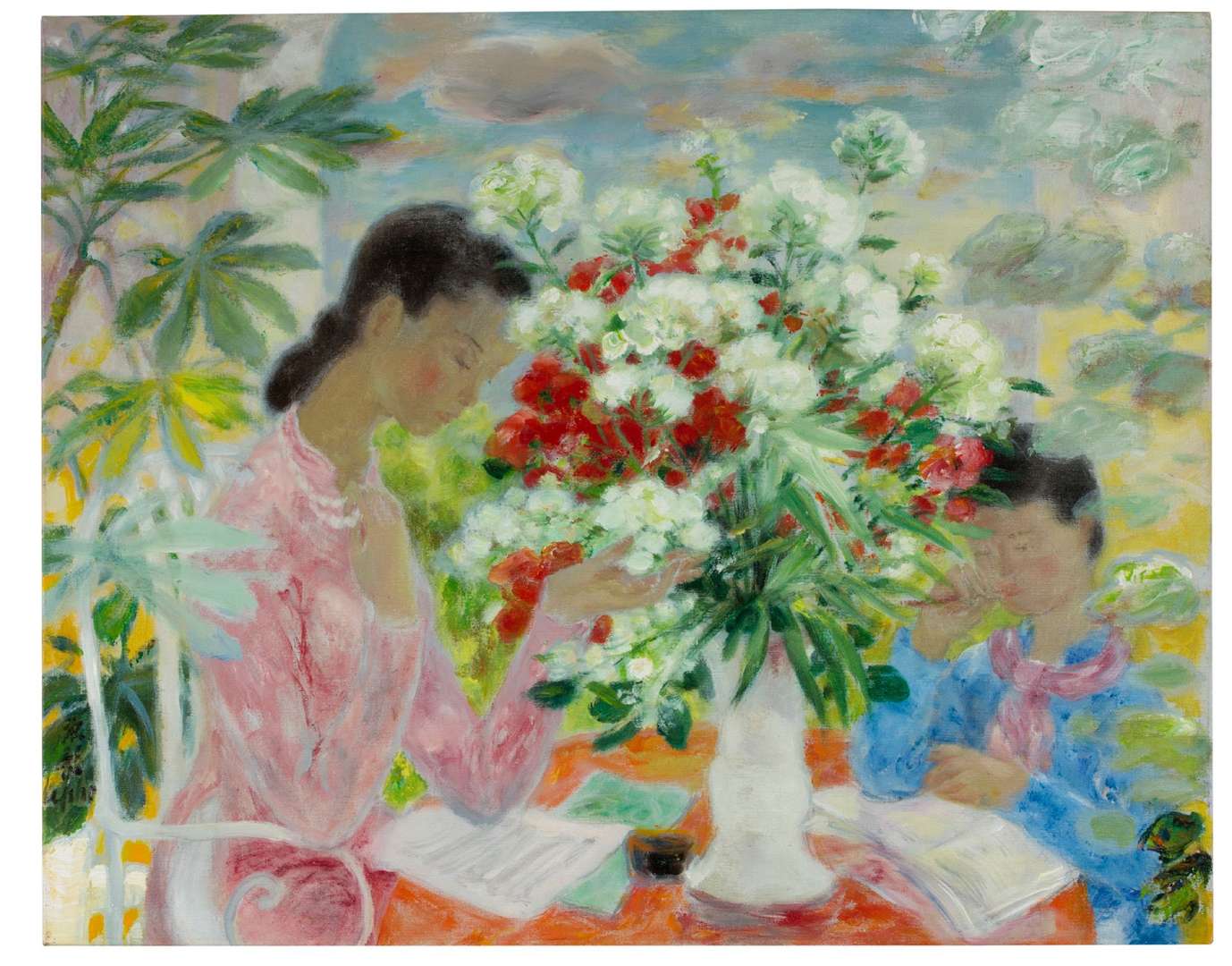
La lettre
Oil on canvas, signed lower left, titled on reverse
74 x 92 cm - 29 1/8 x 36 1/4 in
Lê Phổ: Painter of women. He who, in the same way as the Tchan painters, looks at nature with dazzled eyes ¹
“The work of the Aix-en-Provence master Cézanne had inspired Picasso, who referred to him as ‘the father of us all’, and also resonated with Lê Phổ.”
Considered as one of the leading figures of modern Vietnamese art, Lê Phổ was born in 1907 in Hà Tây province into a respected mandarin family, his father being the last viceroy of Tonkin. Showing a predisposition for painting and drawing, he entered the first class of the Indochina School of Fine Arts in 1925. He was soon noticed by the director and founder of the school, Victor Tar-dieu, for whom he retained a strong attachment throughout his life. Lê Phổ assimilated to perfec-tion the teachings of his teachers. The school promoted Vietnamese artistic traditions such as painting on silk or lacquer, while sensitizing this new generation of artists to Western history and artistic techniques. Indeed, one can read with ease the influences of the Italian Primitives or the Impressionists in Lê Phổ ‘s works.
In 1931, he came to France to present his works on the occasion of the International Colonial Exhibition. He chose to stay in Paris for a year to attend classes at the Ecole des Beaux-Arts, then undertook several trips to Europe. He returned to Vietnam in 1933 and taught at the Indochina School of Fine Arts in Hanoi. He decided to settle permanently in France in 1937 and quickly gained a certain notoriety.
Enriched by his exhibitions with Romanet, Lê Phổ was approached by gallery owner Wally Findlay, who wanted to commission a number of his paint-ings for the American public in 1963. His works became more flamboyant and were produced in large format, as a tribute to Matisse, of whom Lê Phổ was a fervent admirer. A new energy can be felt in his touch and palette. La Lettre bears witness to the transition to this last period of artistic maturity for the painter. The depiction of a woman and a child in a green, flowering garden is a recurring theme for the painter, and his most prolific during this period. The delicacy and elegance of the work sublimate the serenity of the scene, which appealed to collectors across the Atlantic.
¹ Waldemar-George, Wally Findlay Galleries International, Paris, 1970.
La lettre
Oil on canvas, signed lower left, titled on reverse
74 x 92 cm - 29 1/8 x 36 1/4 in
Lê Phổ: Painter of women. He who, in the same way as the Tchan painters, looks at nature with dazzled eyes ¹
“The work of the Aix-en-Provence master Cézanne had inspired Picasso, who referred to him as ‘the father of us all’, and also resonated with Lê Phổ.”
Considered as one of the leading figures of modern Vietnamese art, Lê Phổ was born in 1907 in Hà Tây province into a respected mandarin family, his father being the last viceroy of Tonkin. Showing a predisposition for painting and drawing, he entered the first class of the Indochina School of Fine Arts in 1925. He was soon noticed by the director and founder of the school, Victor Tar-dieu, for whom he retained a strong attachment throughout his life. Lê Phổ assimilated to perfec-tion the teachings of his teachers. The school promoted Vietnamese artistic traditions such as painting on silk or lacquer, while sensitizing this new generation of artists to Western history and artistic techniques. Indeed, one can read with ease the influences of the Italian Primitives or the Impressionists in Lê Phổ ‘s works.
In 1931, he came to France to present his works on the occasion of the International Colonial Exhibition. He chose to stay in Paris for a year to attend classes at the Ecole des Beaux-Arts, then undertook several trips to Europe. He returned to Vietnam in 1933 and taught at the Indochina School of Fine Arts in Hanoi. He decided to settle permanently in France in 1937 and quickly gained a certain notoriety.
Enriched by his exhibitions with Romanet, Lê Phổ was approached by gallery owner Wally Findlay, who wanted to commission a number of his paint-ings for the American public in 1963. His works became more flamboyant and were produced in large format, as a tribute to Matisse, of whom Lê Phổ was a fervent admirer. A new energy can be felt in his touch and palette. La Lettre bears witness to the transition to this last period of artistic maturity for the painter. The depiction of a woman and a child in a green, flowering garden is a recurring theme for the painter, and his most prolific during this period. The delicacy and elegance of the work sublimate the serenity of the scene, which appealed to collectors across the Atlantic.
¹ Waldemar-George, Wally Findlay Galleries International, Paris, 1970.