
&w=3840&q=75)
&w=3840&q=75)
&w=3840&q=75)
&w=3840&q=75)
&w=3840&q=75)
&w=3840&q=75)
&w=3840&q=75)
&w=3840&q=75)


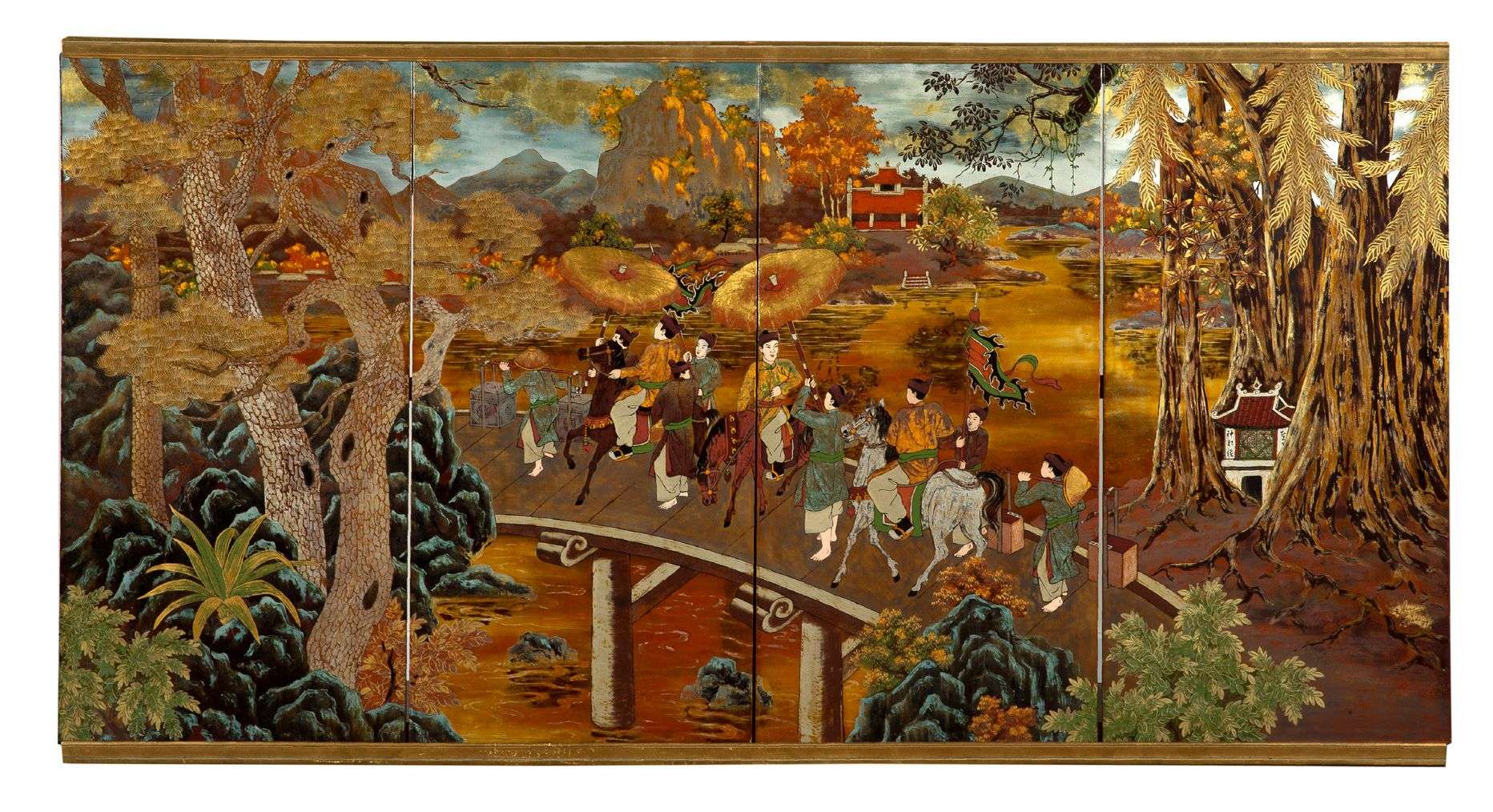
NGUYEN QUANG MAU (XXe siècle)
Le retour des jeunes diplômés, 1951
Lacquer with gold and silver highlights, signed, located and dated lower right.
Screen with 4 panels
99,5 x 200 cm - 39 3/16 x 78 3/4 in.
Width of each panel:
19 5/8 + 19 5/8 + 19 5/8 + 19 5/8 in.
LA GENÉSE D’UN ART INÉDIT: LA LAQUE
The birth of a new art: Vietnamese lacquer. Ancestral techniques and contemporary approaches
“Lacquer is an application of painting and decorative art. It is a magnificent material and should be a ‘National’ art form, for it is Tonkin that produces the most esteemed lacquers [...]. It is absolutely necessary to give lacquer work considerable importance. Our first attempts date back to 1929 [...] and we must push the study of this art form infinitely further.”
Lacquer painting is a major art in Vietnam, insep-arable from the cultural history of the country. It is a traditional art by excellence, but also shines abroad and makes Vietnam a strong center for this ancestral technique. Although this craftsmanship dates back to the 15th century, its current influence owes much to the impetus of Joseph Inguimberty at the Indochina School of Fine Arts, who intro-duced lacquerware courses in 1927. Thanks to new ideas introduced with the modernity of the School, the French teacher clearly redefined the creative process of lacquer and gave it new principles. With the help of Alix Aymé, a free and talented artist, they worked to enrich the use of colours. Traditionally, only red, black, brown, but also silver and gold were represented. But with the introduction of new materials such as eggshell, cadmium sulphide or chromium oxide, other colours such as white, yellow or green appeared. This creative renewal has continued ever since, allowing artists to impose this Asian technique as the equal of Western painting.
Le retour des jeunes diplômés, 1951
Lacquer with gold and silver highlights, signed, located and dated lower right.
Screen with 4 panels
99,5 x 200 cm - 39 3/16 x 78 3/4 in.
Width of each panel:
19 5/8 + 19 5/8 + 19 5/8 + 19 5/8 in.
LA GENÉSE D’UN ART INÉDIT: LA LAQUE
The birth of a new art: Vietnamese lacquer. Ancestral techniques and contemporary approaches
“Lacquer is an application of painting and decorative art. It is a magnificent material and should be a ‘National’ art form, for it is Tonkin that produces the most esteemed lacquers [...]. It is absolutely necessary to give lacquer work considerable importance. Our first attempts date back to 1929 [...] and we must push the study of this art form infinitely further.”
Lacquer painting is a major art in Vietnam, insep-arable from the cultural history of the country. It is a traditional art by excellence, but also shines abroad and makes Vietnam a strong center for this ancestral technique. Although this craftsmanship dates back to the 15th century, its current influence owes much to the impetus of Joseph Inguimberty at the Indochina School of Fine Arts, who intro-duced lacquerware courses in 1927. Thanks to new ideas introduced with the modernity of the School, the French teacher clearly redefined the creative process of lacquer and gave it new principles. With the help of Alix Aymé, a free and talented artist, they worked to enrich the use of colours. Traditionally, only red, black, brown, but also silver and gold were represented. But with the introduction of new materials such as eggshell, cadmium sulphide or chromium oxide, other colours such as white, yellow or green appeared. This creative renewal has continued ever since, allowing artists to impose this Asian technique as the equal of Western painting.