
&w=3840&q=75)
&w=3840&q=75)
&w=3840&q=75)
&w=3840&q=75)
&w=3840&q=75)
&w=3840&q=75)

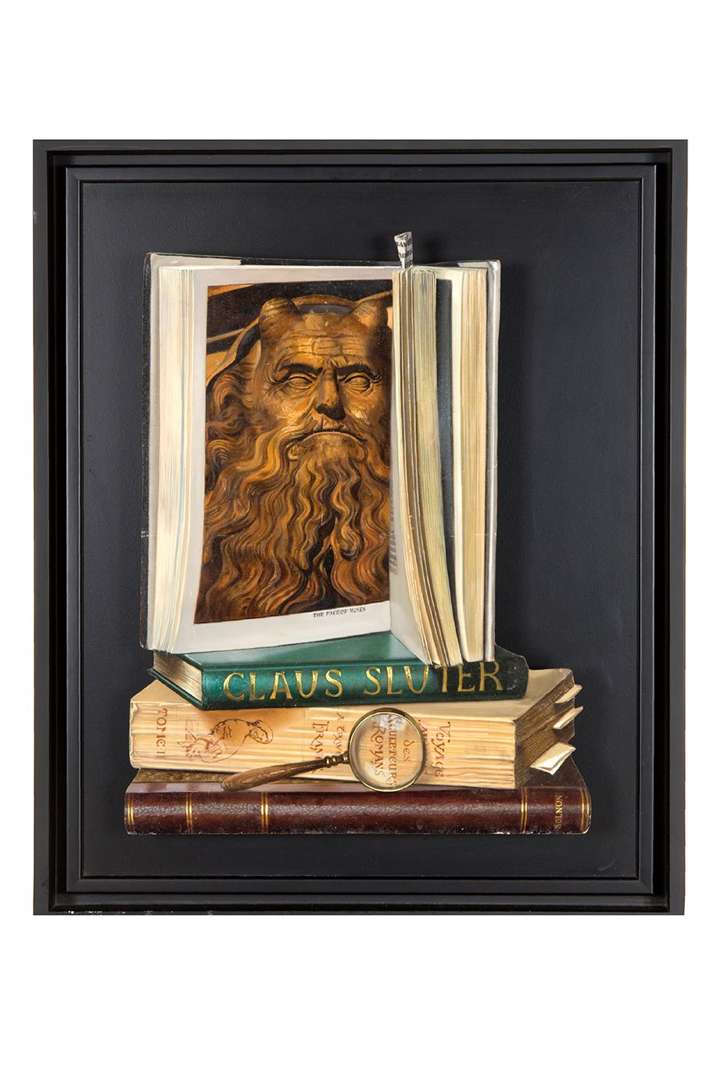
DANIEL SOLNON (B. 1943)
Trompe-l'oeil in homage to the sculptor Claus Sluter (1355-1406)
Oil on curved panel
Signed lower right
(Small gaps in the paint layer and old restorations)
Oil on panel, signed lower right
44 x 34,3 cm (format irrégulier) - 17 3/8 x 13 1/2 in. (irregular size)
Provenance
Private collection, France
"Daniel Solnon was born in Paris in 1943. As a teenager, he met [Pierre] Gilou in Morvan, where both their families lived. Later, having both become artists, they often worked together on the motif. Driven at an early age to earn a living, Daniel Solnon worked at various odd jobs, leaving him little time to paint. Eventually, however, he devoted himself to portraiture, for which he showed particular talent. He then moved on to landscapes, still lifes and trompe-l'oeil, where he excelled. Cadiou, who had encouraged him, soon invited him to exhibit with the Trompe-I'oeil-réalité group. In the course of exhibitions and salons, Daniel Solnon came to the attention of the critics. Arthur Comte wrote: "Daniel Solnon is still too little known... I predict the brightest future for him. On the one hand, he is a painter of tenderness with infinite appeasements, and on the other, he is a painter of vigor, because he is an artist of character." Daniel Solnon's smooth, pppppppprecious brushwork, close to the classical artists he so admires, offers us a fresh take on reality. With him, we return to the subject, which regains the importance it seems to have lost throughout the 20th century to plastic and conceptual research. He has the science of drawing and painting, but also an imagination tinged with poetry and purity. No pompous academicism, but the expression of his inner impulses. Daniel Solnon is also a master of the abandoned "chantourné" technique, which he updates by staging contemporary objects. The scalloped edge, with its cut-out lines, accentuates the relief and reinforces the illusion created by trompe-l'oeil. His composition lies outside the painting and in our visual space. Present in numerous private and public collections, Daniel Solnon, like a true artist, remains lucid and modest. Martin Monester, "Trompe-l'oeil contemporain, Les maîtres du réalisme", Paris: Éditions place des Victoires, 2009, p. 179Claus Sluter, also known as Claes de Slutere van Herlamen (circa 1355-1406), was a sculptor from the Netherlands in the service of the Dukes of Burgundy. His innovative work had a lasting influence on the international Gothic sculpture of his time. His masterpieces include the portal to the chapel of the Chartreuse de Champmol, the Well of Moses - from which Solnon chose a detail for his trompe-l'oeil - and the tomb of Philippe le Hardi, which he only began.
Trompe-l'oeil in homage to the sculptor Claus Sluter (1355-1406)
Oil on curved panel
Signed lower right
(Small gaps in the paint layer and old restorations)
Oil on panel, signed lower right
44 x 34,3 cm (format irrégulier) - 17 3/8 x 13 1/2 in. (irregular size)
Provenance
Private collection, France
"Daniel Solnon was born in Paris in 1943. As a teenager, he met [Pierre] Gilou in Morvan, where both their families lived. Later, having both become artists, they often worked together on the motif. Driven at an early age to earn a living, Daniel Solnon worked at various odd jobs, leaving him little time to paint. Eventually, however, he devoted himself to portraiture, for which he showed particular talent. He then moved on to landscapes, still lifes and trompe-l'oeil, where he excelled. Cadiou, who had encouraged him, soon invited him to exhibit with the Trompe-I'oeil-réalité group. In the course of exhibitions and salons, Daniel Solnon came to the attention of the critics. Arthur Comte wrote: "Daniel Solnon is still too little known... I predict the brightest future for him. On the one hand, he is a painter of tenderness with infinite appeasements, and on the other, he is a painter of vigor, because he is an artist of character." Daniel Solnon's smooth, pppppppprecious brushwork, close to the classical artists he so admires, offers us a fresh take on reality. With him, we return to the subject, which regains the importance it seems to have lost throughout the 20th century to plastic and conceptual research. He has the science of drawing and painting, but also an imagination tinged with poetry and purity. No pompous academicism, but the expression of his inner impulses. Daniel Solnon is also a master of the abandoned "chantourné" technique, which he updates by staging contemporary objects. The scalloped edge, with its cut-out lines, accentuates the relief and reinforces the illusion created by trompe-l'oeil. His composition lies outside the painting and in our visual space. Present in numerous private and public collections, Daniel Solnon, like a true artist, remains lucid and modest. Martin Monester, "Trompe-l'oeil contemporain, Les maîtres du réalisme", Paris: Éditions place des Victoires, 2009, p. 179Claus Sluter, also known as Claes de Slutere van Herlamen (circa 1355-1406), was a sculptor from the Netherlands in the service of the Dukes of Burgundy. His innovative work had a lasting influence on the international Gothic sculpture of his time. His masterpieces include the portal to the chapel of the Chartreuse de Champmol, the Well of Moses - from which Solnon chose a detail for his trompe-l'oeil - and the tomb of Philippe le Hardi, which he only began.