
&w=3840&q=75)
&w=3840&q=75)
&w=3840&q=75)
&w=3840&q=75)
&w=3840&q=75)
&w=3840&q=75)
&w=3840&q=75)
&w=3840&q=75)


111
Napoléon Ier (1769-1821)
The item was sold for 23 427 €
Fees include commission and taxes.
Napoléon Ier (1769-1821)
5 L.S. "Nap" or "NP," Jan. 31-March 14, 1814, to Archchancellor
CAMBACERES| 3 letters are written by Fain| 15 pages in-4.
[780, 784, 787-789]
Campaign of France.
Brienne January 31. "I do not see any inconvenience in all that you propose to me for the different services. I suppose that you have received the order of service. The idea that you had of taking what was done last year seems to me very appropriate.
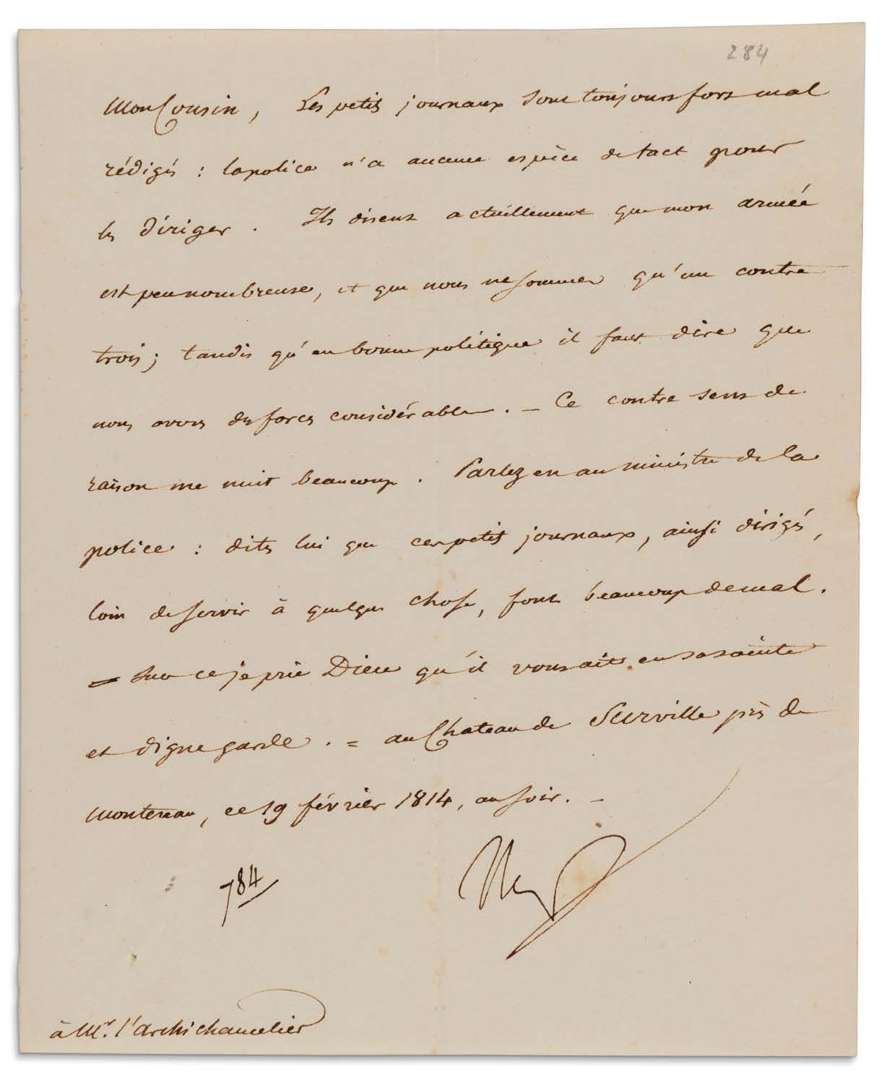
Chateau de Surville near Montereau February 19. "The little newspapers are always very badly written: the police have no tact to direct them. They say at present that my army is small, and that we are only one against three| whereas in good politics one should say that we have considerable forces. This misinterpretation of reason is very harmful to me. Speak about it to the minister of the police: tell him that these small newspapers, thus directed, far from being useful for something, do a lot of harm"...
Soissons March 13. "I am surprised that a man of your experience who has known me for 20 years should write such things to me. Do you think that I have fallen into a tailspin and that I am weak enough to let the opinion of 2 or 3 onlookers influence my own? I esteem and love the Duke of
Conegliano [Moncey]| but if it had entered into my calculations to send the Duke of Padua [Arrighi] and Ornano, what I would have been told could displease me, would have only given me more reason to send them. Know well that whatever the circumstances and the events, as long as I live, I command. How could you believe such nonsense? The only reason of the country of birth of these two generals would have taken away this idea from me! Fear has taken away your judgment. The Empress has more spirit than you others. She refused to send Meneval or Mole to speak to me about peace. She did well. I would have sent them away from my room. I can only see faction and the idea to make themselves popular in the supposition that I do not want peace. Besides, as everything is known, it hurts public opinion and foreigners. [...] I was also grateful to the Empress for having continued to go through the underground and for not having adhered to the advice of the King [Joseph] who claimed that it was frightening.
The Empress is not an actress: it is her attachment to France and to her husband that should make her loved and esteemed by the public and not the details of her private life. How does the King think of changing the habits of the palace. It is to disavow what I have done. [...] All this is only small things but it would make me fear for the fate of France if the King were to reign one day! Because with weakness one goes to the scaffold and it is by speaking unceasingly to Louis 16 of the need to please the people and to give in to the opinion that one lost this prince! It is for the people to please their Sovereign and not for the sovereigns to please the people. It is enough that the Sovereign be just and do the good of his people. - It seems to me that the Empress does not need your advice, but I must make you aware that you must tell her in all things not to depart from her usual manner| she is perfect and pleases me, which is better than pleasing the public and which, moreover, has not been a bad success| let her therefore not change any of her habits.
[...] I pass on to you your fear, from which I hope you will soon be cured: you will live quietly and without storm the rest of your days with my esteem and my full confidence for your good services for 20 years. Try to persuade the King that the way to conduct myself will never be to make me afraid of the public| that I am not afraid, that I do not care about the 6,000 people who make up the opinion in Paris| and that I know my relations and my way of being with 39,994,000 inhabitants of the provinces and the countryside. Here is what you do not know enough: the King ignores doubtless that I am not a new man in France!
Reims, March 14, 10 a.m. "My Cousin, there has been talk of making addresses to ask me for peace. This idea, which is a real crime, could not have been ignored by you: why did you not make it known to me and how did you not make it known to others how criminal this idea was and how it was likely to have a bad effect on opinion, on the foreigner and on me. Would anyone be so foolish as to suppose that, having all the responsibility and the dangers of business, I wanted to leave the popularity to another? Would there still be someone who would want to call himself the first citizen of Paris? If these ideas came, how did you not open your eyes to the impossibility and even the personal danger that one incurs in such steps? [...] My God! how silly all this is! [You can explain this to the King [Joseph], who seems to be mistaken, and especially to
5 L.S. "Nap" or "NP," Jan. 31-March 14, 1814, to Archchancellor
CAMBACERES| 3 letters are written by Fain| 15 pages in-4.
[780, 784, 787-789]
Campaign of France.
Brienne January 31. "I do not see any inconvenience in all that you propose to me for the different services. I suppose that you have received the order of service. The idea that you had of taking what was done last year seems to me very appropriate.
Chateau de Surville near Montereau February 19. "The little newspapers are always very badly written: the police have no tact to direct them. They say at present that my army is small, and that we are only one against three| whereas in good politics one should say that we have considerable forces. This misinterpretation of reason is very harmful to me. Speak about it to the minister of the police: tell him that these small newspapers, thus directed, far from being useful for something, do a lot of harm"...
Soissons March 13. "I am surprised that a man of your experience who has known me for 20 years should write such things to me. Do you think that I have fallen into a tailspin and that I am weak enough to let the opinion of 2 or 3 onlookers influence my own? I esteem and love the Duke of
Conegliano [Moncey]| but if it had entered into my calculations to send the Duke of Padua [Arrighi] and Ornano, what I would have been told could displease me, would have only given me more reason to send them. Know well that whatever the circumstances and the events, as long as I live, I command. How could you believe such nonsense? The only reason of the country of birth of these two generals would have taken away this idea from me! Fear has taken away your judgment. The Empress has more spirit than you others. She refused to send Meneval or Mole to speak to me about peace. She did well. I would have sent them away from my room. I can only see faction and the idea to make themselves popular in the supposition that I do not want peace. Besides, as everything is known, it hurts public opinion and foreigners. [...] I was also grateful to the Empress for having continued to go through the underground and for not having adhered to the advice of the King [Joseph] who claimed that it was frightening.
The Empress is not an actress: it is her attachment to France and to her husband that should make her loved and esteemed by the public and not the details of her private life. How does the King think of changing the habits of the palace. It is to disavow what I have done. [...] All this is only small things but it would make me fear for the fate of France if the King were to reign one day! Because with weakness one goes to the scaffold and it is by speaking unceasingly to Louis 16 of the need to please the people and to give in to the opinion that one lost this prince! It is for the people to please their Sovereign and not for the sovereigns to please the people. It is enough that the Sovereign be just and do the good of his people. - It seems to me that the Empress does not need your advice, but I must make you aware that you must tell her in all things not to depart from her usual manner| she is perfect and pleases me, which is better than pleasing the public and which, moreover, has not been a bad success| let her therefore not change any of her habits.
[...] I pass on to you your fear, from which I hope you will soon be cured: you will live quietly and without storm the rest of your days with my esteem and my full confidence for your good services for 20 years. Try to persuade the King that the way to conduct myself will never be to make me afraid of the public| that I am not afraid, that I do not care about the 6,000 people who make up the opinion in Paris| and that I know my relations and my way of being with 39,994,000 inhabitants of the provinces and the countryside. Here is what you do not know enough: the King ignores doubtless that I am not a new man in France!
Reims, March 14, 10 a.m. "My Cousin, there has been talk of making addresses to ask me for peace. This idea, which is a real crime, could not have been ignored by you: why did you not make it known to me and how did you not make it known to others how criminal this idea was and how it was likely to have a bad effect on opinion, on the foreigner and on me. Would anyone be so foolish as to suppose that, having all the responsibility and the dangers of business, I wanted to leave the popularity to another? Would there still be someone who would want to call himself the first citizen of Paris? If these ideas came, how did you not open your eyes to the impossibility and even the personal danger that one incurs in such steps? [...] My God! how silly all this is! [You can explain this to the King [Joseph], who seems to be mistaken, and especially to