
&w=3840&q=75)
&w=3840&q=75)
&w=3840&q=75)
&w=3840&q=75)
&w=3840&q=75)
&w=3840&q=75)
&w=3840&q=75)
&w=3840&q=75)

1
Napoléon Ier (1769-1821)
The item was sold for 3 199 €
Fees include commission and taxes.
Napoléon Ier (1769-1821)
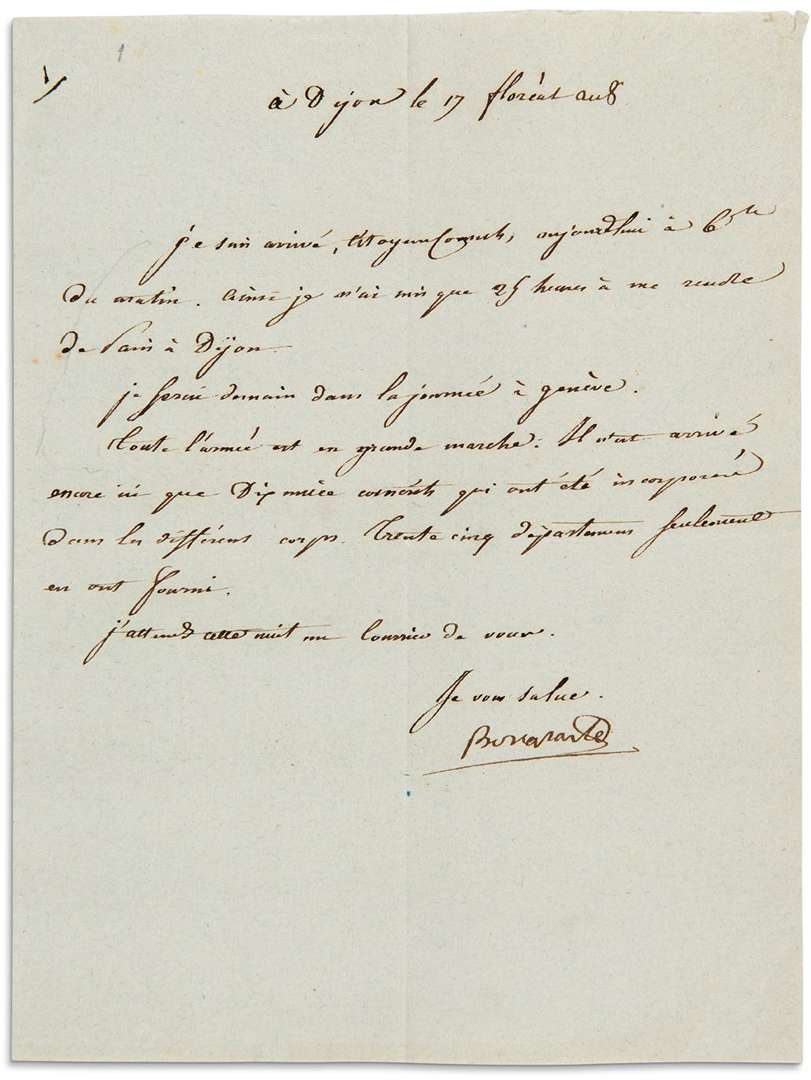
L.S. " Bonaparte ", Dijon 17 floréal VIII [7 May 1800], to " citoyens Consuls " CAMBACÉRÈS and LEBRUN| the letter is written by Bourrienne| 1 page in-4. [1]
En route for Italy.
"I arrived, citizens Consuls, today at 6 am. Thus I took only 25 hours from Paris to Dijon. I will be tomorrow during the day at
Geneva. All the army is on the march. Only ten thousand conscripts have arrived here yet, and they have been incorporated into the different corps.
Thirty-five departments only have provided some"...
This set of nearly 800 letters of Napoleon to
Cambaceres is exceptional, by its number, its interest and its history.
With the death of the former Consul then Archchancellor of the Empire
Cambaceres, on March 8, 1824, its papers are seized by royal order.
At the end of a four years lawsuit, led by Hubert, duke of Cambaceres, nephew of the Archchancellor, the manuscript of the
Memories and certain correspondences (of which the letters of
Napoleon) are returned to the family, and the State can integrate in
Archives a certain number of papers.
These documents, after the death of Hubert de Cambaceres in 1881, then of the duchess in 1883, pass to his grand-nephew, the baron
Maurice Delaire de Cambaceres (1855-1906), then to his son Jean (1889-1960), who yields them to his friend Charles Michel| The grand-fi lle of Charles Michel, Laurence Chatel de Brancion, having inherited these papers, publishes in 1999 the Memoires inedits de Cambaceres, to whom she also dedicates in 2002 a remarkable biography, based on its files.
The correspondence of Napoleon to Cambaceres is proposed in April 2005 to the National Archives, which fi nally give up in June with its purchase. The Aristophil company then acquired it.
The letters, dictated by Napoleon, were written by his secretaries, Bourrienne, then Méneval and Fain mainly, then signed by him, who sometimes added a few words or corrected them by hand.
The first letters were addressed by the first Consul
Bonaparte to the two citizen Consuls Cambacérès and Lebrun, then to Cambacérès alone, with whom he established a privileged relationship.
When Napoleon becomes Emperor, he names Cambaceres
Archchancellor of the Empire. From then on, the letters generally begin with the apostrophe "My cousin", the acknowledgement of reception of the letters of his correspondent, and end with the formula: "On this, I pray God that he has you in his holy and worthy guard".
A great part of these letters were annotated by Cambaceres, often briefly: "to copy entirely", sometimes a little more lengthily.
They were numbered formerly from 1 to 801| we indicated this number between brackets at the end of the description.
From the Consulate to the Hundred Days, from 1800 to 1815, the history of France and Napoleon is evoked at the end of these letters.
L.S. " Bonaparte ", Dijon 17 floréal VIII [7 May 1800], to " citoyens Consuls " CAMBACÉRÈS and LEBRUN| the letter is written by Bourrienne| 1 page in-4. [1]
En route for Italy.
"I arrived, citizens Consuls, today at 6 am. Thus I took only 25 hours from Paris to Dijon. I will be tomorrow during the day at
Geneva. All the army is on the march. Only ten thousand conscripts have arrived here yet, and they have been incorporated into the different corps.
Thirty-five departments only have provided some"...
This set of nearly 800 letters of Napoleon to
Cambaceres is exceptional, by its number, its interest and its history.
With the death of the former Consul then Archchancellor of the Empire
Cambaceres, on March 8, 1824, its papers are seized by royal order.
At the end of a four years lawsuit, led by Hubert, duke of Cambaceres, nephew of the Archchancellor, the manuscript of the
Memories and certain correspondences (of which the letters of
Napoleon) are returned to the family, and the State can integrate in
Archives a certain number of papers.
These documents, after the death of Hubert de Cambaceres in 1881, then of the duchess in 1883, pass to his grand-nephew, the baron
Maurice Delaire de Cambaceres (1855-1906), then to his son Jean (1889-1960), who yields them to his friend Charles Michel| The grand-fi lle of Charles Michel, Laurence Chatel de Brancion, having inherited these papers, publishes in 1999 the Memoires inedits de Cambaceres, to whom she also dedicates in 2002 a remarkable biography, based on its files.
The correspondence of Napoleon to Cambaceres is proposed in April 2005 to the National Archives, which fi nally give up in June with its purchase. The Aristophil company then acquired it.
The letters, dictated by Napoleon, were written by his secretaries, Bourrienne, then Méneval and Fain mainly, then signed by him, who sometimes added a few words or corrected them by hand.
The first letters were addressed by the first Consul
Bonaparte to the two citizen Consuls Cambacérès and Lebrun, then to Cambacérès alone, with whom he established a privileged relationship.
When Napoleon becomes Emperor, he names Cambaceres
Archchancellor of the Empire. From then on, the letters generally begin with the apostrophe "My cousin", the acknowledgement of reception of the letters of his correspondent, and end with the formula: "On this, I pray God that he has you in his holy and worthy guard".
A great part of these letters were annotated by Cambaceres, often briefly: "to copy entirely", sometimes a little more lengthily.
They were numbered formerly from 1 to 801| we indicated this number between brackets at the end of the description.
From the Consulate to the Hundred Days, from 1800 to 1815, the history of France and Napoleon is evoked at the end of these letters.