
&w=3840&q=75)
&w=3840&q=75)
&w=3840&q=75)
&w=3840&q=75)
&w=3840&q=75)
&w=3840&q=75)
&w=3840&q=75)
&w=3840&q=75)


59
NÉPAL, VALLÉE DE KATMANDOU
The item was sold for 52 000 €
Fees include commission and taxes.
NÉPAL, VALLÉE DE KATMANDOU
= MALLA DYNASTY, 16th CENTURY
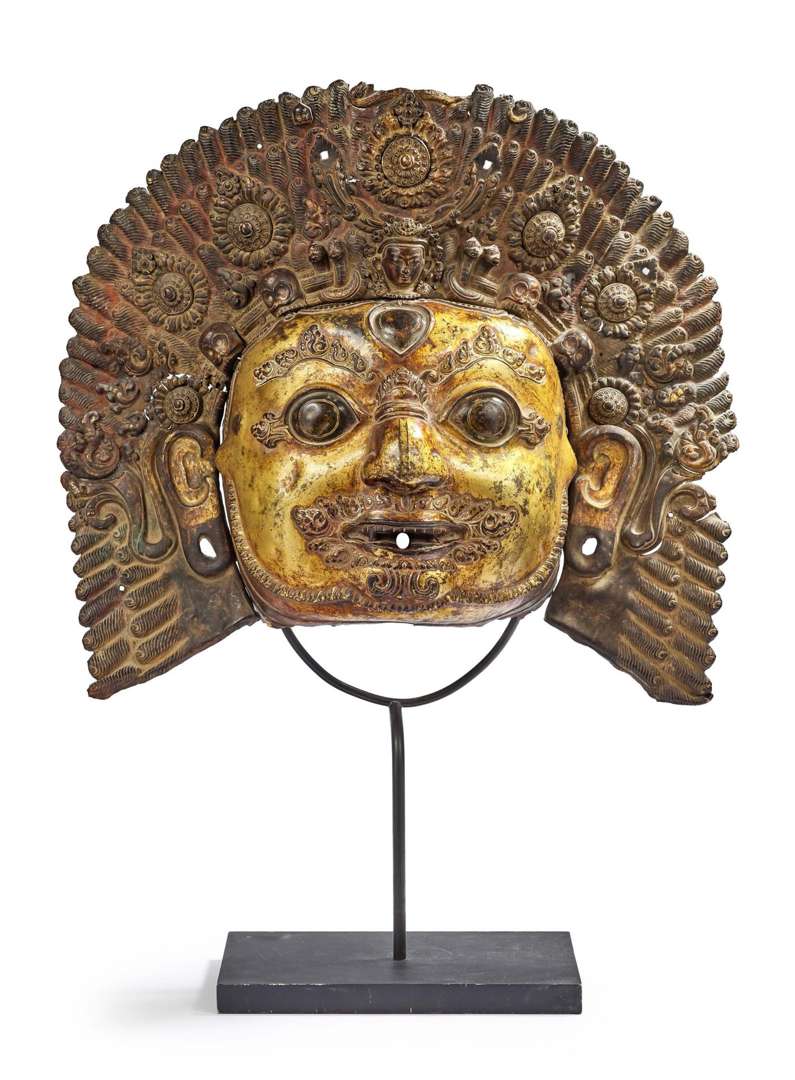
exceptional mask of bhairava, a fierce form of shiva, made of an assembly of hammered, embossed, gilded and polychromed copper alloy plates, represented in a wrathful aspect, the eyes and the third eye of clairvoyance exorbitant, the earlobes pierced, The half-open mouth bristling with fangs and framed by a moustache flamed in the same way as the eyebrows, the face framed by bristling braids of hair bearing the crescent moon rising behind a tiara with five elaborate finials, one of which is tripartite in the center, embellished with four heads of citipatis linked by four snakes and a figure of shiva in the center. base. size 47 x 53 cm (missing and worn) provenance - sale, the kemper collection of himalayan art, christie's, amsterdam, october 11, 1994, lot 67 - private collection, france (acquired during the previous sale) related works - mask of bhairava, paris, musée national des arts asiatiques-guimet (inv. ma 5941) - bhairava mask, london, victoria, sotheby's, paris, june 16, 2022, lot 63 note the art of 'nepal' occupies a very prominent place in the himalayan world. although it originated in india, it quickly gained autonomy through the original refinement of its means of expression and succeeded in extending its reputation far beyond the small territory in which it originated, to the point where it aroused the interest of the imperial court in china. during the annual pachali bhairabjatra and indrajatra festivities held in kathmandu at the end of september, masks of the hindu god bhairava are placed in front of temples and homes. from these deities' heads, which are never worn by officiants or dancers, streams of domestic beer and rice liquor flow from flashlights and are consumed by devotees. carved masks are emblematic of nepalese art. our bhairava mask, made of gilded copper alloy, combines techniques as varied as carving, hammering, repoussé and poly
= MALLA DYNASTY, 16th CENTURY
exceptional mask of bhairava, a fierce form of shiva, made of an assembly of hammered, embossed, gilded and polychromed copper alloy plates, represented in a wrathful aspect, the eyes and the third eye of clairvoyance exorbitant, the earlobes pierced, The half-open mouth bristling with fangs and framed by a moustache flamed in the same way as the eyebrows, the face framed by bristling braids of hair bearing the crescent moon rising behind a tiara with five elaborate finials, one of which is tripartite in the center, embellished with four heads of citipatis linked by four snakes and a figure of shiva in the center. base. size 47 x 53 cm (missing and worn) provenance - sale, the kemper collection of himalayan art, christie's, amsterdam, october 11, 1994, lot 67 - private collection, france (acquired during the previous sale) related works - mask of bhairava, paris, musée national des arts asiatiques-guimet (inv. ma 5941) - bhairava mask, london, victoria, sotheby's, paris, june 16, 2022, lot 63 note the art of 'nepal' occupies a very prominent place in the himalayan world. although it originated in india, it quickly gained autonomy through the original refinement of its means of expression and succeeded in extending its reputation far beyond the small territory in which it originated, to the point where it aroused the interest of the imperial court in china. during the annual pachali bhairabjatra and indrajatra festivities held in kathmandu at the end of september, masks of the hindu god bhairava are placed in front of temples and homes. from these deities' heads, which are never worn by officiants or dancers, streams of domestic beer and rice liquor flow from flashlights and are consumed by devotees. carved masks are emblematic of nepalese art. our bhairava mask, made of gilded copper alloy, combines techniques as varied as carving, hammering, repoussé and poly