
&w=3840&q=75)
&w=3840&q=75)
&w=3840&q=75)
&w=3840&q=75)
&w=3840&q=75)
&w=3840&q=75)


154
PROUDHON Pierre-Joseph (1809-1865) écrivain et théoricien politique.
The item was sold for 2 860 €
Fees include commission and taxes.
PROUDHON Pierre-Joseph (1809-1865) écrivain et théoricien politique.
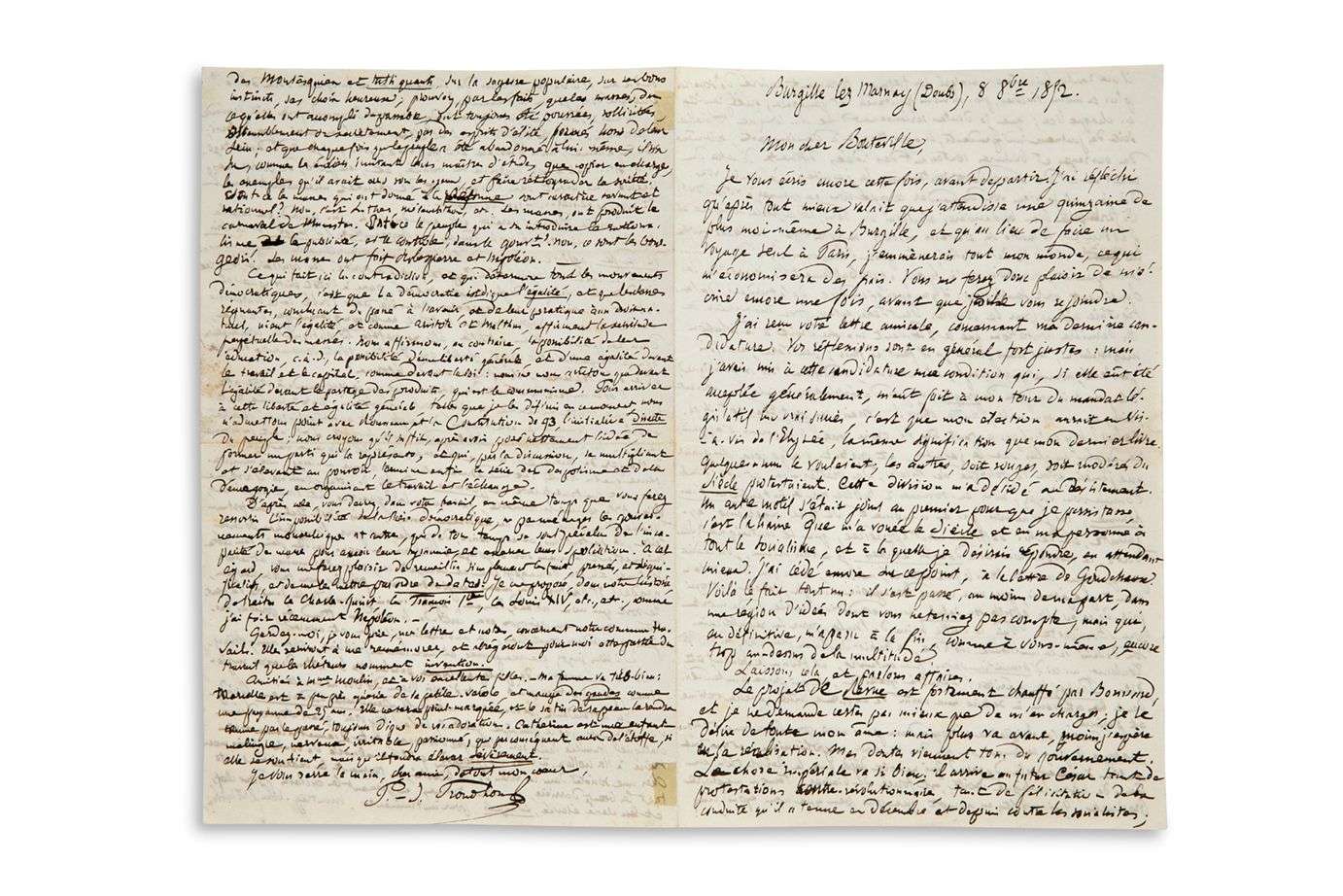
L.A.S. " P.-J. Proudhon ", Burgille lez Marnay (Doubs) October 8, 1852, to his collaborator Marc-Lucien BOUTTEVILLE| 4 pages in-8.
Long and interesting political letter, on his project of revolutionary review, and on the policy of repression of Napoleon III.
He first explains his plan to run for the legislative elections: "I had put a condition on this candidacy which, if it had been generally accepted, would have made me, in turn, a real success in the legislative mandate, that my election would have had the same meaning with respect to the Elysée as my book [The Social Revolution demonstrated by the coup d'état]. Some wanted it| the others, either reds or moderates of the Century protested. This decision made me decide to withdraw.
Another motive was added to the first one for me to persist, it is the hatred that the Siècle had for me, and in my person for all socialism, and to which I wished to respond while waiting for better. I gave in again on this point when I read Goudchaux's letter"...
The project of a review is "strongly heated by Boussard, and I certainly do not ask for anything better than to take charge of it| I desire it with all my soul| but the more it goes ahead, the less I hope in its realization. My doubts all come from the government. The imperial thing goes so well, it arrives to the future
Caesar so many counter-revolutionary protests, so many congratulations of the conduct that he held in December and since, against the socialists| He seems to me himself, in spite of his phlegm, so intoxicated by the more or less sincere, more or less spontaneous and general ovations that he receives in every place, that I seriously doubt a longer tolerance, either of independent newspapers or of those belonging to former parties, or even of works and pamphlets containing ideas different from those of the master and of his ardent supporters, the Jesuits. I doubt [...]
If I interpret the last elections in Paris correctly, the capital separates and abstains: half of the registered voters do not vote| of the other half, half, that is to say a quarter of the total, vote for the Emperor"| it is the same in Lyon, and probably in Marseille: "there is, whatever one says, coldness, antipathy, even for the power. Perhaps it is to triumph over these last hesitations that the President marches straight to the imperialist solution| he too thinks that it is necessary to finish| perhaps once proclaimed, named by the people and crowned, he will modify his policy and will make a little progress, a little social revolution, not being able to do, like his uncle, anything else!... But are these perhaps of any value? Is there not as much reason to believe that the Emperor will lean more and more on the Jesuits, and, therefore, will commit himself more than ever to the policy of the Nicholas, the Metternich and the Bomba [Ferdinand II]? [...] Undoubtedly, the Revolution is in the things, I know it better, I dare to say it, than whoever it is, but the fact is denied, ignored, with more enthusiasm than ever, by a blind, ferocious bourgeois mass, which makes what it calls its salvation a condition of life or death for Bonaparte. Then the old hatred of the uncle, for the republicans, his disdain of the idolatrous multitude, betrays itself more and more in L.-N. [...] Certainly the society does not retrograde| but, for the moment, it marks the step only to the sound of the Napoleonic drums, and who knows how many years that will last?
Who does not see already that the Revolution, instead of following the straight line, is forced to skew, witness my own brochure! Who doesn't see, in a word, that if we have five or ten years of this regime, the course of events in Europe will be deviated? [...] If our Revue appears, it will be successful, I guarantee it| it will be the Revolution, the one preached by the People, the People's Representative and the Voice of the People, sitting in the foyer of the Tuileries, in the very heart of the Empire, threatening from on high the Church, Capital and Authority. On the contrary, the forbidden Review, Socialism, more and more abhorred, passes to the historical state, and dies out, at least in its first expression, in the oblivion of the bourgeoisie and the masses. Do you think that the police do not understand this, and that, in their present preoccupations, they do not prefer to follow their policy of conservation with the bourgeoisie and the clergy, rather than to enter gently into the path of philosophical tolerance and reform?
It is a constant fact in history [...] that every new monarchy, every usurpation, every tyranny, every Caesarism, begins with the support of the people, and, as soon as it is installed, seeks the support of the great ones and puts itself on guard against the people. L. - N. is not a man to change tactics| like his uncle, whose vestiges he adores, he thinks that society is an administration, an army, a clergy, a magistracy, and
L.A.S. " P.-J. Proudhon ", Burgille lez Marnay (Doubs) October 8, 1852, to his collaborator Marc-Lucien BOUTTEVILLE| 4 pages in-8.
Long and interesting political letter, on his project of revolutionary review, and on the policy of repression of Napoleon III.
He first explains his plan to run for the legislative elections: "I had put a condition on this candidacy which, if it had been generally accepted, would have made me, in turn, a real success in the legislative mandate, that my election would have had the same meaning with respect to the Elysée as my book [The Social Revolution demonstrated by the coup d'état]. Some wanted it| the others, either reds or moderates of the Century protested. This decision made me decide to withdraw.
Another motive was added to the first one for me to persist, it is the hatred that the Siècle had for me, and in my person for all socialism, and to which I wished to respond while waiting for better. I gave in again on this point when I read Goudchaux's letter"...
The project of a review is "strongly heated by Boussard, and I certainly do not ask for anything better than to take charge of it| I desire it with all my soul| but the more it goes ahead, the less I hope in its realization. My doubts all come from the government. The imperial thing goes so well, it arrives to the future
Caesar so many counter-revolutionary protests, so many congratulations of the conduct that he held in December and since, against the socialists| He seems to me himself, in spite of his phlegm, so intoxicated by the more or less sincere, more or less spontaneous and general ovations that he receives in every place, that I seriously doubt a longer tolerance, either of independent newspapers or of those belonging to former parties, or even of works and pamphlets containing ideas different from those of the master and of his ardent supporters, the Jesuits. I doubt [...]
If I interpret the last elections in Paris correctly, the capital separates and abstains: half of the registered voters do not vote| of the other half, half, that is to say a quarter of the total, vote for the Emperor"| it is the same in Lyon, and probably in Marseille: "there is, whatever one says, coldness, antipathy, even for the power. Perhaps it is to triumph over these last hesitations that the President marches straight to the imperialist solution| he too thinks that it is necessary to finish| perhaps once proclaimed, named by the people and crowned, he will modify his policy and will make a little progress, a little social revolution, not being able to do, like his uncle, anything else!... But are these perhaps of any value? Is there not as much reason to believe that the Emperor will lean more and more on the Jesuits, and, therefore, will commit himself more than ever to the policy of the Nicholas, the Metternich and the Bomba [Ferdinand II]? [...] Undoubtedly, the Revolution is in the things, I know it better, I dare to say it, than whoever it is, but the fact is denied, ignored, with more enthusiasm than ever, by a blind, ferocious bourgeois mass, which makes what it calls its salvation a condition of life or death for Bonaparte. Then the old hatred of the uncle, for the republicans, his disdain of the idolatrous multitude, betrays itself more and more in L.-N. [...] Certainly the society does not retrograde| but, for the moment, it marks the step only to the sound of the Napoleonic drums, and who knows how many years that will last?
Who does not see already that the Revolution, instead of following the straight line, is forced to skew, witness my own brochure! Who doesn't see, in a word, that if we have five or ten years of this regime, the course of events in Europe will be deviated? [...] If our Revue appears, it will be successful, I guarantee it| it will be the Revolution, the one preached by the People, the People's Representative and the Voice of the People, sitting in the foyer of the Tuileries, in the very heart of the Empire, threatening from on high the Church, Capital and Authority. On the contrary, the forbidden Review, Socialism, more and more abhorred, passes to the historical state, and dies out, at least in its first expression, in the oblivion of the bourgeoisie and the masses. Do you think that the police do not understand this, and that, in their present preoccupations, they do not prefer to follow their policy of conservation with the bourgeoisie and the clergy, rather than to enter gently into the path of philosophical tolerance and reform?
It is a constant fact in history [...] that every new monarchy, every usurpation, every tyranny, every Caesarism, begins with the support of the people, and, as soon as it is installed, seeks the support of the great ones and puts itself on guard against the people. L. - N. is not a man to change tactics| like his uncle, whose vestiges he adores, he thinks that society is an administration, an army, a clergy, a magistracy, and