
&w=3840&q=75)
&w=3840&q=75)
&w=3840&q=75)
&w=3840&q=75)
&w=3840&q=75)
&w=3840&q=75)
&w=3840&q=75)
&w=3840&q=75)


35
GERMAINE RICHIER (1902-1959)
The item was sold for 52 000 €
Fees include commission and taxes.
GERMAINE RICHIER (1902-1959)
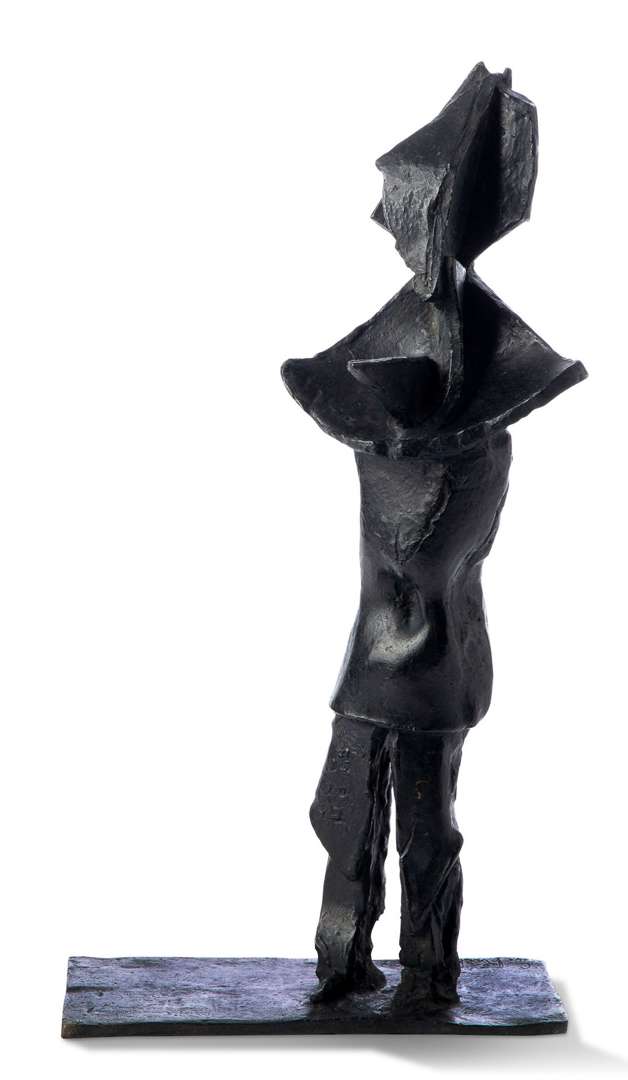
Guerrier n°3, 1953
Bronze with dark pationa, lost-wax casting, signed and numbered 6/8 on the base and bearing the stamp L. Thinot foundery in Paris on the base's edge
30.5 x 16.5 x 11 cm
11 13/16 x 6 19/64 x 4 21/ in.
Germaine Richier
Guerrier n°3, 1953
Germaine Richier, a French sculptor of international renown, was part of the renewal of sculpture alongside Alberto Giacometti and Marino Marini. After a classical training at the École des Beaux-Arts in Montpellier, she joined Antoine Bourdelle's studio in 1926, where she met Alberto Giacometti, who was being taught by the master between 1922 and 1925. Her early works are quite academic and she works particularly the bust. Throughout her life, she relied on triangulation, a method applied by Bourdelle that allows the form to be divided into triangles by drawing on the living model. The importance of joints as axes of construction and form is a lesson from Matisse that she assimilated| the markers she traces on her drawings indicate the structure of the skeleton, and numerous lines grid the bodies. Germaine Richier received recognition from artistic circles in her youth, and was awarded the medal of honor at the 1937 World's Fair in Paris, and participated in the 1939 New York International Fair. During the war, she left Paris to settle in Zurich. It is from 1940, that a new aesthetic is announced in his production with the sculpture Le Crapaud which mixes the man and the animal. She moves away from the illusionist tradition to tend towards new modes of figuration generated by the socio-political context of the war. In the aftermath of the Second World War, Man's very essence is called into question. Humanist values had collapsed, and several artists were working to construct a new vision of humanity. In 1953, Germaine Richier moved to Saint-Tropez and this period marked a renewal in her approach. Le Guerrier n°3 belongs to this very particular production. Germaine Richier uses the material to bring mystery and strangeness to her sculptures. The sharp angles and edges of this figure refer to its warrior nature, thus leaving this work in the field of figuration. Bourdelle's teaching and Rodin's legacy are visible in this work, which places it in a continuity of figurative sculpture, while making undeniable stylistic and thematic breaks.
"We are, whether we like it or not, delicate and mysterious machines, and that's the way it is." — wrote Germaine Richier in a letter to Franz Hellens
Guerrier n°3, 1953
Bronze with dark pationa, lost-wax casting, signed and numbered 6/8 on the base and bearing the stamp L. Thinot foundery in Paris on the base's edge
30.5 x 16.5 x 11 cm
11 13/16 x 6 19/64 x 4 21/ in.
Germaine Richier
Guerrier n°3, 1953
Germaine Richier, a French sculptor of international renown, was part of the renewal of sculpture alongside Alberto Giacometti and Marino Marini. After a classical training at the École des Beaux-Arts in Montpellier, she joined Antoine Bourdelle's studio in 1926, where she met Alberto Giacometti, who was being taught by the master between 1922 and 1925. Her early works are quite academic and she works particularly the bust. Throughout her life, she relied on triangulation, a method applied by Bourdelle that allows the form to be divided into triangles by drawing on the living model. The importance of joints as axes of construction and form is a lesson from Matisse that she assimilated| the markers she traces on her drawings indicate the structure of the skeleton, and numerous lines grid the bodies. Germaine Richier received recognition from artistic circles in her youth, and was awarded the medal of honor at the 1937 World's Fair in Paris, and participated in the 1939 New York International Fair. During the war, she left Paris to settle in Zurich. It is from 1940, that a new aesthetic is announced in his production with the sculpture Le Crapaud which mixes the man and the animal. She moves away from the illusionist tradition to tend towards new modes of figuration generated by the socio-political context of the war. In the aftermath of the Second World War, Man's very essence is called into question. Humanist values had collapsed, and several artists were working to construct a new vision of humanity. In 1953, Germaine Richier moved to Saint-Tropez and this period marked a renewal in her approach. Le Guerrier n°3 belongs to this very particular production. Germaine Richier uses the material to bring mystery and strangeness to her sculptures. The sharp angles and edges of this figure refer to its warrior nature, thus leaving this work in the field of figuration. Bourdelle's teaching and Rodin's legacy are visible in this work, which places it in a continuity of figurative sculpture, while making undeniable stylistic and thematic breaks.
"We are, whether we like it or not, delicate and mysterious machines, and that's the way it is." — wrote Germaine Richier in a letter to Franz Hellens