
&w=3840&q=75)
&w=3840&q=75)
&w=3840&q=75)
&w=3840&q=75)
&w=3840&q=75)
&w=3840&q=75)


NÉPAL OU TIBET XIXe SIÈCLE
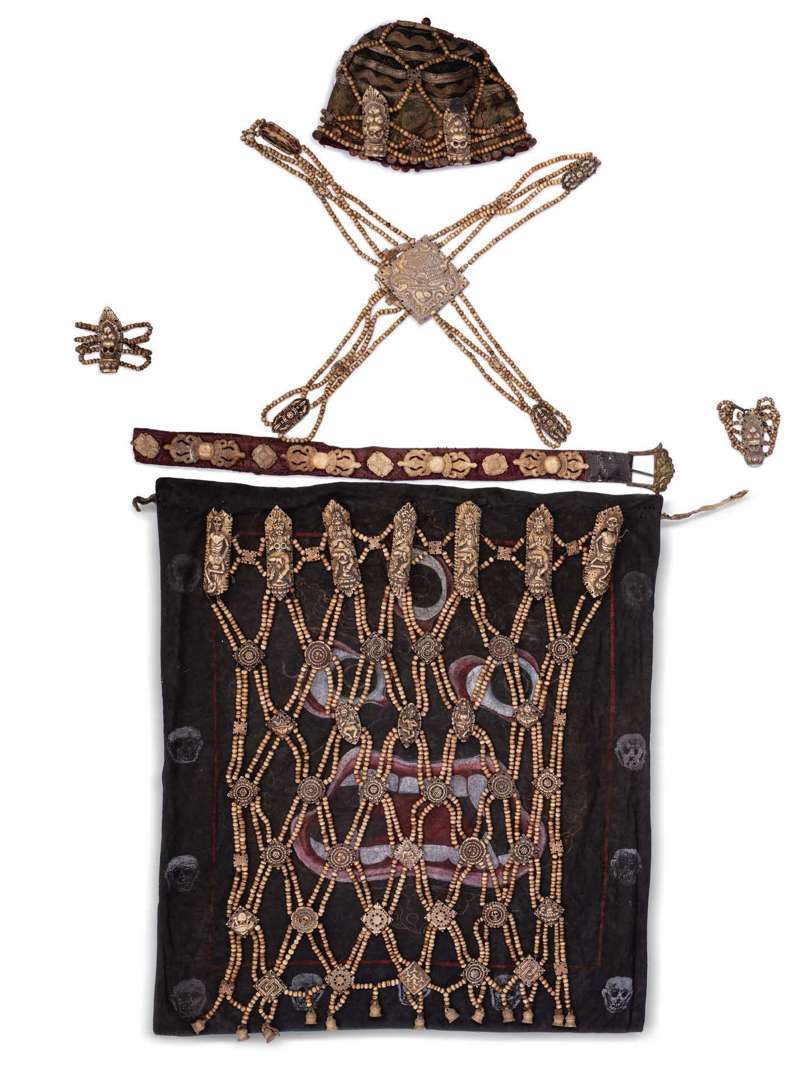
Ritual outfit of a shaman including the rus rgyan ("bone apron" in Tibetan), of quadrangular type, the headdress, the two bracelets and a belt. The latter and the bone pectoral (probably buffalo) rest on their cloth support, and are decorated with small carved plates of Citipati deities and skeletons.
The rus rgyan probably represents the face of Mahakala on the textile part, and the pectoral a face of Kirtimukha, a fierce-looking beast and a prophylactic motif (repelling disease).
Dim. apron : 70 x 65 cm - Dim. headdress : 18,5 x 28 cm
L. bracelets : 8 cm - L. belt : 90 cm
H. pectoral: 55,5 cm
(Wear of use)
N.B.
The upper row, key to the interpretation of the ornament, is the richest in iconography. On the central element, Hevajra or Samvara in union with their feminine counterparts, or a dâkinî who could be
Vajravârâhî or Vajradâkinî, the others invariably appearing four or six dancing dâkinî.
For the rest of the set, the small decorative bone figures often represent the tantric cycle of Chakrasamvara (comprising 62 deities in total), or spirits and ghosts of the earthly and carnal world.
Ritual outfit of a shaman including the rus rgyan ("bone apron" in Tibetan), of quadrangular type, the headdress, the two bracelets and a belt. The latter and the bone pectoral (probably buffalo) rest on their cloth support, and are decorated with small carved plates of Citipati deities and skeletons.
The rus rgyan probably represents the face of Mahakala on the textile part, and the pectoral a face of Kirtimukha, a fierce-looking beast and a prophylactic motif (repelling disease).
Dim. apron : 70 x 65 cm - Dim. headdress : 18,5 x 28 cm
L. bracelets : 8 cm - L. belt : 90 cm
H. pectoral: 55,5 cm
(Wear of use)
N.B.
The upper row, key to the interpretation of the ornament, is the richest in iconography. On the central element, Hevajra or Samvara in union with their feminine counterparts, or a dâkinî who could be
Vajravârâhî or Vajradâkinî, the others invariably appearing four or six dancing dâkinî.
For the rest of the set, the small decorative bone figures often represent the tantric cycle of Chakrasamvara (comprising 62 deities in total), or spirits and ghosts of the earthly and carnal world.