
&w=3840&q=75)
&w=3840&q=75)
&w=3840&q=75)
&w=3840&q=75)
&w=3840&q=75)
&w=3840&q=75)
&w=3840&q=75)
&w=3840&q=75)


NAU John Antoine (1860-1918).
Poèmes triviaux et mystiques, with a portrait of John-Antoine
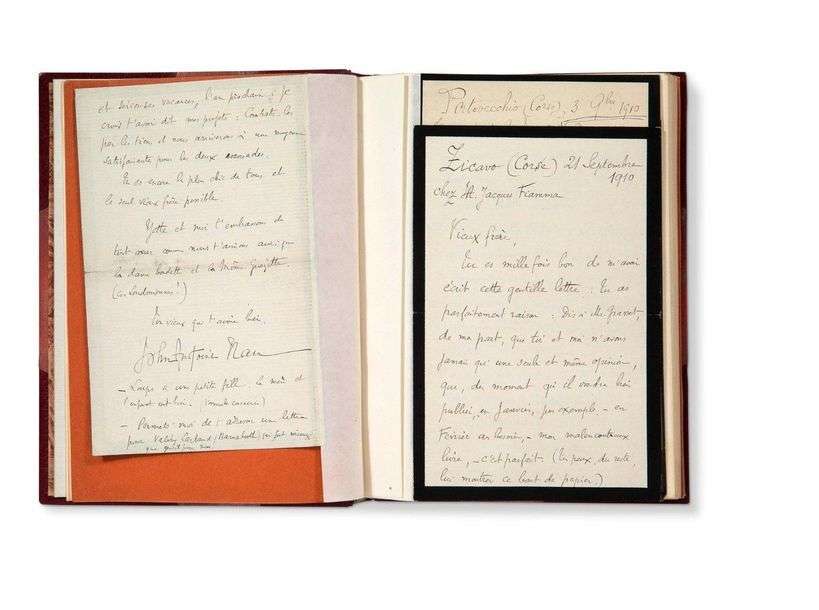
Nau by Henri-Edmond Cross (Paris, Albert Messein, collection "La Phalange", 1924)| with 15 L.A.S. (2 unsigned) from John-Antoine NAU| in-8, covers and spine preserved, letters mounted on mounts or strong wove paper, all bound in one volume of red half-maroquin, head gilt. and spine preserved, the letters mounted on tabs or on strong wove paper, the whole bound in a volume of red half-maroquin with corners, gilt head.
Posthumous first edition, printed in an edition of 535 copies, one of the 25 on Vergé d'Arches (unjustified) at large margins.
Copy of Jean ROYÈRE, who produced this edition, enriched with a beautiful literary correspondence of John-Antoine NAU.
John-Antoine NAU, first Goncourt Prize in 1903 for Force ennemie, was then in Corsica, and wrote to his "old brother" Royère who was to be his executor (42 pages in-8, most of them on mourning paper, and 4 on the back of illustrated postcards). The letters are written from Zicavo and Portovecchio from September to December 1910| one is signed "Giovanni-Antonio Navetti", and another "Adolphe Brisson [with Masonic signs] known as John Antoine Nau". There is a lot of talk about La
Phalange, Nau's collaboration with this review and with various daily newspapers, the possible publication of a novel by Grasset (Cristobal le poète), and above all their contemporaries René Chalupt and Félix Fénéon, André
Fontainas, Judith Gautier, Gustave Geffroy, Gérault-Richard, Valery
Larbaud, Marius-Ary Leblond, Jules Lemaitre, Charles Morice, Jacques
Rivière, Alfred Vallette, Léon Werth, etc.
September 7. On his works: Autre âge ingrat, En suivant les goélands (a collection dedicated to Royère)| he highly recommends his "half-compatriot", Stuart Merrill, "a delightful boy whom I like very much [...] he has a lot of talent and hates Americans almost as much as I do. Besides, all clean Americans abhor the Yankees. He has long existed as a poet. September 21st. As a good anti-republican and "ci-devant" revolutionary, he would like to "try to take down" the Gazette de France: "I am not happy and fuck all my contemporaries except you and yours. (Except also Fénéon, Rivière and a few others, like that pig Guy Lavaud who never answers me when I write to him)"... November 3. Quotation of admirable verses by Royère, including one, "miraculous", "worthy of Baudelaire": "Love, oh death huddled in a passing flesh!"... 30 November. He is pleased that his book is published in advance in La Phalange| tribute to this review "which is always literary and which counts J. Royère, Vielé-Griffin and Jammes among its poets, without forgetting Guy Lavaud and Chalupt, the best of the young"... December 7th. Praise for Des fleurs, why Lavaud| he would like to slip into the review ten lines "of a grey and extinguished royalism" in favour of Quelques propos d'un contre-révolutionnaire by
Guy Chardonchamp... December 28. "Very good the few words you reply to this ... posterior of Clément Vautel. He is not even capable of being venomous, this gigolo, but he is outrageously stupid!"... Etc.
Two original photographs of Royère meditating on Nau's grave in the Tréboul cemetery are mounted at the head of the volume, and following the correspondence, three autograph envelopes to Ange Toussaint-Luca, plus a postcard representing Nau's grave.
Poèmes triviaux et mystiques, with a portrait of John-Antoine
Nau by Henri-Edmond Cross (Paris, Albert Messein, collection "La Phalange", 1924)| with 15 L.A.S. (2 unsigned) from John-Antoine NAU| in-8, covers and spine preserved, letters mounted on mounts or strong wove paper, all bound in one volume of red half-maroquin, head gilt. and spine preserved, the letters mounted on tabs or on strong wove paper, the whole bound in a volume of red half-maroquin with corners, gilt head.
Posthumous first edition, printed in an edition of 535 copies, one of the 25 on Vergé d'Arches (unjustified) at large margins.
Copy of Jean ROYÈRE, who produced this edition, enriched with a beautiful literary correspondence of John-Antoine NAU.
John-Antoine NAU, first Goncourt Prize in 1903 for Force ennemie, was then in Corsica, and wrote to his "old brother" Royère who was to be his executor (42 pages in-8, most of them on mourning paper, and 4 on the back of illustrated postcards). The letters are written from Zicavo and Portovecchio from September to December 1910| one is signed "Giovanni-Antonio Navetti", and another "Adolphe Brisson [with Masonic signs] known as John Antoine Nau". There is a lot of talk about La
Phalange, Nau's collaboration with this review and with various daily newspapers, the possible publication of a novel by Grasset (Cristobal le poète), and above all their contemporaries René Chalupt and Félix Fénéon, André
Fontainas, Judith Gautier, Gustave Geffroy, Gérault-Richard, Valery
Larbaud, Marius-Ary Leblond, Jules Lemaitre, Charles Morice, Jacques
Rivière, Alfred Vallette, Léon Werth, etc.
September 7. On his works: Autre âge ingrat, En suivant les goélands (a collection dedicated to Royère)| he highly recommends his "half-compatriot", Stuart Merrill, "a delightful boy whom I like very much [...] he has a lot of talent and hates Americans almost as much as I do. Besides, all clean Americans abhor the Yankees. He has long existed as a poet. September 21st. As a good anti-republican and "ci-devant" revolutionary, he would like to "try to take down" the Gazette de France: "I am not happy and fuck all my contemporaries except you and yours. (Except also Fénéon, Rivière and a few others, like that pig Guy Lavaud who never answers me when I write to him)"... November 3. Quotation of admirable verses by Royère, including one, "miraculous", "worthy of Baudelaire": "Love, oh death huddled in a passing flesh!"... 30 November. He is pleased that his book is published in advance in La Phalange| tribute to this review "which is always literary and which counts J. Royère, Vielé-Griffin and Jammes among its poets, without forgetting Guy Lavaud and Chalupt, the best of the young"... December 7th. Praise for Des fleurs, why Lavaud| he would like to slip into the review ten lines "of a grey and extinguished royalism" in favour of Quelques propos d'un contre-révolutionnaire by
Guy Chardonchamp... December 28. "Very good the few words you reply to this ... posterior of Clément Vautel. He is not even capable of being venomous, this gigolo, but he is outrageously stupid!"... Etc.
Two original photographs of Royère meditating on Nau's grave in the Tréboul cemetery are mounted at the head of the volume, and following the correspondence, three autograph envelopes to Ange Toussaint-Luca, plus a postcard representing Nau's grave.