
&w=3840&q=75)
&w=3840&q=75)
&w=3840&q=75)
&w=3840&q=75)
&w=3840&q=75)
&w=3840&q=75)
&w=3840&q=75)
&w=3840&q=75)

417
LOUYS Pierre (1870-1925)
The item was sold for 1 581 €
Fees include commission and taxes.
LOUYS Pierre (1870-1925)
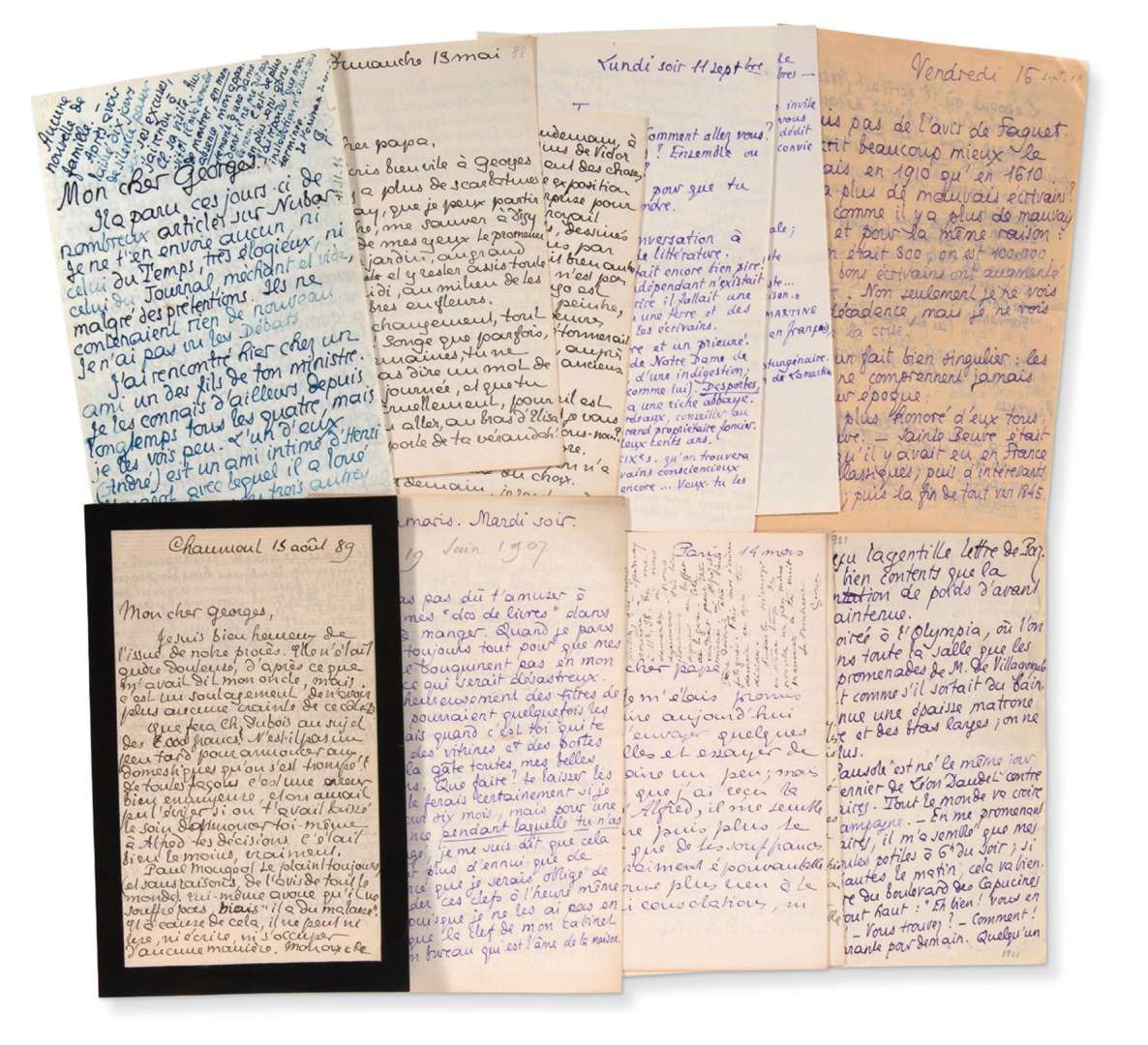
Collection of 25 autographs. 1888-1916. Approximately 123 p. in-12, various papers, some envelopes preserved.
Interesting collection of 8 letters to his father and 17 letters to his brother Georges Louis. (Ink stains on one letter.
A few tears, not serious, on the folds (except for one, longer, one letter seems incomplete)
In 1888, he evokes the works for the Universal Exhibition, "whose iron frameworks already cover the whole Champ de Mars, or almost, [...] up to the Esplanade des Invalides which will also soon disappear under the constructions. The Eiffel Tower is still rising." Among the news about his schooling, he mentions his friend André Gide, who passed his baccalaureate| "I had dinner yesterday at my friend Gide's house, for the 15th or 20th time this winter, I don't count them anymore. He invites me very often, and I never look for pretexts to refuse: he is an excellent fellow and each time I have more pleasure in seeing him."
He gives news of the various family members he visits regularly and worries about his father's ever-fluctuating health. He also details his outings and hobbies, music especially: "I am feeding on Wagner at the moment."
In letters to his father, Georges sometimes adds a note of his own.
To his brother, he gives news of his father's health, of course, but he also talks about his intellectual training. "I am in the process of translating a pamphlet by Lucien which is a marvel of wit, taste and observation.
[...] I will publish it at the same time as my Meleagre. Since I am not yet strong enough to write myself I will content myself for some time with translating." He exposes (and sometimes confesses) his readings: "I have read, in addition to La Petite Fadette, and without consulting you, a volume whose author will erase you... "Au Bonheur des Dames." Oh, don't scold me, I find it amazing! [...] It's a hundred pips above G. Sand's "bergerades."
It's otherwise written, thought out, observed, exposed, lived in." Or again, "I read the third and last philosophical dialogue of Renan, which is bolder and even more curious than the first two| and a few chapters of Taine's psychology, among others that of hallucinations, which is, as Gide had told me, to make one dream." Throughout his correspondence, he expounds literary considerations, both on the authors of his time and on the different artistic movements through the ages. In 1895, he was in Seville where it was Carnival. "My stay here was disturbed [...] by an individual who signed himself Marquis de Ravenel and who had recommended himself to me by Jacques Blanche, Heredia, the Cessess Fleury and Mme Lequeux.
I wrote to Jacques Blanche who declared to me that he was absolutely unaware of it. [...] he has swindled the whole of Seville out of money [...]. He insulted me one night." During this stay, he works: "I gave up pushing Bilitis to the 300th song, as I had never intended to do| but it is not without regret, because I still had many things to say, and it is such an amusing work.
" Later, the same year: "H. refuses [...] the dedication of Aphr. because he still has two girls to marry. [...] Finally, he gave me this argument: I want to write an article for you in the Débats| I could not write it if the book was dedicated to me." In 1900, about King Pausole, which was published in serial form: "It's a bouillabaisse of five or six different 'genres', and I claim in every line to make the reader accept it as the most realistic of Russian novels. I need a certain nerve that is not without concern.
Collection of 25 autographs. 1888-1916. Approximately 123 p. in-12, various papers, some envelopes preserved.
Interesting collection of 8 letters to his father and 17 letters to his brother Georges Louis. (Ink stains on one letter.
A few tears, not serious, on the folds (except for one, longer, one letter seems incomplete)
In 1888, he evokes the works for the Universal Exhibition, "whose iron frameworks already cover the whole Champ de Mars, or almost, [...] up to the Esplanade des Invalides which will also soon disappear under the constructions. The Eiffel Tower is still rising." Among the news about his schooling, he mentions his friend André Gide, who passed his baccalaureate| "I had dinner yesterday at my friend Gide's house, for the 15th or 20th time this winter, I don't count them anymore. He invites me very often, and I never look for pretexts to refuse: he is an excellent fellow and each time I have more pleasure in seeing him."
He gives news of the various family members he visits regularly and worries about his father's ever-fluctuating health. He also details his outings and hobbies, music especially: "I am feeding on Wagner at the moment."
In letters to his father, Georges sometimes adds a note of his own.
To his brother, he gives news of his father's health, of course, but he also talks about his intellectual training. "I am in the process of translating a pamphlet by Lucien which is a marvel of wit, taste and observation.
[...] I will publish it at the same time as my Meleagre. Since I am not yet strong enough to write myself I will content myself for some time with translating." He exposes (and sometimes confesses) his readings: "I have read, in addition to La Petite Fadette, and without consulting you, a volume whose author will erase you... "Au Bonheur des Dames." Oh, don't scold me, I find it amazing! [...] It's a hundred pips above G. Sand's "bergerades."
It's otherwise written, thought out, observed, exposed, lived in." Or again, "I read the third and last philosophical dialogue of Renan, which is bolder and even more curious than the first two| and a few chapters of Taine's psychology, among others that of hallucinations, which is, as Gide had told me, to make one dream." Throughout his correspondence, he expounds literary considerations, both on the authors of his time and on the different artistic movements through the ages. In 1895, he was in Seville where it was Carnival. "My stay here was disturbed [...] by an individual who signed himself Marquis de Ravenel and who had recommended himself to me by Jacques Blanche, Heredia, the Cessess Fleury and Mme Lequeux.
I wrote to Jacques Blanche who declared to me that he was absolutely unaware of it. [...] he has swindled the whole of Seville out of money [...]. He insulted me one night." During this stay, he works: "I gave up pushing Bilitis to the 300th song, as I had never intended to do| but it is not without regret, because I still had many things to say, and it is such an amusing work.
" Later, the same year: "H. refuses [...] the dedication of Aphr. because he still has two girls to marry. [...] Finally, he gave me this argument: I want to write an article for you in the Débats| I could not write it if the book was dedicated to me." In 1900, about King Pausole, which was published in serial form: "It's a bouillabaisse of five or six different 'genres', and I claim in every line to make the reader accept it as the most realistic of Russian novels. I need a certain nerve that is not without concern.