
&w=3840&q=75)
&w=3840&q=75)
&w=3840&q=75)
&w=3840&q=75)
&w=3840&q=75)
&w=3840&q=75)
&w=3840&q=75)
&w=3840&q=75)


84
POL CHAMBOST (1906-1983)
The item was sold for 2 600 €
Fees include commission and taxes.
POL CHAMBOST (1906-1983)
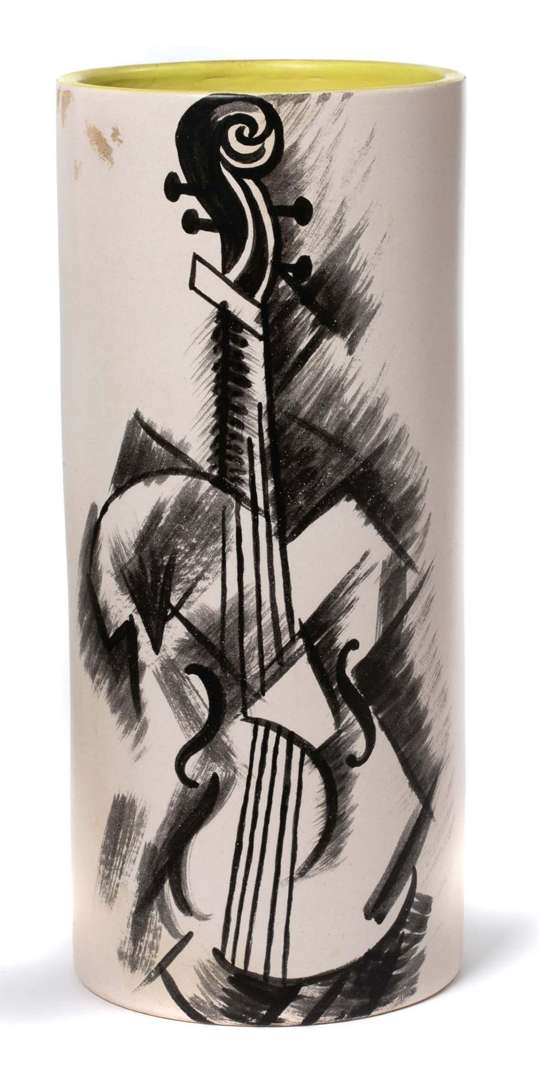
LARGE CYLINDRICAL VASE MODEL 1100
Enamelled white on the outside and lime yellow on the inside.
Decorated with a cubist violin in the manner of Braque, enamelled in black. Circa 1959
Height 37,5 cm
(Some missing enamel)
PROVENANCE Private collection, Paris
HISTORY This vase was commissioned by Colette Gueden to
Pol Chambost for her fair-exhibition "Commedia dell'arte" which was inaugurated in April 1959.
As far as we know, only 6 pieces of this series have been listed in the invoice book of the Poterie Pol Chambost These vases were only edited for Colette Gueden.
We thank Philippe Chambost for the text that accompanies this note and for his precious research in the archives of Pol Chambost.
Large cylindrical vase decorated with a violin.
14 9/16 in.
While succeeding Charlotte
Chauchet-Guilleré in 1938 as artistic director of Primavera, Colette
Gueden never ceased to seek out the best of French craftsmanship in order to present decorative objects of the highest quality at her "petites foires", which attracted the Parisian elite in search of the new aesthetic
Parisienne, synonymous with chic and good French taste. Her collaboration with the sculptor-ceramist Pol Chambost installed at
Ivry-sur-Seine (where Jean Besnard practises his art) is known since 1943, asking him to help her "with a turned decorative dish and a hand-modelled basket" that she will present at the next Salon de l'Imagerie.
Over almost two decades, the ceramist will be present with his creations alongside the stylist to testify to the evolution of this decorative art of prestige but accessible to all.
Colette Gueden, preparing her spring 1959 exhibition, solicits Chambost again in a letter dated December 16, 1958 in which she explains her project: "The general theme is on the dance genre
Commedia del Arte... I would like you to look for me... different models (including) a vase decorated in black and white lozenges Harlequin. It is in fact, freehand sketch in support, a suggestion of a cylinder vase of 39 to 40 cm high and 18cm in diameter. Finally the pages of sketches follow one another and the freehand results in three "cylinder vases" with a decoration of musical instruments: violin, guitar and mandolin. The order note of February 17, 1959 confirms the precision of the request, namely "Very high cylindrical vase with musical instrument decoration in black on white enamel, red, lime yellow or black interior". She adds: "a guitar and a violin to hang on the wall to put flowers would be nice too".
The invoices of the "Poterie Pol Chambost" of March 9, 13 and 19, 1959 give an account of the delivery of the works under the name
Model 1100 or "vase décor music".
Six specimens in total are marketed without precision of decorations. If the violin model is listed in the Poterie d'Ivry's repertoire of models, it seems that from reading all the invoices in the Chambost archives, these "music décor" vases were only produced for Colette Gueden.
If Colette Gueden is aware of the ceramist's aptitude for translating his plastic aspirations into models, she is also aware of his series of figurative designs painted in the spirit of Braque and Picasso and produced in 1956. Pol is not going to simplistically trace the line of musical instruments drawn by the stylist. If he met Picasso and his ceramic work in Vallauris in 1954, he leans more towards Georges Braque's vision to fuel his creative imagination. Seriously documented on the subject, it is in the work of Maurice
Gieure published by Pierre Tisné that he finds a pictorial model for his violin represented here.
The pose, the surroundings, the line are inspired by certain drawings of Braque such as "Broc et violon" of 1910 or "La Bouteille de Marc", an Indian ink of 1914. He makes his own, but through the glaze, the vision and technique of the Master.
The white glaze is here the support of the black line, which is enough to reveal the ceramist's liking for drawing. It must be said that, born of a sculptor father and a painter mother and drawing teacher, Chambost was one of the first creators to emerge from the brand new reform of the teaching of the School of Arts applied to industry and rightly initiated in 1922 by the City Council of Paris, on the eve of the 1925 International Exhibition of Modern Decorative and Industrial Arts.
Draughtsman, modeller, baker... but also enameller, with that contrast of yellow inside which characterises the style of the 1950s so well.
Philippe Chambost
LARGE CYLINDRICAL VASE MODEL 1100
Enamelled white on the outside and lime yellow on the inside.
Decorated with a cubist violin in the manner of Braque, enamelled in black. Circa 1959
Height 37,5 cm
(Some missing enamel)
PROVENANCE Private collection, Paris
HISTORY This vase was commissioned by Colette Gueden to
Pol Chambost for her fair-exhibition "Commedia dell'arte" which was inaugurated in April 1959.
As far as we know, only 6 pieces of this series have been listed in the invoice book of the Poterie Pol Chambost These vases were only edited for Colette Gueden.
We thank Philippe Chambost for the text that accompanies this note and for his precious research in the archives of Pol Chambost.
Large cylindrical vase decorated with a violin.
14 9/16 in.
While succeeding Charlotte
Chauchet-Guilleré in 1938 as artistic director of Primavera, Colette
Gueden never ceased to seek out the best of French craftsmanship in order to present decorative objects of the highest quality at her "petites foires", which attracted the Parisian elite in search of the new aesthetic
Parisienne, synonymous with chic and good French taste. Her collaboration with the sculptor-ceramist Pol Chambost installed at
Ivry-sur-Seine (where Jean Besnard practises his art) is known since 1943, asking him to help her "with a turned decorative dish and a hand-modelled basket" that she will present at the next Salon de l'Imagerie.
Over almost two decades, the ceramist will be present with his creations alongside the stylist to testify to the evolution of this decorative art of prestige but accessible to all.
Colette Gueden, preparing her spring 1959 exhibition, solicits Chambost again in a letter dated December 16, 1958 in which she explains her project: "The general theme is on the dance genre
Commedia del Arte... I would like you to look for me... different models (including) a vase decorated in black and white lozenges Harlequin. It is in fact, freehand sketch in support, a suggestion of a cylinder vase of 39 to 40 cm high and 18cm in diameter. Finally the pages of sketches follow one another and the freehand results in three "cylinder vases" with a decoration of musical instruments: violin, guitar and mandolin. The order note of February 17, 1959 confirms the precision of the request, namely "Very high cylindrical vase with musical instrument decoration in black on white enamel, red, lime yellow or black interior". She adds: "a guitar and a violin to hang on the wall to put flowers would be nice too".
The invoices of the "Poterie Pol Chambost" of March 9, 13 and 19, 1959 give an account of the delivery of the works under the name
Model 1100 or "vase décor music".
Six specimens in total are marketed without precision of decorations. If the violin model is listed in the Poterie d'Ivry's repertoire of models, it seems that from reading all the invoices in the Chambost archives, these "music décor" vases were only produced for Colette Gueden.
If Colette Gueden is aware of the ceramist's aptitude for translating his plastic aspirations into models, she is also aware of his series of figurative designs painted in the spirit of Braque and Picasso and produced in 1956. Pol is not going to simplistically trace the line of musical instruments drawn by the stylist. If he met Picasso and his ceramic work in Vallauris in 1954, he leans more towards Georges Braque's vision to fuel his creative imagination. Seriously documented on the subject, it is in the work of Maurice
Gieure published by Pierre Tisné that he finds a pictorial model for his violin represented here.
The pose, the surroundings, the line are inspired by certain drawings of Braque such as "Broc et violon" of 1910 or "La Bouteille de Marc", an Indian ink of 1914. He makes his own, but through the glaze, the vision and technique of the Master.
The white glaze is here the support of the black line, which is enough to reveal the ceramist's liking for drawing. It must be said that, born of a sculptor father and a painter mother and drawing teacher, Chambost was one of the first creators to emerge from the brand new reform of the teaching of the School of Arts applied to industry and rightly initiated in 1922 by the City Council of Paris, on the eve of the 1925 International Exhibition of Modern Decorative and Industrial Arts.
Draughtsman, modeller, baker... but also enameller, with that contrast of yellow inside which characterises the style of the 1950s so well.
Philippe Chambost