
&w=3840&q=75)
&w=3840&q=75)
&w=3840&q=75)
&w=3840&q=75)
&w=3840&q=75)
&w=3840&q=75)
&w=3840&q=75)
&w=3840&q=75)

172
MéRIMéE Prosper (1803-1870)
The item was sold for 2 340 €
Fees include commission and taxes.
MéRIMéE Prosper (1803-1870)
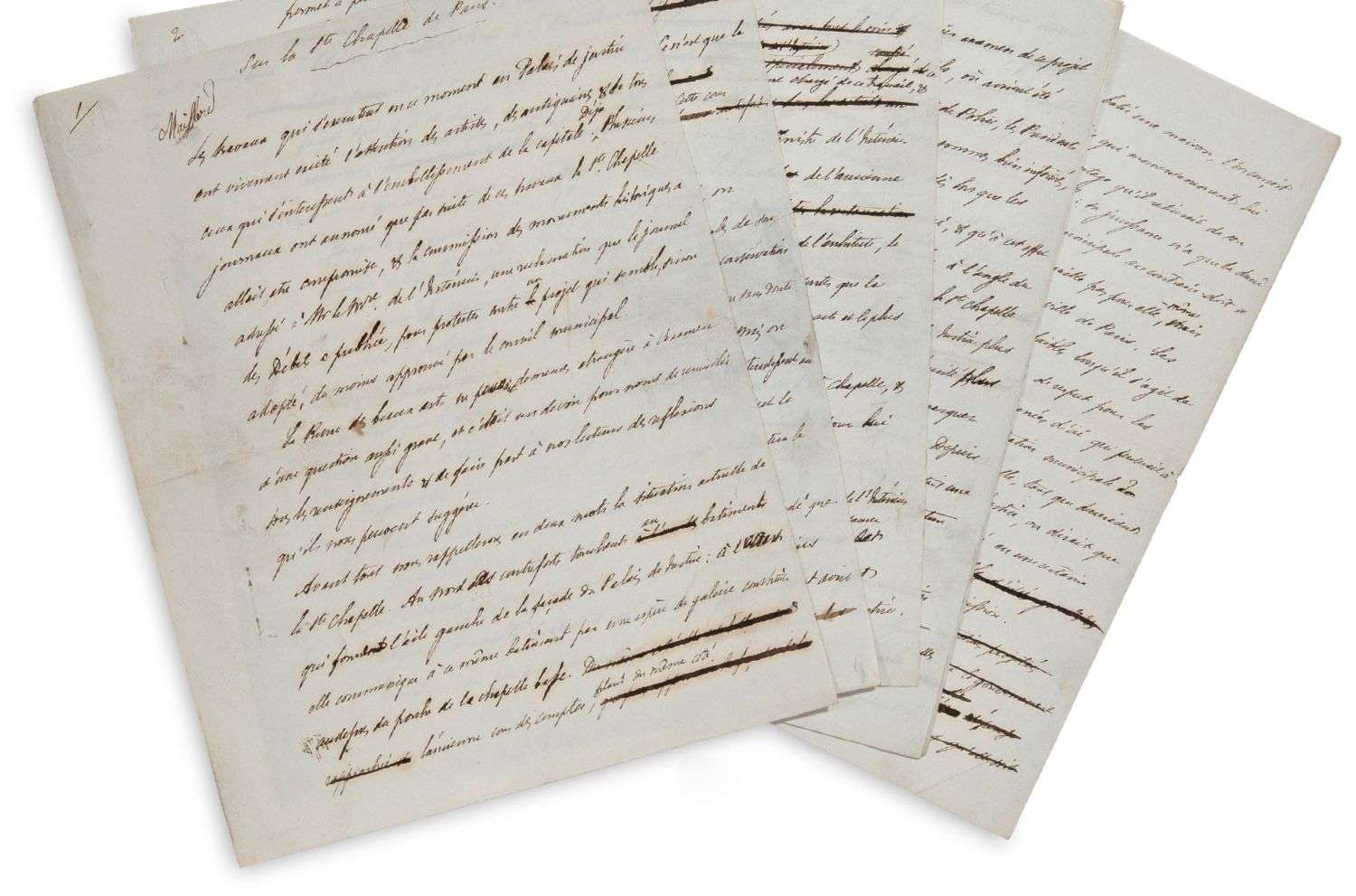
Autograph MANUSCRIPT, On the Ste Chapelle de Paris, [1843]| 8 pages in-4.
Protest against a project to enlarge the Palais de Justice that threatens the Sainte-Chapelle.
This beautiful article for the defense of the historical monuments of the old town
Paris appeared without an author's name on March 7, 1843 in the first issue of the magazine Les Beaux-Arts, under the title "La Sainte-Chapelle"| the manuscript contains erasures and corrections.
"The work currently being carried out at the Law Courts has excited the attention of artists, antique dealers, & all those interested in the embellishment of the capital. Already several newspapers have announced that as a result of these works the Holy Chapel is going to be compromised, & the Commission of Historical Monuments has addressed a complaint to the Mother of the Interior..."... The Sainte-Chapelle, flanked by the Palace of Justice, the former Court of Auditors and a narrow passage, can only be admired by the spectator from the south side. No one doubts the administration's intention to preserve and enhance the Chapel, since it has been restored and returned to worship. Mérimée retraces the history of the project to enlarge the Palais de Justice since 1830: approval of the project by M. Huyot, postponement of the work, resumption of the project by M. Duc. However, there are now alarming signs of how the Chapel is to be treated: "The municipal administration has just decided to open a street parallel to the wharf. Between this street and the Cour du Mai, the buildings assigned to the criminal police courts & the Prefecture of Police are to be raised to a considerable height. The cour du Mai was therefore built in the courtyard, reduced by a third, and the only side where the Ste Chapelle was still clear was obstructed.
That's not all: we want to increase the width of the building overlooking rue de la Barillerie| this means reducing the cour du Mai even further, encroaching on the already narrow passage that separates this building from the chevet of the Ste
Chapelle. Finally, there is still talk of a gallery, or I don't know what construction, which would come to lean against the west of the Ste Chapelle. Thus on all sides, the monument of St. Louis would be tightened, let us say better imprisoned, deprived of air, light, means of flow for water. The Cour du Mai would become a kind of well| the buildings that would enclose it to the south would develop on a narrow street, or rather on a dead end, facing the cabarets & the dirtiest houses on the island"... It is very much to be feared that the municipal administration would want to sacrifice the memories of the past to considerations of economy. But it must "worry about the future. She does not work for herself, but for an immortal being, which is the city of Paris. Considerations of economy are very weak when it comes to convenience, dignity, greatness, respect for memories of the past. In a few years from now, who would think of the economy obtained by the municipal administration? But as long as the Ste Chapelle lasts, as long as the petty construction of the Palace of Justice lasts, it would seem that the capital of France was administered in a certain year by men who did not understand their great mission".
Autograph MANUSCRIPT, On the Ste Chapelle de Paris, [1843]| 8 pages in-4.
Protest against a project to enlarge the Palais de Justice that threatens the Sainte-Chapelle.
This beautiful article for the defense of the historical monuments of the old town
Paris appeared without an author's name on March 7, 1843 in the first issue of the magazine Les Beaux-Arts, under the title "La Sainte-Chapelle"| the manuscript contains erasures and corrections.
"The work currently being carried out at the Law Courts has excited the attention of artists, antique dealers, & all those interested in the embellishment of the capital. Already several newspapers have announced that as a result of these works the Holy Chapel is going to be compromised, & the Commission of Historical Monuments has addressed a complaint to the Mother of the Interior..."... The Sainte-Chapelle, flanked by the Palace of Justice, the former Court of Auditors and a narrow passage, can only be admired by the spectator from the south side. No one doubts the administration's intention to preserve and enhance the Chapel, since it has been restored and returned to worship. Mérimée retraces the history of the project to enlarge the Palais de Justice since 1830: approval of the project by M. Huyot, postponement of the work, resumption of the project by M. Duc. However, there are now alarming signs of how the Chapel is to be treated: "The municipal administration has just decided to open a street parallel to the wharf. Between this street and the Cour du Mai, the buildings assigned to the criminal police courts & the Prefecture of Police are to be raised to a considerable height. The cour du Mai was therefore built in the courtyard, reduced by a third, and the only side where the Ste Chapelle was still clear was obstructed.
That's not all: we want to increase the width of the building overlooking rue de la Barillerie| this means reducing the cour du Mai even further, encroaching on the already narrow passage that separates this building from the chevet of the Ste
Chapelle. Finally, there is still talk of a gallery, or I don't know what construction, which would come to lean against the west of the Ste Chapelle. Thus on all sides, the monument of St. Louis would be tightened, let us say better imprisoned, deprived of air, light, means of flow for water. The Cour du Mai would become a kind of well| the buildings that would enclose it to the south would develop on a narrow street, or rather on a dead end, facing the cabarets & the dirtiest houses on the island"... It is very much to be feared that the municipal administration would want to sacrifice the memories of the past to considerations of economy. But it must "worry about the future. She does not work for herself, but for an immortal being, which is the city of Paris. Considerations of economy are very weak when it comes to convenience, dignity, greatness, respect for memories of the past. In a few years from now, who would think of the economy obtained by the municipal administration? But as long as the Ste Chapelle lasts, as long as the petty construction of the Palace of Justice lasts, it would seem that the capital of France was administered in a certain year by men who did not understand their great mission".