
&w=3840&q=75)
&w=3840&q=75)
&w=3840&q=75)
&w=3840&q=75)
&w=3840&q=75)
&w=3840&q=75)
&w=3840&q=75)
&w=3840&q=75)


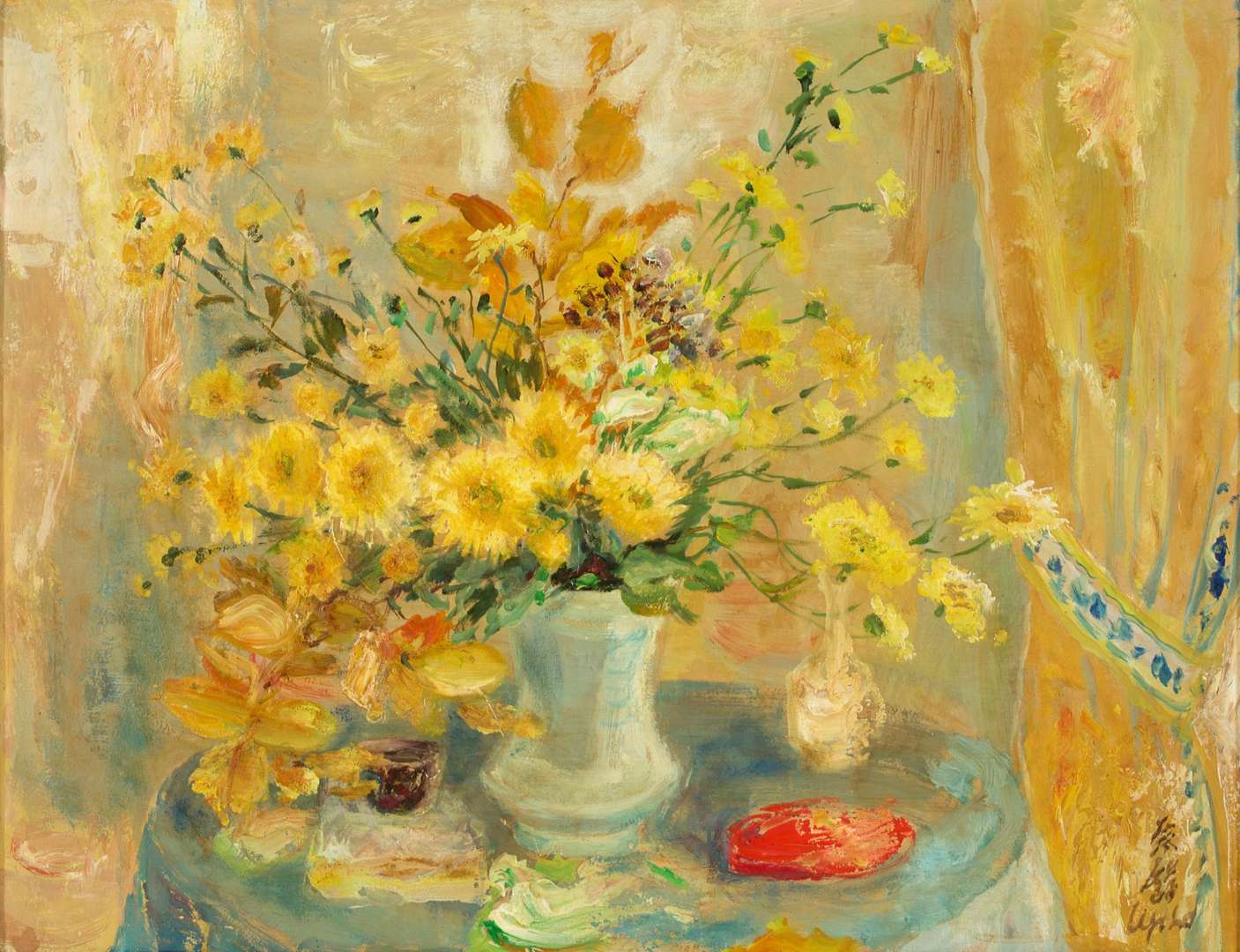
LE PHO (1907-2001)
The opaline vase
Oil on silk mounted on isorel, signed lower right, titled on the back
50 x 64.5 cm - 19 3/4 x 25 3/8 in.
A certificate of inclusion in the catalogue raisonné of the artist currently in preparation by Charlotte Aguttes-Reynier will be given to the buyer
PROVENANCE
Galerie Romanet, Paris
Private collection, France
The strength of Le Pho's work lies in a clever mixture of cultures. The artist manages to take up the artistic codes of his native country while mastering Western know-how. The opaline vase perfectly embodies this double dimension. A talented artist, Le Pho plays with influences by combining the ancestral technique of silk with oil, a medium much appreciated by Western artists. If the Master takes up the very classical genre of the still life, his vision brings a new freshness: the traditional codes are found but Le Pho manages to create a certain intimacy through the curtain closing the composition. The palette dominated by a yellow chromatic range brings a certain gaiety to this painting.
The blue tones of the vase, the tablecloth but also the curtain tieback subtly contrast the whole. The background of a great modernity, quickly brushed but nevertheless highly mastered, allows to put forward the subject. Composed mainly of chrysanthemums, this bouquet reminds us of the constant double reading in the artist's work. Indeed, these flowers pay tribute to the dead in European culture but are also synonymous with nobility and durability in Asia. Like these flowers whose exact meaning varies according to culture and whose beauty everyone agrees on, Le Pho sets himself up as an artist linking cultures to offer a unique, most beautiful art.
Sức mạnh trong tác phẩm nghệ thuật của Lê Phổ nằm ở sự kết hợp khoa học giữa các nền văn hóa. Họa sĩ thành công trong việc sử dụng lại các mã hóa nghệ thuật của đất nước bản địa trong khi cũng làm chủ bí quyết phong cách Âu Châu. Bình hoa thủy tinh có sắc trắng đục thể hiện một cách hoàn hảo sự phối hợp này. Họa sĩ tài năng Lê Phổ như đang chơi đùa bằng cách kết hợp kỹ thuật lụa truyền thống với sơn dầu, kỹ thuật rất phổ biến của các họa sĩ phương Tây. Nếu như họa sĩ sử dụng lại thể loại rất cổ điển của tranh tĩnh vật, tầm nhìn của ông mang đến sự tươi mới : các mã hóa truyền thống được tìm thấy nhưng Lê Phổ thành công tạo ra một sự gắn kết nhất định thông qua tấm màn đóng lại bố cục của bức tranh. Các sắc màu chi phối bởi một gam màu vàng mang lại một sự vui vẻ nhất định cho bức tranh này. Các tông màu xanh của chiếc bình, khăn trải bàn cũng như tấm rèm tạo nên sự tương phản tinh tế cho toàn bộ bức tranh. Bối cảnh hiện đại được thể hiện trong tầm kiểm soát, cho phép làm nổi bật chủ đề. Đối tượng chủ yếu là hoa cúc, bó hoa này gợi nhớ lại sự kết đôi liên tục trong tác phẩm của họa sĩ. Thật vậy, những bông hoa này vinh danh những người đã mất trong văn hóa châu Âu nhưng cũng đồng nghĩa với sự quý phái và bền vững ở châu Á. Hình ảnh của những bông hoa này có ý nghĩa chính xác khác nhau tùy theo các nền văn hóa mà tất cả đều đồng ý nhận ra vẻ đẹp của nó. Lê Phổ là một họa sĩ liên kết các nền văn hóa để trưng bày một bản sắc nghệ thuật độc đáo, đẹp đẽ nhất.
LÊ PHỔ
Considered one of the leading figures of modern Vietnamese art, Le Pho was born in 1907 in Ha Tay province into a respected mandarin family, his father being the last Viceroy of Tonkin. Showing a predisposition for painting and drawing, he joined the first class of the Indochina School of Fine Arts in 1925. He was quickly noticed by the director and founder of the school, Victor Tardieu, to whom he remained strongly attached throughout his life. Pho assimilates to perfection the teachings of his teachers. The school valued Vietnamese artistic traditions such as silk painting or lacquer, while making this new generation of artists aware of Western history and artistic techniques. Indeed, one can easily read the influences of the Italian Primitives or the Impressionists in the works of Le Pho. In 1931, he came to France to present his works at the International Colonial Exhibition. He chose to stay in Paris for a year to attend the Ecole des Beaux-Arts, and then made several trips to Europe. He returned to Vietnam in 1933, and taught at the Indochina School of Fine Arts in Hanoi. He decided to settle permanently in France in 1937 and quickly acquired a great notoriety.
Được coi là một trong những nhân vật hàng đầu của nền mỹ thuật Việt Nam hiện đại, Lê Phổ sinh năm 1907 tại tỉnh Hà Tây trong một gia đình quan lại được kính nể, cha là kinh lược sứ cuối cùng của Bắc Kỳ. Thể hiện thiên hướng về hội họa v
The opaline vase
Oil on silk mounted on isorel, signed lower right, titled on the back
50 x 64.5 cm - 19 3/4 x 25 3/8 in.
A certificate of inclusion in the catalogue raisonné of the artist currently in preparation by Charlotte Aguttes-Reynier will be given to the buyer
PROVENANCE
Galerie Romanet, Paris
Private collection, France
The strength of Le Pho's work lies in a clever mixture of cultures. The artist manages to take up the artistic codes of his native country while mastering Western know-how. The opaline vase perfectly embodies this double dimension. A talented artist, Le Pho plays with influences by combining the ancestral technique of silk with oil, a medium much appreciated by Western artists. If the Master takes up the very classical genre of the still life, his vision brings a new freshness: the traditional codes are found but Le Pho manages to create a certain intimacy through the curtain closing the composition. The palette dominated by a yellow chromatic range brings a certain gaiety to this painting.
The blue tones of the vase, the tablecloth but also the curtain tieback subtly contrast the whole. The background of a great modernity, quickly brushed but nevertheless highly mastered, allows to put forward the subject. Composed mainly of chrysanthemums, this bouquet reminds us of the constant double reading in the artist's work. Indeed, these flowers pay tribute to the dead in European culture but are also synonymous with nobility and durability in Asia. Like these flowers whose exact meaning varies according to culture and whose beauty everyone agrees on, Le Pho sets himself up as an artist linking cultures to offer a unique, most beautiful art.
Sức mạnh trong tác phẩm nghệ thuật của Lê Phổ nằm ở sự kết hợp khoa học giữa các nền văn hóa. Họa sĩ thành công trong việc sử dụng lại các mã hóa nghệ thuật của đất nước bản địa trong khi cũng làm chủ bí quyết phong cách Âu Châu. Bình hoa thủy tinh có sắc trắng đục thể hiện một cách hoàn hảo sự phối hợp này. Họa sĩ tài năng Lê Phổ như đang chơi đùa bằng cách kết hợp kỹ thuật lụa truyền thống với sơn dầu, kỹ thuật rất phổ biến của các họa sĩ phương Tây. Nếu như họa sĩ sử dụng lại thể loại rất cổ điển của tranh tĩnh vật, tầm nhìn của ông mang đến sự tươi mới : các mã hóa truyền thống được tìm thấy nhưng Lê Phổ thành công tạo ra một sự gắn kết nhất định thông qua tấm màn đóng lại bố cục của bức tranh. Các sắc màu chi phối bởi một gam màu vàng mang lại một sự vui vẻ nhất định cho bức tranh này. Các tông màu xanh của chiếc bình, khăn trải bàn cũng như tấm rèm tạo nên sự tương phản tinh tế cho toàn bộ bức tranh. Bối cảnh hiện đại được thể hiện trong tầm kiểm soát, cho phép làm nổi bật chủ đề. Đối tượng chủ yếu là hoa cúc, bó hoa này gợi nhớ lại sự kết đôi liên tục trong tác phẩm của họa sĩ. Thật vậy, những bông hoa này vinh danh những người đã mất trong văn hóa châu Âu nhưng cũng đồng nghĩa với sự quý phái và bền vững ở châu Á. Hình ảnh của những bông hoa này có ý nghĩa chính xác khác nhau tùy theo các nền văn hóa mà tất cả đều đồng ý nhận ra vẻ đẹp của nó. Lê Phổ là một họa sĩ liên kết các nền văn hóa để trưng bày một bản sắc nghệ thuật độc đáo, đẹp đẽ nhất.
LÊ PHỔ
Considered one of the leading figures of modern Vietnamese art, Le Pho was born in 1907 in Ha Tay province into a respected mandarin family, his father being the last Viceroy of Tonkin. Showing a predisposition for painting and drawing, he joined the first class of the Indochina School of Fine Arts in 1925. He was quickly noticed by the director and founder of the school, Victor Tardieu, to whom he remained strongly attached throughout his life. Pho assimilates to perfection the teachings of his teachers. The school valued Vietnamese artistic traditions such as silk painting or lacquer, while making this new generation of artists aware of Western history and artistic techniques. Indeed, one can easily read the influences of the Italian Primitives or the Impressionists in the works of Le Pho. In 1931, he came to France to present his works at the International Colonial Exhibition. He chose to stay in Paris for a year to attend the Ecole des Beaux-Arts, and then made several trips to Europe. He returned to Vietnam in 1933, and taught at the Indochina School of Fine Arts in Hanoi. He decided to settle permanently in France in 1937 and quickly acquired a great notoriety.
Được coi là một trong những nhân vật hàng đầu của nền mỹ thuật Việt Nam hiện đại, Lê Phổ sinh năm 1907 tại tỉnh Hà Tây trong một gia đình quan lại được kính nể, cha là kinh lược sứ cuối cùng của Bắc Kỳ. Thể hiện thiên hướng về hội họa v