
&w=3840&q=75)
&w=3840&q=75)
&w=3840&q=75)
&w=3840&q=75)
&w=3840&q=75)
&w=3840&q=75)
&w=3840&q=75)
&w=3840&q=75)


3
ALIX AYMÉ (1894-1989)
The item was sold for 322 600 €
Fees include commission and taxes.
ALIX AYMÉ (1894-1989)
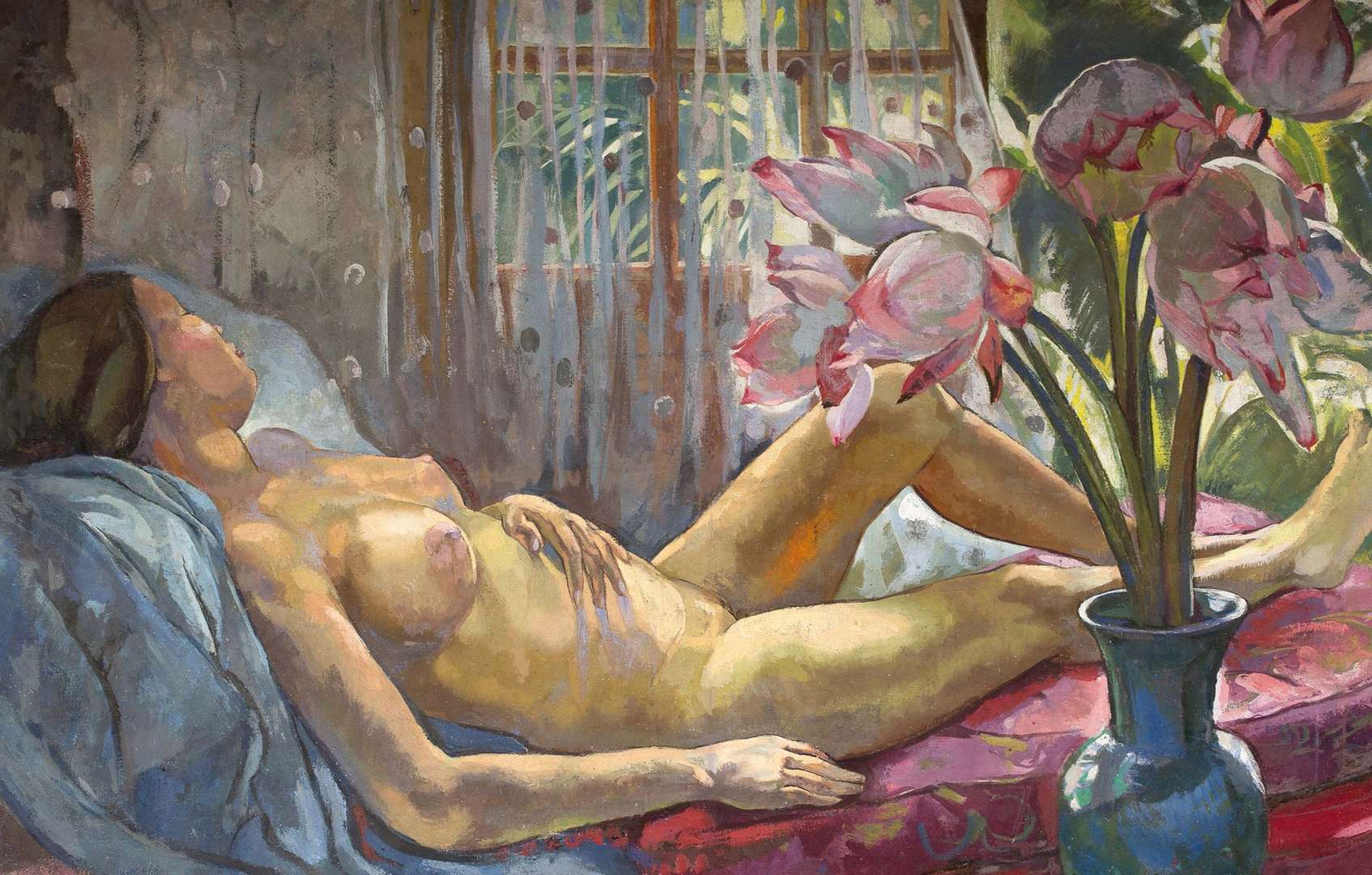
Nude with Lotus, circa 1938
Oil on canvas
68 x 109 cm -26 3/4 x 42 7/8 in.
This work is referenced under the number H/T 003 in the online catalogue raisonné of the artist prepared by the Association des amis d'Alix Aymé
PROVENANCE
Private collection, France
BIBLIOGRAPHY
Pascal Lacombe, Guy Ferrer, Alix Aymé, Une artiste peintre en Indochine, Somogy
Editions d'Art, Paris, 2011, p.66
In the middle of the 20th century, the French government, wishing to promote its colonies, set up an official system allowing a wide diffusion of indigenous cultures. Eager to reinforce its colonialist policy, Indochina was particularly highlighted for its exemplary nature. Thus, many artists were chosen to represent Indochinese culture at the Universal Exhibitions. Alix Aymé was one of these official representatives and was commissioned by the French government to decorate the Laos pavilion for the 1931 Universal Exhibition. In parallel to this official painting, the curious and tireless traveler artist never ceases to immerse herself in Asian culture. Representing the landscapes that surround her but also the native models posing in her studio, Alix Aymé immortalizes an era. Her Western training is never far away and can be read in her works. Nude with Lotuses thus takes up a subject typical of European artistic culture. In the manner of Manet's Olympia, a naked young woman lies comfortably on cushions and a quilt. With her left hand gently resting on her stomach, she seems to be asleep. The sun discreetly illuminates this scene while a light wind stirs the curtains on the windows. The precepts taught by his master, Maurice Denis, a nabi and great colorist, are present. The superbly mastered palette offers an explosion of tones. The colours are liberated and are even sometimes arbitrary: thus orange, yellow or blue touches can be read on the model. Alix Aymé borrows from the impressionists the black outline also dear to Gauguin. Thanks to the pinkish tones, a very feminine atmosphere emerges from this composition. Like Titian in his Venus of Urbino who uses a small dog, Alix Aymé takes up the symbol of femininity through the lotus. A flower composed of eight petals, it belongs to the iconography of sensuality. However, this lascivious vision is temporized by the Indochinese approach of this scene. Thus, the young woman does not have the defiant look of certain Western models, she is simply dozing. She shares the innocence of Gauguin's Tahitian female nudes. Sensitive to primitivism and ethnography, Alix Aymé puts on canvas a sweet vision of Indochina. The jungle appearing in the window but also these lotuses cultivated in Asia which are also simply appreciated as a flower complete this native decor. Combining a European artistic technique with a sensitivity and respect for Asian society, the artist stands as one of the best ambassadors of Indochinese culture.
Vào giữa thế kỷ XX, chính phủ Pháp mong muốn quảng bá các thuộc địa của mình, thành lập một kế hoạch chính thức cho phép phổ biến rộng rãi về các nền văn hóa bản địa. Mong muốn củng cố chính trị thuộc địa Đông Dương đặc biệt muốn quảng bá nó như môt gương mẫu mực. Do đó, nhiều họa sĩ được chọn để đại diện cho văn hóa Đông Dương trong các triển lãm thế giới. Alix Aymé là một trong những đại diện chính thức này, được nhà nước Pháp chỉ định để trang trí khu nhà Lào cho hội chợ triển lãm thế giới năm 1931. Song song với công việc chính thức này, họa sĩ tò mò tham quan không mỏi mệt và không bao giờ ngừng hấp thụ văn hóa châu Á. Thể hiện những cảnh quan bao quanh bà cũng như các người mẫu thổ dân trong xưởng của mình, Alix Ayme bất tử hóa một thời kỳ. Sự đào tạo phương Tây của bà không bao giờ là rất xa và có thể đọc trong các tác phẩm của bà. Khỏa thân và sen do đó lấy lại một chủ đề điển hình của văn hóa nghệ thuật châu Âu. Theo cách của Olympia của Manet, một phụ nữ trẻ nằm khỏa thân, thoải mái trên các gối đệm và một chiếc chăn. Bàn tay trái đặt một cách tinh tế trên bụng của mình, có vẻ như ngủ. Mặt trời kín đáo soi sáng cảnh này trong khi một cơn gió nhẹ kích động rèm ở cửa sổ. Các giới luật được dạy bởi người thầy của bà, Maurice Denis và Nabi. Bảng màu được kiểm soát tuyệt vời cung cấp một sự bùng phát của các tông màu. Màu sắc được giải thoát và đôi khi tùy ý: do đó, các màu cam, vàng hoặc xanh lam thể hiện rõ trên cơ thể người mẫu. Alix Aymé mượn của trường phái ấn tượng đường viền màu đen cũng được chuộng bởi Gauguin. Nhờ có các tông màu hồng một bầu không khí rất nữ tính xuất hiện từ bố cục này. Giống như Titian trong Venus of Urbino, sử dụng một con chó nhỏ, Alix Ayme lấy biểu tượng của nữ tính t
PA2021
Nude with Lotus, circa 1938
Oil on canvas
68 x 109 cm -26 3/4 x 42 7/8 in.
This work is referenced under the number H/T 003 in the online catalogue raisonné of the artist prepared by the Association des amis d'Alix Aymé
PROVENANCE
Private collection, France
BIBLIOGRAPHY
Pascal Lacombe, Guy Ferrer, Alix Aymé, Une artiste peintre en Indochine, Somogy
Editions d'Art, Paris, 2011, p.66
In the middle of the 20th century, the French government, wishing to promote its colonies, set up an official system allowing a wide diffusion of indigenous cultures. Eager to reinforce its colonialist policy, Indochina was particularly highlighted for its exemplary nature. Thus, many artists were chosen to represent Indochinese culture at the Universal Exhibitions. Alix Aymé was one of these official representatives and was commissioned by the French government to decorate the Laos pavilion for the 1931 Universal Exhibition. In parallel to this official painting, the curious and tireless traveler artist never ceases to immerse herself in Asian culture. Representing the landscapes that surround her but also the native models posing in her studio, Alix Aymé immortalizes an era. Her Western training is never far away and can be read in her works. Nude with Lotuses thus takes up a subject typical of European artistic culture. In the manner of Manet's Olympia, a naked young woman lies comfortably on cushions and a quilt. With her left hand gently resting on her stomach, she seems to be asleep. The sun discreetly illuminates this scene while a light wind stirs the curtains on the windows. The precepts taught by his master, Maurice Denis, a nabi and great colorist, are present. The superbly mastered palette offers an explosion of tones. The colours are liberated and are even sometimes arbitrary: thus orange, yellow or blue touches can be read on the model. Alix Aymé borrows from the impressionists the black outline also dear to Gauguin. Thanks to the pinkish tones, a very feminine atmosphere emerges from this composition. Like Titian in his Venus of Urbino who uses a small dog, Alix Aymé takes up the symbol of femininity through the lotus. A flower composed of eight petals, it belongs to the iconography of sensuality. However, this lascivious vision is temporized by the Indochinese approach of this scene. Thus, the young woman does not have the defiant look of certain Western models, she is simply dozing. She shares the innocence of Gauguin's Tahitian female nudes. Sensitive to primitivism and ethnography, Alix Aymé puts on canvas a sweet vision of Indochina. The jungle appearing in the window but also these lotuses cultivated in Asia which are also simply appreciated as a flower complete this native decor. Combining a European artistic technique with a sensitivity and respect for Asian society, the artist stands as one of the best ambassadors of Indochinese culture.
Vào giữa thế kỷ XX, chính phủ Pháp mong muốn quảng bá các thuộc địa của mình, thành lập một kế hoạch chính thức cho phép phổ biến rộng rãi về các nền văn hóa bản địa. Mong muốn củng cố chính trị thuộc địa Đông Dương đặc biệt muốn quảng bá nó như môt gương mẫu mực. Do đó, nhiều họa sĩ được chọn để đại diện cho văn hóa Đông Dương trong các triển lãm thế giới. Alix Aymé là một trong những đại diện chính thức này, được nhà nước Pháp chỉ định để trang trí khu nhà Lào cho hội chợ triển lãm thế giới năm 1931. Song song với công việc chính thức này, họa sĩ tò mò tham quan không mỏi mệt và không bao giờ ngừng hấp thụ văn hóa châu Á. Thể hiện những cảnh quan bao quanh bà cũng như các người mẫu thổ dân trong xưởng của mình, Alix Ayme bất tử hóa một thời kỳ. Sự đào tạo phương Tây của bà không bao giờ là rất xa và có thể đọc trong các tác phẩm của bà. Khỏa thân và sen do đó lấy lại một chủ đề điển hình của văn hóa nghệ thuật châu Âu. Theo cách của Olympia của Manet, một phụ nữ trẻ nằm khỏa thân, thoải mái trên các gối đệm và một chiếc chăn. Bàn tay trái đặt một cách tinh tế trên bụng của mình, có vẻ như ngủ. Mặt trời kín đáo soi sáng cảnh này trong khi một cơn gió nhẹ kích động rèm ở cửa sổ. Các giới luật được dạy bởi người thầy của bà, Maurice Denis và Nabi. Bảng màu được kiểm soát tuyệt vời cung cấp một sự bùng phát của các tông màu. Màu sắc được giải thoát và đôi khi tùy ý: do đó, các màu cam, vàng hoặc xanh lam thể hiện rõ trên cơ thể người mẫu. Alix Aymé mượn của trường phái ấn tượng đường viền màu đen cũng được chuộng bởi Gauguin. Nhờ có các tông màu hồng một bầu không khí rất nữ tính xuất hiện từ bố cục này. Giống như Titian trong Venus of Urbino, sử dụng một con chó nhỏ, Alix Ayme lấy biểu tượng của nữ tính t
PA2021