
&w=3840&q=75)
&w=3840&q=75)
&w=3840&q=75)
&w=3840&q=75)
&w=3840&q=75)
&w=3840&q=75)
&w=3840&q=75)
&w=3840&q=75)


2
MAI TRUNG THU (1906-1980)
The item was sold for 106 600 €
Fees include commission and taxes.
MAI TRUNG THU (1906-1980)
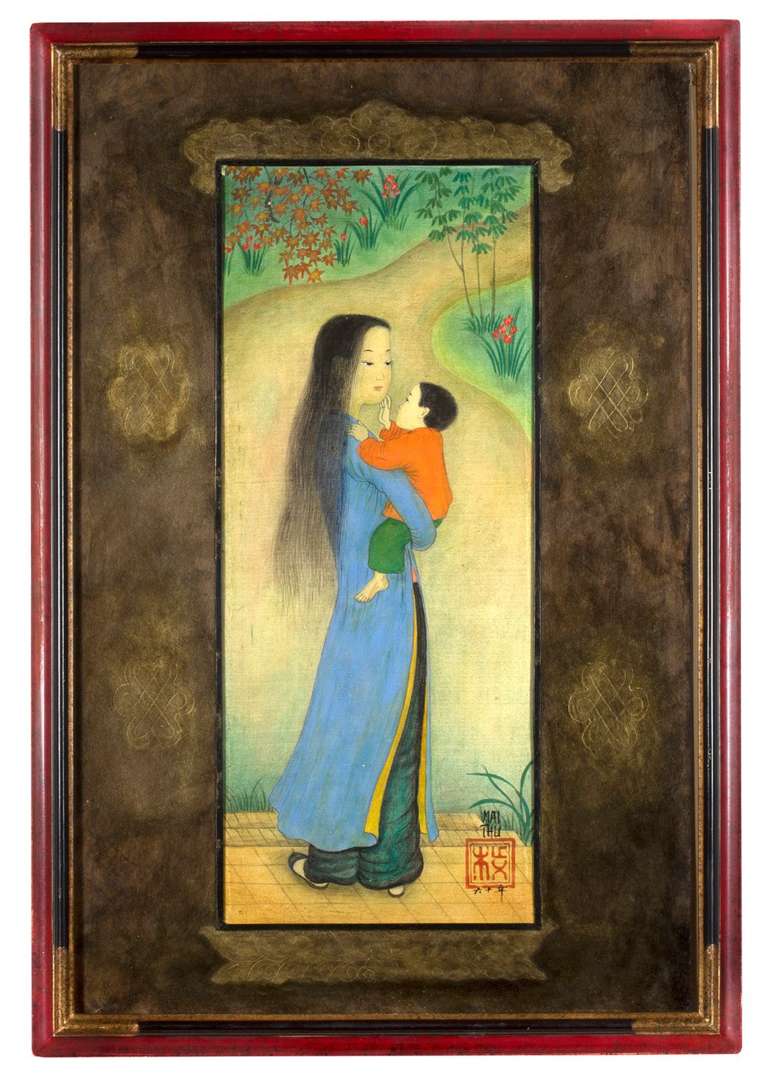
Young woman and child in a landscape, 1960
Ink and colours on silk, signed and dated lower right, in the original frame made by the artist
44.5 x 19.5 cm - 17 1/2 x 7 5/8 in.
A certificate of inclusion in the artist's catalogue raisonné currently being prepared by Charlotte Aguttes-Reynier will be given to the buyer
A certificate of authenticity written by the Galerie Anne Apesteguy dated 21 July 2000 will be given to the buyer
PROVENANCE
Apesteguy Gallery, Deauville
Private collection, France
Painter of intimacy, Mai Trung Thu excels in the representation of the family bond. Siblings or mother and child, the Vietnamese models are magnificently captured by the artist's skillful brush. Young woman and child in a landscape illustrates Mai Trung Thu's ability to capture maternal tenderness. The young woman is shown in a three-quarter view holding a small boy whose hand caresses the mother's face. The tenderness is visible through the gestures of the characters and can also be read in the affectionate look shared. If the Western influence is felt through the choice of an open perspective, the essential figurative elements of this composition borrow from the artist's native culture: the characters wear traditional dress in an Asian vegetation. The long silhouettes, the palette made of primary colors but also the format are characteristic of the works of the artist forging his unique style. Anxious to offer a work of art in its entirety, Mai Trung Thu attaches great importance to the realization of the framing which he often does himself as in this work. A craftsman and artist proud of his country, he fully masters the precepts of his teaching, which he has been able to surpass to pay tribute to the families of his country.
Họa sĩ của sự thân mật, Mai Trung Thứ xuất sắc trong thể hiện liên kết trong gia đình. Anh chị em hoặc mẹ và con, các nhân vật Việt Nam được tạo hình đẹp bởi bút vẽ khéo léo của họa sĩ. Phụ nữ trẻ và con cái đứng trước một khung cảnh thể hiện năng lực của Mai Trung Thứ trong nắm bắt sự dịu dàng của người mẹ. Thân hình người phụ nữ trẻ được hiện ra ba phần tư và giữ trong vòng tay một cậu bé với bàn tay vuốt ve khuôn mặt của mẹ. Sự dịu dàng có thể nhìn thấy thông qua cử chỉ của các nhân vật và cũng có thể đọc trong cái nhìn tình cảm được chia sẻ. Nếu như ảnh hưởng của phương Tây được cảm nhận thông qua sự lựa chọn của một cảnh quan mở, các yếu tố tượng hình thiết của cục này mượn từ văn hóa bản địa của họa sĩ: các nhân vật mang trang phục truyền thống trong thảm thực vật chatu Á. Các bóng hình thon dài, bảng màu với các màu chính cũng như kích thước là đặc trưng của các tác phẩm của họa sĩ, rèn luyện nên phong cách độc đáo của ông. Mai Trung Thứ chú trọng cung cấp một tác phẩm nghệ thuật trọn vẹn nên ông dành thời gian để làm khung cho tranh và ông thường tự mình làm việc này. Nghệ nhân và họa sĩ tự hào về đất nước, ông hoàn toàn nắm bắt những giới luật của việc học mà ông đã vượt qua để vinh danh hình ảnh gia đình của đất nước mình.
MAI TRUNG THỨ
Born in 1906 near Haïphong, Mai Trung Thu attended the French high school in Hanoi. Like Le Pho, Vu Cao Dam and Le Van De, he was part of the first class of the Indochina School of Fine Arts, founded and directed by the painter Victor Tardieu. Invited to participate in the 1931 Colonial Exhibition, Mai Thu discovered France. Falling under its spell, he settled there at the end of the 1930s and remained there until the end of his life. Although he was strongly influenced by the artistic education he received from Tardieu and Joseph Inguimberty, he was the one of his comrades who retained the deepest Vietnamese identity. Mai Thu devoted himself to gouache or ink on silk, typically Asian processes that allowed him to develop an art rich in reminiscence of traditional Chinese and Vietnamese art. An independent artist, he remains no less committed and concerned about the future of his country.
Sinh năm 1906 gần Hải Phòng, Mai Trung Thứ học trường trung học Pháp ở Hà Nội. Giống như Lê Phổ, Vũ Cao Đàm hay Lê Văn Đệ, ông thuộc về khóa đầu tiên của trường Mỹ thuật Đông Dương, do họa sĩ Victor Tardieu sáng lập và làm giam đốc. Được mời tham gia Triển lãm thuộc địa năm 1931, Mai Thứ khám phá nước Pháp. Bị mê hoặc, ông định cư vào năm 1937 và ở cho đến cuối cuộc đời của ông. Mặc dù được in dấu mạnh mẽ bởi sự dạy dỗ về mỹ thuật mà ông nhận được từ Tardieu và Joseph Inguimberty, ông là một trong số những người họa sĩ bạn trong khóa giữ bản sắc Việt Nam sâu sắc nhất. Mai Thứ dành hết tâm huyết cho bột màu hoặc mực in trên lụa, kỹ thuật đặc trưng của châu Á, cho phép ông phát triển một nghệ thuật thuật giàu sự gợi nhớ về mỹ thuật thống Trung Quốc và Việt Nam. Là một họa sĩ độc lập, ông
Young woman and child in a landscape, 1960
Ink and colours on silk, signed and dated lower right, in the original frame made by the artist
44.5 x 19.5 cm - 17 1/2 x 7 5/8 in.
A certificate of inclusion in the artist's catalogue raisonné currently being prepared by Charlotte Aguttes-Reynier will be given to the buyer
A certificate of authenticity written by the Galerie Anne Apesteguy dated 21 July 2000 will be given to the buyer
PROVENANCE
Apesteguy Gallery, Deauville
Private collection, France
Painter of intimacy, Mai Trung Thu excels in the representation of the family bond. Siblings or mother and child, the Vietnamese models are magnificently captured by the artist's skillful brush. Young woman and child in a landscape illustrates Mai Trung Thu's ability to capture maternal tenderness. The young woman is shown in a three-quarter view holding a small boy whose hand caresses the mother's face. The tenderness is visible through the gestures of the characters and can also be read in the affectionate look shared. If the Western influence is felt through the choice of an open perspective, the essential figurative elements of this composition borrow from the artist's native culture: the characters wear traditional dress in an Asian vegetation. The long silhouettes, the palette made of primary colors but also the format are characteristic of the works of the artist forging his unique style. Anxious to offer a work of art in its entirety, Mai Trung Thu attaches great importance to the realization of the framing which he often does himself as in this work. A craftsman and artist proud of his country, he fully masters the precepts of his teaching, which he has been able to surpass to pay tribute to the families of his country.
Họa sĩ của sự thân mật, Mai Trung Thứ xuất sắc trong thể hiện liên kết trong gia đình. Anh chị em hoặc mẹ và con, các nhân vật Việt Nam được tạo hình đẹp bởi bút vẽ khéo léo của họa sĩ. Phụ nữ trẻ và con cái đứng trước một khung cảnh thể hiện năng lực của Mai Trung Thứ trong nắm bắt sự dịu dàng của người mẹ. Thân hình người phụ nữ trẻ được hiện ra ba phần tư và giữ trong vòng tay một cậu bé với bàn tay vuốt ve khuôn mặt của mẹ. Sự dịu dàng có thể nhìn thấy thông qua cử chỉ của các nhân vật và cũng có thể đọc trong cái nhìn tình cảm được chia sẻ. Nếu như ảnh hưởng của phương Tây được cảm nhận thông qua sự lựa chọn của một cảnh quan mở, các yếu tố tượng hình thiết của cục này mượn từ văn hóa bản địa của họa sĩ: các nhân vật mang trang phục truyền thống trong thảm thực vật chatu Á. Các bóng hình thon dài, bảng màu với các màu chính cũng như kích thước là đặc trưng của các tác phẩm của họa sĩ, rèn luyện nên phong cách độc đáo của ông. Mai Trung Thứ chú trọng cung cấp một tác phẩm nghệ thuật trọn vẹn nên ông dành thời gian để làm khung cho tranh và ông thường tự mình làm việc này. Nghệ nhân và họa sĩ tự hào về đất nước, ông hoàn toàn nắm bắt những giới luật của việc học mà ông đã vượt qua để vinh danh hình ảnh gia đình của đất nước mình.
MAI TRUNG THỨ
Born in 1906 near Haïphong, Mai Trung Thu attended the French high school in Hanoi. Like Le Pho, Vu Cao Dam and Le Van De, he was part of the first class of the Indochina School of Fine Arts, founded and directed by the painter Victor Tardieu. Invited to participate in the 1931 Colonial Exhibition, Mai Thu discovered France. Falling under its spell, he settled there at the end of the 1930s and remained there until the end of his life. Although he was strongly influenced by the artistic education he received from Tardieu and Joseph Inguimberty, he was the one of his comrades who retained the deepest Vietnamese identity. Mai Thu devoted himself to gouache or ink on silk, typically Asian processes that allowed him to develop an art rich in reminiscence of traditional Chinese and Vietnamese art. An independent artist, he remains no less committed and concerned about the future of his country.
Sinh năm 1906 gần Hải Phòng, Mai Trung Thứ học trường trung học Pháp ở Hà Nội. Giống như Lê Phổ, Vũ Cao Đàm hay Lê Văn Đệ, ông thuộc về khóa đầu tiên của trường Mỹ thuật Đông Dương, do họa sĩ Victor Tardieu sáng lập và làm giam đốc. Được mời tham gia Triển lãm thuộc địa năm 1931, Mai Thứ khám phá nước Pháp. Bị mê hoặc, ông định cư vào năm 1937 và ở cho đến cuối cuộc đời của ông. Mặc dù được in dấu mạnh mẽ bởi sự dạy dỗ về mỹ thuật mà ông nhận được từ Tardieu và Joseph Inguimberty, ông là một trong số những người họa sĩ bạn trong khóa giữ bản sắc Việt Nam sâu sắc nhất. Mai Thứ dành hết tâm huyết cho bột màu hoặc mực in trên lụa, kỹ thuật đặc trưng của châu Á, cho phép ông phát triển một nghệ thuật thuật giàu sự gợi nhớ về mỹ thuật thống Trung Quốc và Việt Nam. Là một họa sĩ độc lập, ông