
&w=3840&q=75)
&w=3840&q=75)
&w=3840&q=75)
&w=3840&q=75)
&w=3840&q=75)
&w=3840&q=75)
&w=3840&q=75)
&w=3840&q=75)


104
JAPON PÉRIODE EDO, FIN XVIIE - XVIIIE SIÈCLE
The item was sold for 9 750 €
Fees include commission and taxes.
JAPON PÉRIODE EDO, FIN XVIIE - XVIIIE SIÈCLE
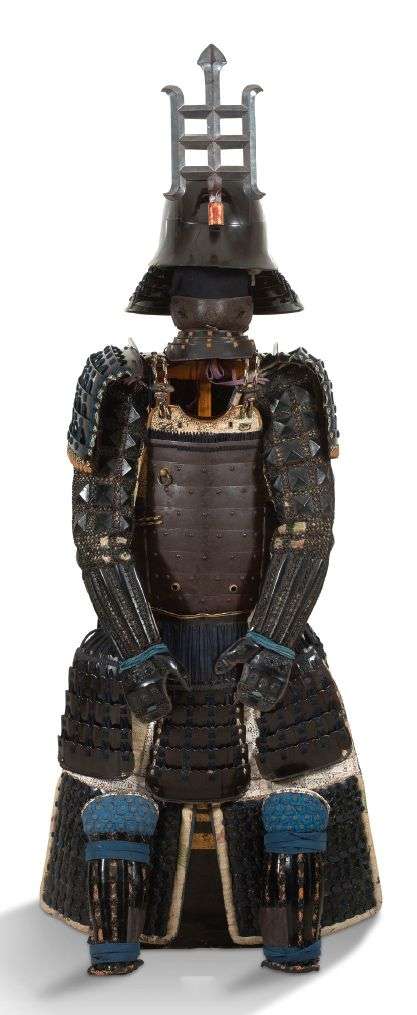
Armour of the hatomune roku-dô gusoku type, comprising :
- a black lacquered hineno-zunari-kabuto type helmet, with spear-shaped maedate, with black lacquered straight four-lamellar shikoro, joined in blue kebiki-odoshi|
- The hoate chinrest in natural iron, gilded on the reverse, decorated with a mon, with yodarekake of straight lamellae|
- the hatomune-dô type iron cuirass, in two parts articulated on three elements, with straight horizontal plates, with a seven-sided kusazuri skirt, six of which have five iyozane strips laced with blue sugake-odoshi, one with straight strips|
- The shoulder pads sode with five straight lamellae lacquered in black and joined in blue sugake-odoshi|
- The shino-gote type sleeves made of chainmail with diamond tips|
- The haidate, made of small black lacquered plates, decorated with repetitive floral motifs|
- The shino-suneate type leggings.
With a black lacquered chest decorated with a gold lacquered mon.
Total height on mannequin : 141 cm
JAPANESE ARMOR Japanese armor is unique in its kind, and it is the reflection of a unique culture, the only one to have flourished under the domination of a class of warriors over such a long period of time, nearly seven centuries, of which the first four founded the last three.
Now the armor, in its evolution, tells that of Japan.
Thus, from its beginnings, around the 4th-5th century, to the beginning of the 17th century, the structure of Japanese armor is linked to essentially practical considerations of use in wartime. Its evolution, in several stages, follows that of the weapons used, first the bow, then the sword, and finally firearms, gradually modifying the techniques of combat and therefore of protection.
From the XVIIth century until the middle of the
19th century, with the centralized and authoritarian feudal regime established by the Tokugawa shogun of the Edo period, armors continue to be made, but now much more according to aesthetic and prestige considerations than to practical ones, with notably a taste for the past initiating the resumption of ancient models.
For the neophyte, two Japanese armors can, at first sight, seem similar.
This is undoubtedly the case with the two suits of armour we are presenting. At first glance, the only difference that jumps out is their maedate, the frontal element that decorates the helmet.
This was the purpose of these maedate, sometimes exuberant, just like some helmets, allowing the quick identification of those who wore them. But a closer look at the elements that make up the armor shows that despite a similar structure, they can be very different. This is the case of our two armours, whose title gives some clues: the tatehagi roku-dô, a six-part articulated armour, made of vertical plates| the hatomune roku-dô, also in six parts, but inspired by the Spanish braces of the 16th century. There are also differences in the types of masks, in the plates that make up the shoulder pads, gorgerin, skirt| in the way they are laced together| in the sleeves and leggings. For each type, for each shade, a specific term, allowing a very precise description, although not always easy to master, but significant of the richness of this unique ornament that is the Japanese armor.
THE JAPANESE ARMOUR The Japanese armour is unique in its kind and reflects a unique culture, the only one to have flourished under the domination of a class of warriors over such a long period of time, nearly seven centuries, of which the first four founded the last three. And the armour, in its evolution, tells the story of Japan.
From its beginnings around the 4th-5th century, to the early 17th century, the Japanese armour is first structured under practical considerations, for its use in wardtimes. Its evolution in several stages follows that of the weapons used, first of all the bow then the sword and at last firearms, all of them gradually modifying the techniques in the art of fighting and therefore protection.
From the 17th century until the middle of the 19th century, with the centralised and authoritarian feudal regime established by the Tokugawa shogun of the Edo period, armours continue to be manufactured, but now much more according to considerations on aesthetic and prestige, including a taste for the past which initiated the resurgence of ancient models. From the layman's point of view, two Japanese armours could appear as similar, and this is probably the case with those we present. At first sight, the only di
Armour of the hatomune roku-dô gusoku type, comprising :
- a black lacquered hineno-zunari-kabuto type helmet, with spear-shaped maedate, with black lacquered straight four-lamellar shikoro, joined in blue kebiki-odoshi|
- The hoate chinrest in natural iron, gilded on the reverse, decorated with a mon, with yodarekake of straight lamellae|
- the hatomune-dô type iron cuirass, in two parts articulated on three elements, with straight horizontal plates, with a seven-sided kusazuri skirt, six of which have five iyozane strips laced with blue sugake-odoshi, one with straight strips|
- The shoulder pads sode with five straight lamellae lacquered in black and joined in blue sugake-odoshi|
- The shino-gote type sleeves made of chainmail with diamond tips|
- The haidate, made of small black lacquered plates, decorated with repetitive floral motifs|
- The shino-suneate type leggings.
With a black lacquered chest decorated with a gold lacquered mon.
Total height on mannequin : 141 cm
JAPANESE ARMOR Japanese armor is unique in its kind, and it is the reflection of a unique culture, the only one to have flourished under the domination of a class of warriors over such a long period of time, nearly seven centuries, of which the first four founded the last three.
Now the armor, in its evolution, tells that of Japan.
Thus, from its beginnings, around the 4th-5th century, to the beginning of the 17th century, the structure of Japanese armor is linked to essentially practical considerations of use in wartime. Its evolution, in several stages, follows that of the weapons used, first the bow, then the sword, and finally firearms, gradually modifying the techniques of combat and therefore of protection.
From the XVIIth century until the middle of the
19th century, with the centralized and authoritarian feudal regime established by the Tokugawa shogun of the Edo period, armors continue to be made, but now much more according to aesthetic and prestige considerations than to practical ones, with notably a taste for the past initiating the resumption of ancient models.
For the neophyte, two Japanese armors can, at first sight, seem similar.
This is undoubtedly the case with the two suits of armour we are presenting. At first glance, the only difference that jumps out is their maedate, the frontal element that decorates the helmet.
This was the purpose of these maedate, sometimes exuberant, just like some helmets, allowing the quick identification of those who wore them. But a closer look at the elements that make up the armor shows that despite a similar structure, they can be very different. This is the case of our two armours, whose title gives some clues: the tatehagi roku-dô, a six-part articulated armour, made of vertical plates| the hatomune roku-dô, also in six parts, but inspired by the Spanish braces of the 16th century. There are also differences in the types of masks, in the plates that make up the shoulder pads, gorgerin, skirt| in the way they are laced together| in the sleeves and leggings. For each type, for each shade, a specific term, allowing a very precise description, although not always easy to master, but significant of the richness of this unique ornament that is the Japanese armor.
THE JAPANESE ARMOUR The Japanese armour is unique in its kind and reflects a unique culture, the only one to have flourished under the domination of a class of warriors over such a long period of time, nearly seven centuries, of which the first four founded the last three. And the armour, in its evolution, tells the story of Japan.
From its beginnings around the 4th-5th century, to the early 17th century, the Japanese armour is first structured under practical considerations, for its use in wardtimes. Its evolution in several stages follows that of the weapons used, first of all the bow then the sword and at last firearms, all of them gradually modifying the techniques in the art of fighting and therefore protection.
From the 17th century until the middle of the 19th century, with the centralised and authoritarian feudal regime established by the Tokugawa shogun of the Edo period, armours continue to be manufactured, but now much more according to considerations on aesthetic and prestige, including a taste for the past which initiated the resurgence of ancient models. From the layman's point of view, two Japanese armours could appear as similar, and this is probably the case with those we present. At first sight, the only di