
&w=3840&q=75)
&w=3840&q=75)
&w=3840&q=75)
&w=3840&q=75)
&w=3840&q=75)
&w=3840&q=75)
&w=3840&q=75)
&w=3840&q=75)


13
Albert Marquet (1875-1947)
The item was sold for 58 500 €
Fees include commission and taxes.
Albert Marquet (1875-1947)
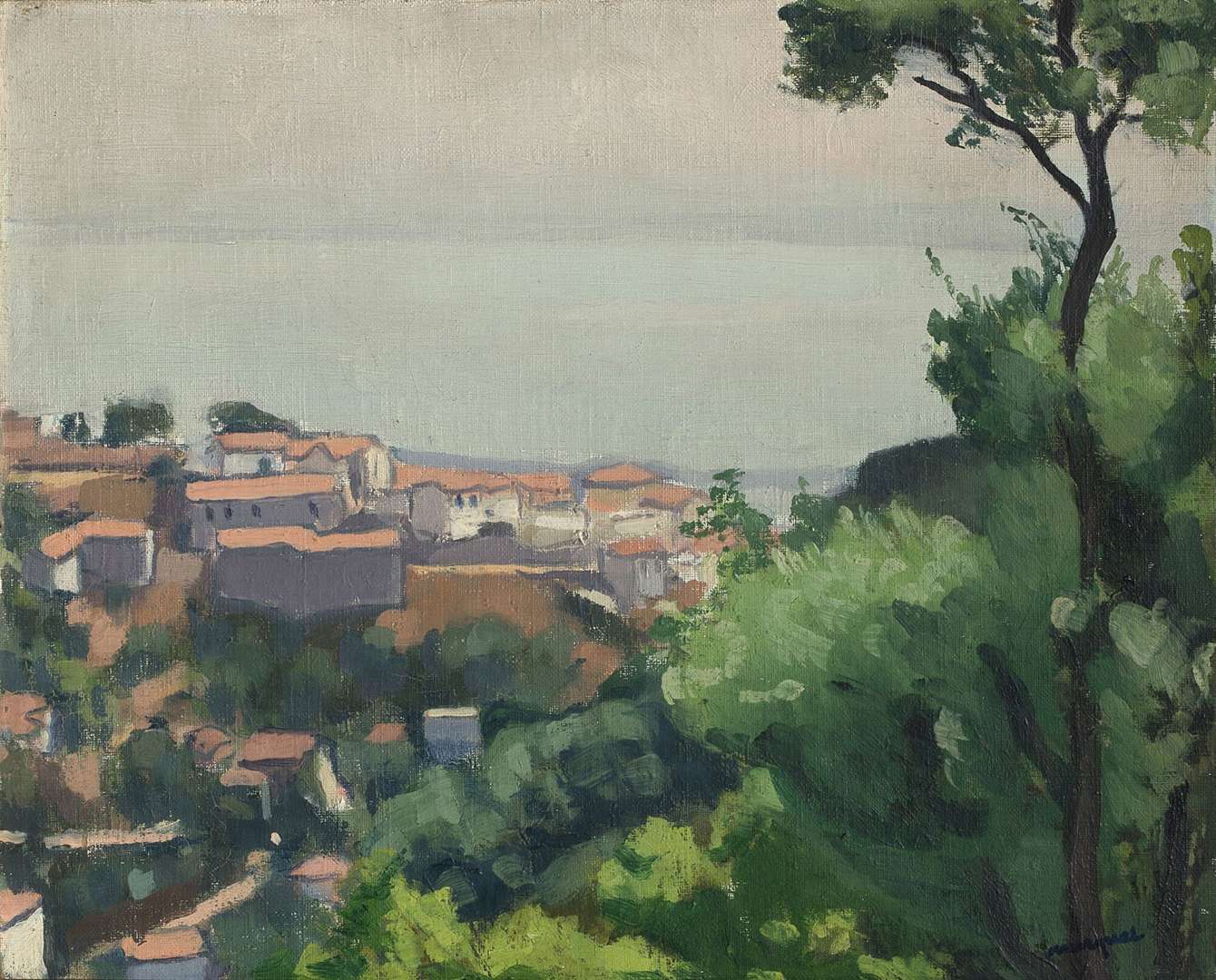
Mustapha Superior, 1924
Oil on canvas mounted on cardboard, signed lower right
32.5 x 40.5 cm
12 3/4 x 16 in.
A certificate written by Marcelle Marquet dated 13 January 1968 will be given to the buyer.
PROVENANCE
Galerie Druet (acquired from the artist on 24 June 1924)
René Dreyfus, 7 March 1924 (acquired from the previous owner)
Galerie Druet, October 10, 1930
Private collection, Ile-de-France
BIBLIOGRAPHY
Jean-Claude Martinet & Guy Wildenstein, Marquet, L'Afrique du Nord, Catalogue de l'oeuvre peint, Skira Seuil, Wildenstein Institute, Paris, 2001, n° I-88, p.132
ALBERT MARQUET
Born in 1875 in Bordeaux, Albert Marquet was a French painter from a modest family. He was attracted to drawing from an early age, and entered the Ecole Nationale des Arts Décoratifs in Paris in 1892. It was there that he met Henri Matisse, who took him under his wing and with whom he became friends. Shortly afterwards, the two artists returned to the Beaux-arts in Paris and frequented Gustave Moreau's studio. Gustave Moreau encouraged him to visit museums to learn how to observe and copy the old masters. In this establishment, he met the artists Charles Camoin and Henri Manguin who remained his companions throughout his life. His classical training did not exclude a keen interest in the Impressionists. Their way of representing and studying landscapes or treating light fascinated and inspired him deeply. Throughout his career, the study of landscapes remained his favourite subject, however, he distanced himself from the artistic techniques of the latter. The 1905 Salon d'Automne was a turning point in his career, where he exhibited with the group of artists that would soon be called the "Fauvists", led by Matisse. An independent and creative artist, he gradually moved away from them to build his own style. From Fauvism, he kept the pure colours, the simplified forms and the synthesis of the composition. Other influences also came to build the painter's singular artistic identity, such as Japonism, or even Symbolism. Marquet is attached to represent the essential, he seeks the harmony of the perfect balance. During his career, the painter made many trips. Algiers, Normandy, Norway... so many destinations which formed the eye of Marquet. This one is attached to represent the landscapes which he crossed. His talent is definitely recognized. He knew a certain success during his life, and exhibited in several places in Europe and outside. The artist died in 1947 in Paris. Mustapha Supérieur is characteristic of Marquet's work. Evoking the mildness of the Mediterranean climate in winter, the artist puts on canvas his particular sensitivity for a country in which he chose to spend his winters. The broad flat tints and simplification of the forms bring a quietude characteristic of Marquet's work. The bird's eye view of the village, which is now a district of Algiers, offers a remarkable glimpse of the immensity of the bay and the sea merging with the sky. The fauvist heritage is found sparingly in a skillfully contrasted palette. The green tones are juxtaposed with the softness of the ochre roofs. This vision of tranquillity evokes the famous lines of the poet Charles Baudelaire: "There, all is order and beauty, luxury, calm and pleasure".
"There, all is order and beauty, luxury, calm and pleasure
Charles Baudelaire
Mustapha Superior, 1924
Oil on canvas mounted on cardboard, signed lower right
32.5 x 40.5 cm
12 3/4 x 16 in.
A certificate written by Marcelle Marquet dated 13 January 1968 will be given to the buyer.
PROVENANCE
Galerie Druet (acquired from the artist on 24 June 1924)
René Dreyfus, 7 March 1924 (acquired from the previous owner)
Galerie Druet, October 10, 1930
Private collection, Ile-de-France
BIBLIOGRAPHY
Jean-Claude Martinet & Guy Wildenstein, Marquet, L'Afrique du Nord, Catalogue de l'oeuvre peint, Skira Seuil, Wildenstein Institute, Paris, 2001, n° I-88, p.132
ALBERT MARQUET
Born in 1875 in Bordeaux, Albert Marquet was a French painter from a modest family. He was attracted to drawing from an early age, and entered the Ecole Nationale des Arts Décoratifs in Paris in 1892. It was there that he met Henri Matisse, who took him under his wing and with whom he became friends. Shortly afterwards, the two artists returned to the Beaux-arts in Paris and frequented Gustave Moreau's studio. Gustave Moreau encouraged him to visit museums to learn how to observe and copy the old masters. In this establishment, he met the artists Charles Camoin and Henri Manguin who remained his companions throughout his life. His classical training did not exclude a keen interest in the Impressionists. Their way of representing and studying landscapes or treating light fascinated and inspired him deeply. Throughout his career, the study of landscapes remained his favourite subject, however, he distanced himself from the artistic techniques of the latter. The 1905 Salon d'Automne was a turning point in his career, where he exhibited with the group of artists that would soon be called the "Fauvists", led by Matisse. An independent and creative artist, he gradually moved away from them to build his own style. From Fauvism, he kept the pure colours, the simplified forms and the synthesis of the composition. Other influences also came to build the painter's singular artistic identity, such as Japonism, or even Symbolism. Marquet is attached to represent the essential, he seeks the harmony of the perfect balance. During his career, the painter made many trips. Algiers, Normandy, Norway... so many destinations which formed the eye of Marquet. This one is attached to represent the landscapes which he crossed. His talent is definitely recognized. He knew a certain success during his life, and exhibited in several places in Europe and outside. The artist died in 1947 in Paris. Mustapha Supérieur is characteristic of Marquet's work. Evoking the mildness of the Mediterranean climate in winter, the artist puts on canvas his particular sensitivity for a country in which he chose to spend his winters. The broad flat tints and simplification of the forms bring a quietude characteristic of Marquet's work. The bird's eye view of the village, which is now a district of Algiers, offers a remarkable glimpse of the immensity of the bay and the sea merging with the sky. The fauvist heritage is found sparingly in a skillfully contrasted palette. The green tones are juxtaposed with the softness of the ochre roofs. This vision of tranquillity evokes the famous lines of the poet Charles Baudelaire: "There, all is order and beauty, luxury, calm and pleasure".
"There, all is order and beauty, luxury, calm and pleasure
Charles Baudelaire