
&w=3840&q=75)
&w=3840&q=75)
&w=3840&q=75)
&w=3840&q=75)
&w=3840&q=75)
&w=3840&q=75)
&w=3840&q=75)
&w=3840&q=75)


11
Camille CLAUDEL (1864-1943)
The item was sold for 10 400 €
Fees include commission and taxes.
Camille CLAUDEL (1864-1943)
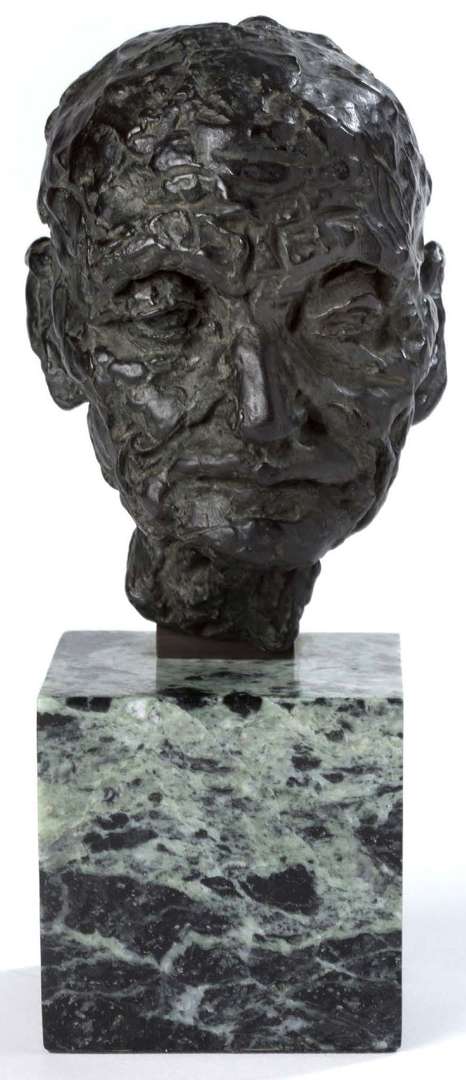
Head of an old man without a bust, study for L'Âge mûr, circa 1894-1996
Bronze, signed on the neck lower left, numbered 7/8, marked with the Coubertin foundry stamp and dated on the back of the neck
12 x 10 x 11.5 cm
4 3/4 x 3 7/8 x 4 1/2 in.
A certificate of authenticity n° 001892 written by Mrs Reine-Marie Paris, niece of the artist, dated September 15, 1996 will be given to the buyer.
The work will be included in the Catalogue critique de l'oeuvre de Camille Claudel currently in preparation at the Galerie Malaquais by the Comité Camille Claudel, under the direction of Eve Turbat, with the number 2021-0318B.
PROVENANCE
Private collection, Lyon
BIBLIOGRAPHY
Reine-Marie Paris, Camille Claudel, re-trouvé, new revised and completed edition, Editions Aittouarès, Paris, 2000, quoted p.337
Reine-Marie Paris, Philippe Cressent, Camille Claudel, Catalogue raisonné, 5th revised, corrected and enlarged edition, Culture Economica, Paris, 2019, n°95-3, quoted p. 594
CAMILLE CLAUDEL
Long unjustly overshadowed by Auguste Rodin, Camille Claudel nevertheless appears as one of the most talented and daring sculptors of the late 19th century. Strengthened by the precepts taught by her former master Rodin but also avant-garde, her sculpture, initially in the wake of her mentor, later adopted a style at the beginning of Art Nouveau. His Head of an Old Man, Study for the Mature Age illustrates the maturity acquired by the artist. Produced more than a decade after his apprenticeship in Rodin's studio, this work has long been mistakenly considered a reworking of La Belle Heaulmière by the famous master. However, a very personal element can be read in this composition. Indeed, this head of an old man is a study of the head of a man in his mature years. An emblematic sculpture by Claudel, L'Âge mûr is an allegory of the love triangle formed by Camille Claudel, Rodin and Rose Beuret, the sculptor's companion. In the first version of 1895, the man is divided between old age, which supports him, and youth, which holds him by the hand, kneeling. In the second version of 1898, the break between the man and the youth is complete| he has dropped his hand, leaving it imploring. It is precisely from this version that the old man's head comes from. The drawn features, marked by age, Camille Claudel manages to work the bronze with an honest truth. The aging man is no longer sublimated but perceived in his sad reality. This sculpture also evokes destiny, the passing of time in the manner of a memento mori in a still life painting. Initially commissioned by Captain André Tissier in 1902, the rights to the print were then bought by his dealer and founder Eugène Blot in 1907. The eight posthumous bronzes made by the Coubertin foundry have made it possible to disseminate and rehabilitate the talent and personal involvement of Camille Claudel in her work.
"Camille Claudel comes to work in bronze with an honest truth. »
Head of an old man without a bust, study for L'Âge mûr, circa 1894-1996
Bronze, signed on the neck lower left, numbered 7/8, marked with the Coubertin foundry stamp and dated on the back of the neck
12 x 10 x 11.5 cm
4 3/4 x 3 7/8 x 4 1/2 in.
A certificate of authenticity n° 001892 written by Mrs Reine-Marie Paris, niece of the artist, dated September 15, 1996 will be given to the buyer.
The work will be included in the Catalogue critique de l'oeuvre de Camille Claudel currently in preparation at the Galerie Malaquais by the Comité Camille Claudel, under the direction of Eve Turbat, with the number 2021-0318B.
PROVENANCE
Private collection, Lyon
BIBLIOGRAPHY
Reine-Marie Paris, Camille Claudel, re-trouvé, new revised and completed edition, Editions Aittouarès, Paris, 2000, quoted p.337
Reine-Marie Paris, Philippe Cressent, Camille Claudel, Catalogue raisonné, 5th revised, corrected and enlarged edition, Culture Economica, Paris, 2019, n°95-3, quoted p. 594
CAMILLE CLAUDEL
Long unjustly overshadowed by Auguste Rodin, Camille Claudel nevertheless appears as one of the most talented and daring sculptors of the late 19th century. Strengthened by the precepts taught by her former master Rodin but also avant-garde, her sculpture, initially in the wake of her mentor, later adopted a style at the beginning of Art Nouveau. His Head of an Old Man, Study for the Mature Age illustrates the maturity acquired by the artist. Produced more than a decade after his apprenticeship in Rodin's studio, this work has long been mistakenly considered a reworking of La Belle Heaulmière by the famous master. However, a very personal element can be read in this composition. Indeed, this head of an old man is a study of the head of a man in his mature years. An emblematic sculpture by Claudel, L'Âge mûr is an allegory of the love triangle formed by Camille Claudel, Rodin and Rose Beuret, the sculptor's companion. In the first version of 1895, the man is divided between old age, which supports him, and youth, which holds him by the hand, kneeling. In the second version of 1898, the break between the man and the youth is complete| he has dropped his hand, leaving it imploring. It is precisely from this version that the old man's head comes from. The drawn features, marked by age, Camille Claudel manages to work the bronze with an honest truth. The aging man is no longer sublimated but perceived in his sad reality. This sculpture also evokes destiny, the passing of time in the manner of a memento mori in a still life painting. Initially commissioned by Captain André Tissier in 1902, the rights to the print were then bought by his dealer and founder Eugène Blot in 1907. The eight posthumous bronzes made by the Coubertin foundry have made it possible to disseminate and rehabilitate the talent and personal involvement of Camille Claudel in her work.
"Camille Claudel comes to work in bronze with an honest truth. »