
&w=3840&q=75)
&w=3840&q=75)
&w=3840&q=75)
&w=3840&q=75)
&w=3840&q=75)
&w=3840&q=75)
&w=3840&q=75)
&w=3840&q=75)


5
Giovanni BOLDINI (1842-1931)
The item was sold for 130 000 €
Fees include commission and taxes.
Giovanni BOLDINI (1842-1931)
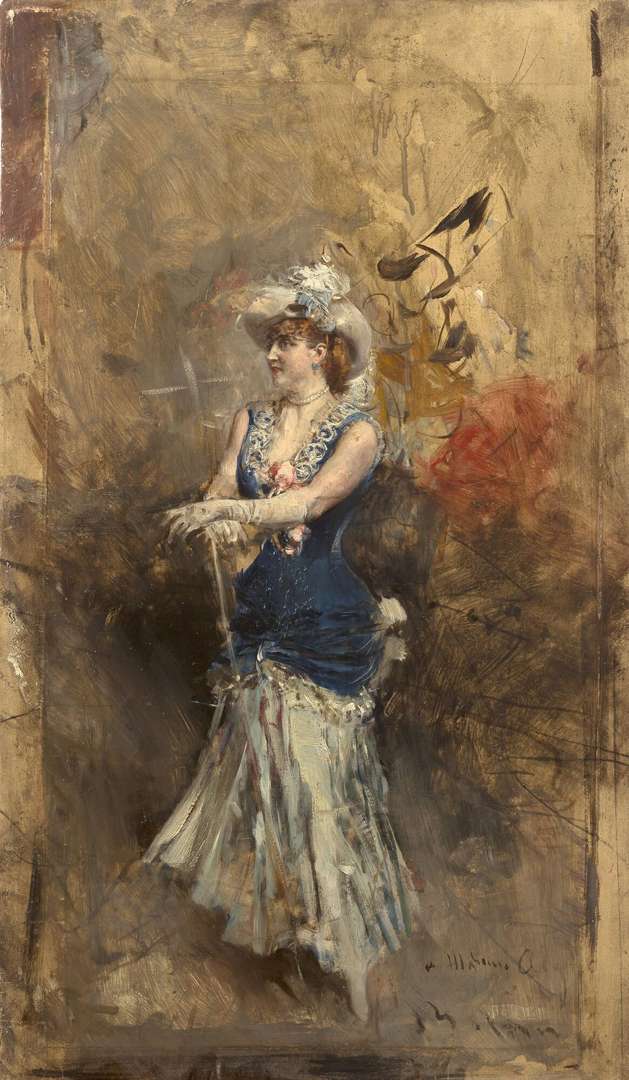
La Réjane on Stage, 1878-84
Oil on panel, signed and dedicated to "Madame Angèle" lower right
64,5 x 37,5 cm
25 3/8 x 14 3/4 in.
A certificate of authenticity numbered 002667 dated 26 September 2017 written by Dr Francesca Dini will be given to the buyer.
PROVENANCE
Albert Lambert, member of the Comédie Française
Private collection, France
Sale Rieunier & Associés, 3 December 2012
GIOVANNI BOLDINI
A socialite painter par excellence, Boldini excelled in the genre of portraiture from his early years in Tuscany. When he moved to London in 1871, his talent allowed him to portray the English aristocracy. Then he moved to Paris, seduced by the art of living in the French capital. From genre scenes to society portraits and capturing the movement of horse-drawn carriages, Boldini perfected his style. La Réjane sur scène is situated in a period of transition in the artist's artistic expression. Already the touch is freer and the spontaneity of the line makes the young woman all the more majestic. This sumptuousness is in keeping with Boldini's feelings for this model, Réjane. Gabrielle Charlotte Réju, whose stage name was Réjane, was a prominent actress and director of an eponymous theatre. If Boldini enjoyed depicting the actress captured in her intimacy in several works, he paints her here in her role as Madame Angèle from the comedy Les Dominos roses by Alfred Delacour and Hennequin. A farce about two wives determined to trick their husbands with costumes, Réjane plays with her charms and delights her audience in this vaudeville theatre. Thanks to his skill, Boldini depicts pretty details that contribute to the charm of the model while maintaining a great deal of freedom in his touch. Thus, the various impastos suggest more than they emphasize. The background, quickly brushed and full of movement, shows great modernity and sublimates the figure. The carefully studied palette is contrasted by pink and blue touches. In three-quarter view, aware of her great beauty, Boldini offers a precious testimony of an icon of the end of the 19th century to whom he dedicates this work.
"From three-quarters, aware of his great beauty, Boldini offers a precious testimony of an icon of the late nineteenth century to whom he dedicates this work"
La Réjane on Stage, 1878-84
Oil on panel, signed and dedicated to "Madame Angèle" lower right
64,5 x 37,5 cm
25 3/8 x 14 3/4 in.
A certificate of authenticity numbered 002667 dated 26 September 2017 written by Dr Francesca Dini will be given to the buyer.
PROVENANCE
Albert Lambert, member of the Comédie Française
Private collection, France
Sale Rieunier & Associés, 3 December 2012
GIOVANNI BOLDINI
A socialite painter par excellence, Boldini excelled in the genre of portraiture from his early years in Tuscany. When he moved to London in 1871, his talent allowed him to portray the English aristocracy. Then he moved to Paris, seduced by the art of living in the French capital. From genre scenes to society portraits and capturing the movement of horse-drawn carriages, Boldini perfected his style. La Réjane sur scène is situated in a period of transition in the artist's artistic expression. Already the touch is freer and the spontaneity of the line makes the young woman all the more majestic. This sumptuousness is in keeping with Boldini's feelings for this model, Réjane. Gabrielle Charlotte Réju, whose stage name was Réjane, was a prominent actress and director of an eponymous theatre. If Boldini enjoyed depicting the actress captured in her intimacy in several works, he paints her here in her role as Madame Angèle from the comedy Les Dominos roses by Alfred Delacour and Hennequin. A farce about two wives determined to trick their husbands with costumes, Réjane plays with her charms and delights her audience in this vaudeville theatre. Thanks to his skill, Boldini depicts pretty details that contribute to the charm of the model while maintaining a great deal of freedom in his touch. Thus, the various impastos suggest more than they emphasize. The background, quickly brushed and full of movement, shows great modernity and sublimates the figure. The carefully studied palette is contrasted by pink and blue touches. In three-quarter view, aware of her great beauty, Boldini offers a precious testimony of an icon of the end of the 19th century to whom he dedicates this work.
"From three-quarters, aware of his great beauty, Boldini offers a precious testimony of an icon of the late nineteenth century to whom he dedicates this work"