
&w=3840&q=75)
&w=3840&q=75)
&w=3840&q=75)
&w=3840&q=75)
&w=3840&q=75)
&w=3840&q=75)
&w=3840&q=75)
&w=3840&q=75)


90
Georges MATHIEU (1921-2012)
The item was sold for 25 350 €
Fees include commission and taxes.
Georges MATHIEU (1921-2012)
Captive complaint
Oil and mixed media on Arches paper, signed lower right and titled on the back
Oil and mixed media on paper, signed lower right
54.5 x 75 cm at view
21 1/2 x 29 1/2 in.
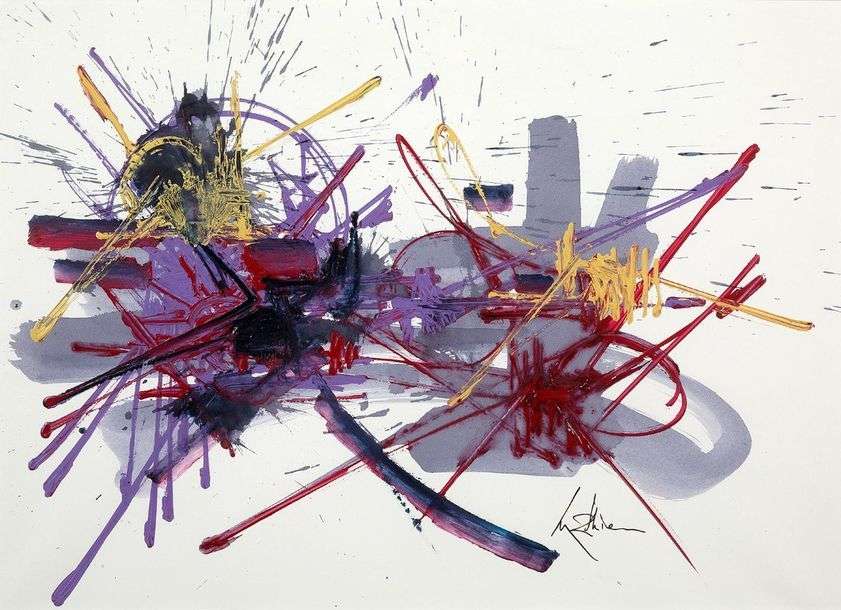
In Plainte captive, we find Georges Mathieu's extremely lively gestures in the rigid, impulsive lines and splashes of paint. Vibrant, frontal lines following very different trajectories emerge from horizontal planes, giving further energy to the construction. This opposition of lacerating signs creates a dramatic tension central to the painting. The traces also evoke the work of the Japanese calligraphers he admired so much. The spontaneity of the work contrasts with the light gouache strokes applied softly to the background. These give an illusion of depth and even volume by suggesting two planes: themselves as a background, with the lines in oil making up the foreground. The work presents a twofold opposition: firstly between the misty gouache background and the lacerating foreground, and secondly between the purple tones and their complementary yellows. The complementarity of colours further intensifies the emotion suggested, making these vibrant strokes surprisingly striking and painful. They are precisely the element that links the work to its title, with the piercing, poignant aspect of these lines and the forceful colours perfectly illustrating the "captive lament". The contrast between foreground and background even suggests acute imminent suffering against an undertone of constant melancholy
GEORGES MATHIEU
The French artist Georges Mathieu, born in 1921, first studied law before devoting himself entirely to fine arts in 1942. In the aftermath of the Second World War, Europe was rebuilding itself and art underwent a complete transformation. In 1947, the art critic Jean José Marchand described Georges Mathieu's paintings by evoking the concept of "lyrical abstraction" for the first time. This was because the artist oppose
Captive complaint
Oil and mixed media on Arches paper, signed lower right and titled on the back
Oil and mixed media on paper, signed lower right
54.5 x 75 cm at view
21 1/2 x 29 1/2 in.
In Plainte captive, we find Georges Mathieu's extremely lively gestures in the rigid, impulsive lines and splashes of paint. Vibrant, frontal lines following very different trajectories emerge from horizontal planes, giving further energy to the construction. This opposition of lacerating signs creates a dramatic tension central to the painting. The traces also evoke the work of the Japanese calligraphers he admired so much. The spontaneity of the work contrasts with the light gouache strokes applied softly to the background. These give an illusion of depth and even volume by suggesting two planes: themselves as a background, with the lines in oil making up the foreground. The work presents a twofold opposition: firstly between the misty gouache background and the lacerating foreground, and secondly between the purple tones and their complementary yellows. The complementarity of colours further intensifies the emotion suggested, making these vibrant strokes surprisingly striking and painful. They are precisely the element that links the work to its title, with the piercing, poignant aspect of these lines and the forceful colours perfectly illustrating the "captive lament". The contrast between foreground and background even suggests acute imminent suffering against an undertone of constant melancholy
GEORGES MATHIEU
The French artist Georges Mathieu, born in 1921, first studied law before devoting himself entirely to fine arts in 1942. In the aftermath of the Second World War, Europe was rebuilding itself and art underwent a complete transformation. In 1947, the art critic Jean José Marchand described Georges Mathieu's paintings by evoking the concept of "lyrical abstraction" for the first time. This was because the artist oppose