
&w=3840&q=75)
&w=3840&q=75)
&w=3840&q=75)
&w=3840&q=75)
&w=3840&q=75)
&w=3840&q=75)


239
SCHUMANN ROBERT (1810-1856)
The item was sold for 5 850 €
Fees include commission and taxes.
SCHUMANN ROBERT (1810-1856)
L.A.S., Dresde 30 avril 1849, à l'éditeur musical Friedrich
KISTNER| 4 pages in-8
Importante lettre sur la publication de son cycle Spanisches
Liederspiel op. 74.
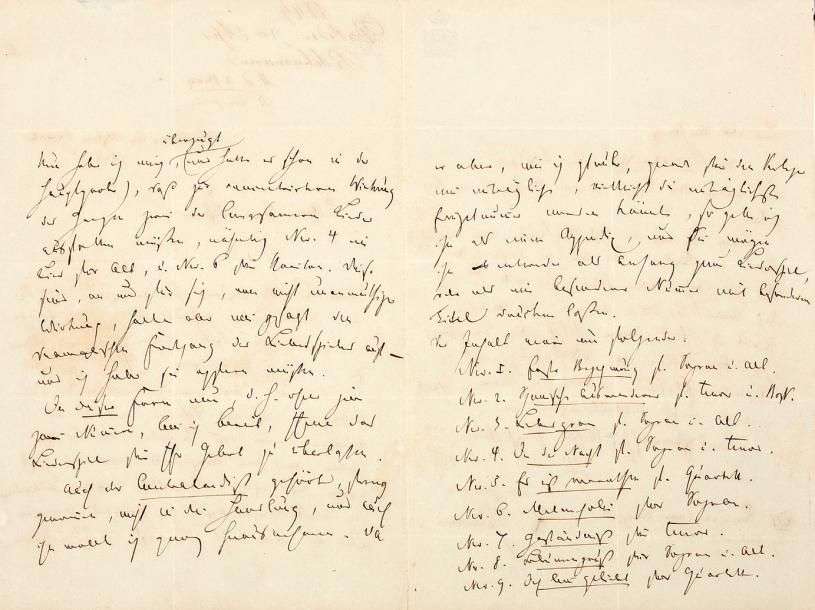
Entre le 24 et le 28 mars 1849, Schumann compose le cycle du Spanisches Liederspiel op. 74, comprenant 3 lieder, 5 duos et 2 quatuors, sur des poèmes d'Emanuel Geibel, inspirés de chants populaires espagnols. The pièces sont interprétées for the premiere fois le 29 avril 1849, avec son épouse Clara au piano. Se pose maintenant la question de la publication de l'oeuvre. Schumann pense que pour maintenir la progression dramatique, il est préférable de supprimer deux pièces. Il liste précisément le contenu de l'édition qu'il souhaite... "If you had been here yesterday, you would have heard my song playing: they sang it very charmingly, and my wife sang it on the
piano. It was a pleasure.
I think we can work something out about the publisher. For the whole thing, as you know it, the commandment that you made to me, according to the scale in which my singing things are now paid to me, would, however, have been a proportionally too small, and I could not have gone into it.
Now I have convinced myself (and already had it in the main rehearsal) that for the concentrated effect of the whole two of the slow songs must fail, namely No. 4 a song for alto, and No. 6 for
baritone. These are, in and of themselves, not undesirable effects, but as I said they stop the dramatic progress of the song play - and I had to sacrifice them.
In this form now, i.e. without the two numbers, I am ready to leave the song play to you for your bid.
Strictly speaking, the contrabandist does not belong in the
plot either, and I also wanted to take him out completely. But since it could, I believe, become a lucrative, perhaps the most lucrative single number for the publisher in particular, I give it as an appendix, and you may have it printed either as the beginning of the
L.A.S., Dresde 30 avril 1849, à l'éditeur musical Friedrich
KISTNER| 4 pages in-8
Importante lettre sur la publication de son cycle Spanisches
Liederspiel op. 74.
Entre le 24 et le 28 mars 1849, Schumann compose le cycle du Spanisches Liederspiel op. 74, comprenant 3 lieder, 5 duos et 2 quatuors, sur des poèmes d'Emanuel Geibel, inspirés de chants populaires espagnols. The pièces sont interprétées for the premiere fois le 29 avril 1849, avec son épouse Clara au piano. Se pose maintenant la question de la publication de l'oeuvre. Schumann pense que pour maintenir la progression dramatique, il est préférable de supprimer deux pièces. Il liste précisément le contenu de l'édition qu'il souhaite... "If you had been here yesterday, you would have heard my song playing: they sang it very charmingly, and my wife sang it on the
piano. It was a pleasure.
I think we can work something out about the publisher. For the whole thing, as you know it, the commandment that you made to me, according to the scale in which my singing things are now paid to me, would, however, have been a proportionally too small, and I could not have gone into it.
Now I have convinced myself (and already had it in the main rehearsal) that for the concentrated effect of the whole two of the slow songs must fail, namely No. 4 a song for alto, and No. 6 for
baritone. These are, in and of themselves, not undesirable effects, but as I said they stop the dramatic progress of the song play - and I had to sacrifice them.
In this form now, i.e. without the two numbers, I am ready to leave the song play to you for your bid.
Strictly speaking, the contrabandist does not belong in the
plot either, and I also wanted to take him out completely. But since it could, I believe, become a lucrative, perhaps the most lucrative single number for the publisher in particular, I give it as an appendix, and you may have it printed either as the beginning of the