
&w=3840&q=75)
&w=3840&q=75)
&w=3840&q=75)
&w=3840&q=75)
&w=3840&q=75)
&w=3840&q=75)
&w=3840&q=75)
&w=3840&q=75)


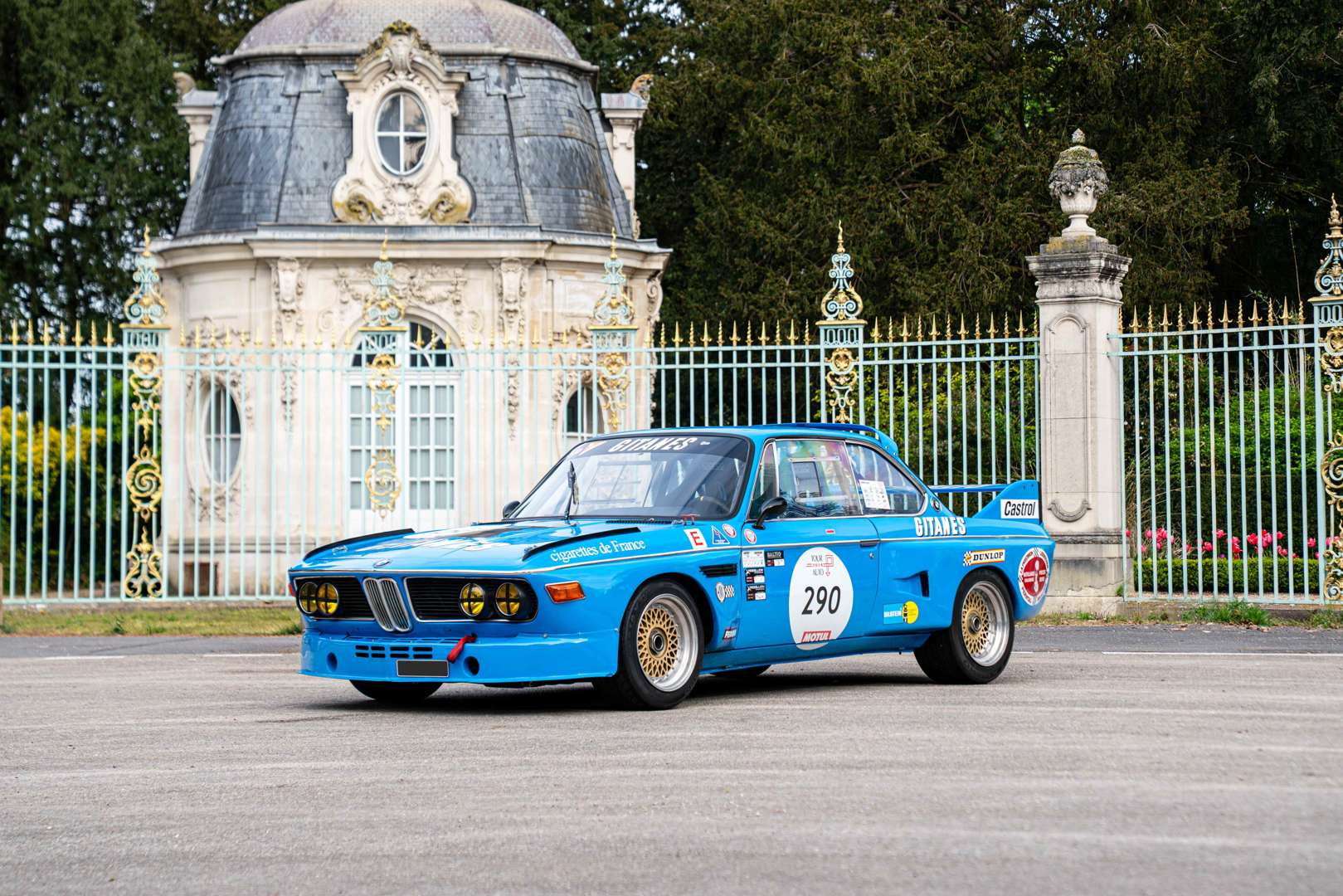
1970 – BMW 3.0 CSL « Gitane » FIA
Carte grise française
French registration title
Voiture de course préparée, notamment avec arceau, vendue sans contrôle technique
Prepared racing car, including roll cage, sold without contrôle technique
Châssis n° 2204067
Une fameuse « batmobile », dans une somptueuse livrée d’époque digne d’une Art Car…
A famous ‘Batmobile’, in a sumptuous vintage livery worthy of an Art Car…
- La 3.0 CSL est l’un des modèles les plus emblématiques de l’histoire du constructeur bavarois. On doit son élaboration à Jochen Neerpasch, ancien directeur de Ford Motorsport, embauché comme ingénieur en chef de BMW Motorsport GmbH, et dont le premier projet fut le retour officiel de l'écurie en compétition automobile avec la E9, marquant ainsi le début du projet CSL.
- L'appellation Coupé Sport Leich (allégé) fait référence aux modifications apportées à la caisse pour homologuer la voiture en Groupe 2. Doté du moteur 6-cylindres en ligne M30 à deux soupapes par cylindre et injection de carburant, ce moteur a été modifié au fil de sa production, passant progressivement à une cylindrée de 3 003 cm³, puis à 3 153 cm³. En version compétition, sa cylindrée atteignait 3 498 cm³ avec une culasse à quatre soupapes par cylindre. Le châssis a été allégé d'environ 213 kg grâce à l'utilisation de vitres en plastique, de composants en aluminium et d'acier plus fin.
- En 1973, une CSL arborant d’incroyables éléments aérodynamiques signés Alpina fait son apparition, rapidement surnommée « Batmobile ». Dans cette configuration, la 3.0 CSL va connaître une longue et brillante carrière en sport automobile. Cette même année, le constructeur allemand remporte le Championnat d'Europe de Formule 2 (avec Jarier) et le Championnat d'Europe des Voitures de Tourisme, ainsi que les 25 Heures du Mans (victoire de classe), avec Hezemans au volant d’une méchante 3.0 CSL, enfin capable de battre les Ford Capri 2600 RS sur leur propre terrain de jeu.
- Ford se reprit en 1974, mais à partir de 1975, les BMW « Batmobiles » remportèrent cinq Championnats d'Europe des Voitures de Tourisme consécutifs, une série de succès sans précédent, faisant de la 3.0 CSL Compétition la BMW de course la plus emblématique de tous les temps…
- La voiture qui illustre ces pages fut construite il y a plus de 10 ans sur une base de 2800 CS (dont elle a conservé l’identité et la carte grise), avec un moteur M30 3,5 l 12-soupapes, pour se conformer à sa fiche d’homologation d’époque, et obtenir son PTH (valide jusqu’en décembre 2028), sésame nécessaire à son engagement en courses historiques. Elle s’est depuis aligné aux Dix Mille Tours du Castellet, au Grand Prix de l'Âge d'Or, au Modena Cente Ore et au Tour Auto, ou ses performances et son look n’ont laissé personne indifférents… Vendue révisée, prête à rouler, avec un gros lot de bord (dont deux jeux de jentes, un pont, une boîte de vitesses…), elle permettra à son équipage d’accéder au plus beaux événements du calendrier de courses historiques, dont Le Mans Classic et le championnat Heritage Touring Cup 1 by Peter Auto, avec une monture de choix.
- The 3.0 CSL is one of the most iconic models in the Bavarian manufacturer’s history. Its development is attributed to Jochen Neerpasch, former director of Ford Motorsport, who was hired as chief engineer at BMW Motorsport GmbH; his first project was the team’s official return to motor racing with the E9, thus marking the start of the CSL project.
- The name Coupé Sport Leich (lightweight) refers to the modifications made to the bodywork to homologate the car for Group 2. Fitted with the M30 inline-six engine featuring two valves per cylinder and fuel injection, this engine was modified over the course of its production, gradually increasing in displacement to 3,003cc, then to 3,153cc. In the competition version, its displacement reached 3,498cc with a cylinder head featuring four valves per cylinder. The chassis was lightened by approximately 213 kg through the use of plastic windows, aluminium components and thinner steel.
- In 1973, a CSL featuring incredible aerodynamic elements designed by Alpina made its debut, quickly earning the nickname ‘Batmobile’. In this configuration, the 3.0 CSL went on to enjoy a long and illustrious career in motor racing. That same year, the German manufacturer won the European Formula 2 Championship (with Jarier) and the European Touring Car Championship, as well as the 24 Hours of Le Mans (class victory), with Hezemans at the wheel of a formidable 3.0 CSL, finally capable of beating the Ford Capri 2600 RS on their own turf.
- Ford bounced back in 1974, but from 1975 onwards, the BMW ‘Batmobiles’ won five consecutive European Touring Car Championships, an unprecedented run of success that made the 3.0 CSL Competition the most iconic BMW racing car of all time…
- The car featured in these pages was built over 10 years ago on a 2800 CS chassis (whose identity and registration title it has retained), with a 3.5-litre 12-valve M30 engine, to comply with its original type-approval specifications and obtain its PTH (valid until December 2028), the essential requirement for its entry into historic races. It has since competed in the Dix Mille Tours du Castellet, the Grand Prix de l'Âge d'Or, the Modena Cente Ore and the Tour Auto, where its performance and looks left no one indifferent… Sold fully serviced, ready to drive, with a comprehensive set of spare parts (including two sets of wheel rims, a driveshaft, a gearbox…), it will enable its crew to compete in the finest events on the historic racing calendar, including Le Mans Classic and Heritage Touring Cup 1 series by Peter Auto, with a first-class machine.
Est. 200 000 – 300 000 €