
&w=3840&q=75)
&w=3840&q=75)
&w=3840&q=75)
&w=3840&q=75)
&w=3840&q=75)
&w=3840&q=75)
&w=3840&q=75)
&w=3840&q=75)


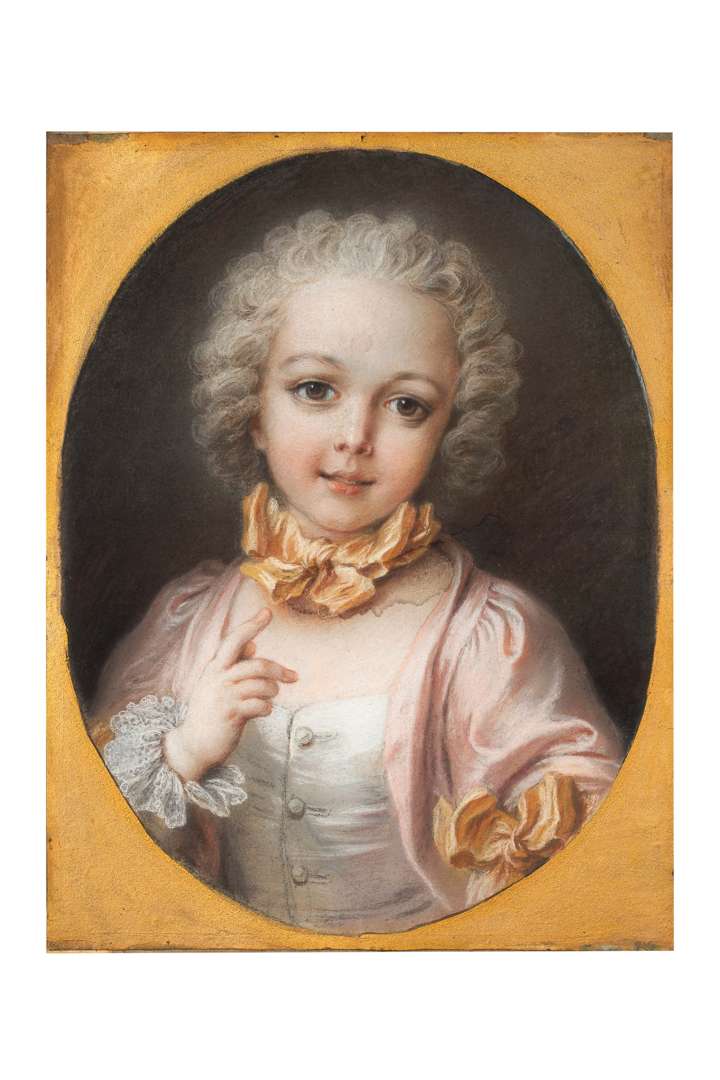
Charles-Antoine COYPEL (Paris, 1694 – 1752)
Bust portrait of a young girl with a yellow bow, one hand raised
Bust portrait of a young girl with a yellow bow, one hand raised
Pastel on paper mounted on board
, 46 x 35 cm – 18 1/8 × 13 3/4 in.
(Water damage running lengthwise down the centre at neck level (approx. 15 cm by 3 cm), small stain in the centre of the forehead)
Oval frame, spandrels in gold gouache.
We would like to thank Mr Neil Jeffares for confirming the authenticity of this pastel from a photograph. It is worth noting that there are several oval pastels with spandrels painted in gold gouache, which suggests this was a common practice for the artist.
Bust portrait of a young girl wearing a yellow bow, with one hand raised, pastel on paper mounted on cardboard
Private collection, France.
Neil Jeffares, *Online Dictionary of Pastellists before 1800*, Coypel Charles-Antoine, no. J.24724024, repr.
Charles-Antoine Coypel (1694–1752) belonged to one of the most important dynasties of French painters of the 17th and 18th centuries. The grandson of Noël Coypel (1628–1707) and son of Antoine Coypel (1661–1722), he received an early artistic education within a milieu closely linked to the royal court and the Royal Academy of Painting and Sculpture. As the heir to this family tradition, he enjoyed a brilliant career during the reigns of Louis XV and the Regency.
A history painter, decorator, draughtsman, engraver and man of letters, Coypel occupied a prominent place in Parisian artistic life. He became First Painter to the Duke of Orléans following his father’s death in 1722, before being appointed First Painter to the King and Director of the Royal Academy of Painting and Sculpture in 1747. He also held the prestigious post of Keeper of the Crown’s Paintings and Drawings.
Whilst Coypel is best known for his history paintings and compositions inspired by theatre or literature, he also developed a significant career as a portraitist. He produced portraits in oil as well as numerous pastels, a technique particularly favoured in the 18th century for its speed of execution and its ability to render the softness of flesh and the velvety texture of fabrics[1]. His subjects were mainly members of the aristocracy and the royal entourage, but he also produced several self-portraits as well as portraits of actors and children.
His portraits are characterised by a great liveliness of expression: the figures often look directly at the viewer and the hands play an essential role in bringing the composition to life. This quest for expressiveness reflects Coypel’s interest in theatre and staging. His portraiture, attentive to psychology and the delicacy of materials, would influence several artists of the following generation, notably Louis Tocqué and certain great French pastel artists of the Age of Enlightenment[2].
This portrait of a young girl with a yellow bow, executed in pastel by Charles-Antoine Coypel, perfectly illustrates the artist’s portraiture skills. Depicted in a bust format within a drawn oval frame, the young model is dressed in the manner of a woman, in keeping with 18th-century custom. The delicate yellow bow around her neck, her slightly powdered curly hair, and the rendering of the fabrics testify to the care Coypel took with materials and textural effects. Here, the pastel allows him to capture both the softness of the skin and the sheen of the fabric, in a technique where line and colour blend subtly.
As in many of Coypel’s portraits, the model’s gaze is directed straight at the viewer, whilst a lively hand, with a raised finger, introduces a dynamic movement into the composition. This attention to gestures reflects the artist’s profound consideration of expression. Charles Coypel wrote that in the absence of “Gesture is a language common to all men, through which one can make oneself heard by the most distant and barbarous nations. (…) The painter, through attitudes and gestures, must not only give voice to his figures, but must also strive to imitate their strength, and to express the feelings and movements of the soul (…)”[3]. This idea, formulated in relation to his genre painting, finds a clear echo in his portraits, where the hands, the liveliness of the gaze and the expression play a full part in the psychological animation of the subject.
The work also displays several characteristics typical of his portraiture: a sober background slightly modulated by light, large open eyes set in shallow sockets, fine eyebrows, and meticulous attention to lace and fabrics[4]. Coypel’s portraits are most often executed as half-length or bust portraits, frequently in an oval format similar to this one. The spandrels enhanced with gold gouache are found in several of his pastels, notably in one of his self-portraits (Fig. 1), and appear to have been a recurring practice of the artist.
The choice to depict a child alone is also indicative of changing sensibilities during the Age of Enlightenment[5]. Until the mid-18th century, portraits of children remained relatively rare outside of princely or religious contexts. Gradually, however, under the influence of new ideas about childhood and education, the child became a subject in her own right. Thus, this portrait bears witness quite early on to this new focus on the individual and childhood, whilst retaining the elegant and sophisticated conventions characteristic of the aristocracy of the time.
[1] Thierry Lefrançois, Charles Coypel: peintre du roi: 1694–1752, Paris, Arthéna, 1994, p. 69.
[2] Ibid., p. 70.
[3] Charles-Antoine Coypel, Discours prononcez dans les Conférences de l’Académie royale de Peinture et de Sculpture, Paris, J. Collombat, 1721, p. 157 [Available online].
[4] Thierry Lefrançois, op. cit., p. 80.
[5] On this subject, see: Edited by Christine Kayser, with the collaboration of Xavier Salmon and Laurent Hugues, L’Enfant chéri au siècle des Lumières, exhibition catalogue, Cholet, Museum of Fine Arts, 15 March – 15 June 2003, p. 14.