
&w=3840&q=75)
&w=3840&q=75)
&w=3840&q=75)
&w=3840&q=75)
&w=3840&q=75)
&w=3840&q=75)
&w=3840&q=75)
&w=3840&q=75)


Anna-Eva Bergman (1909–1987)
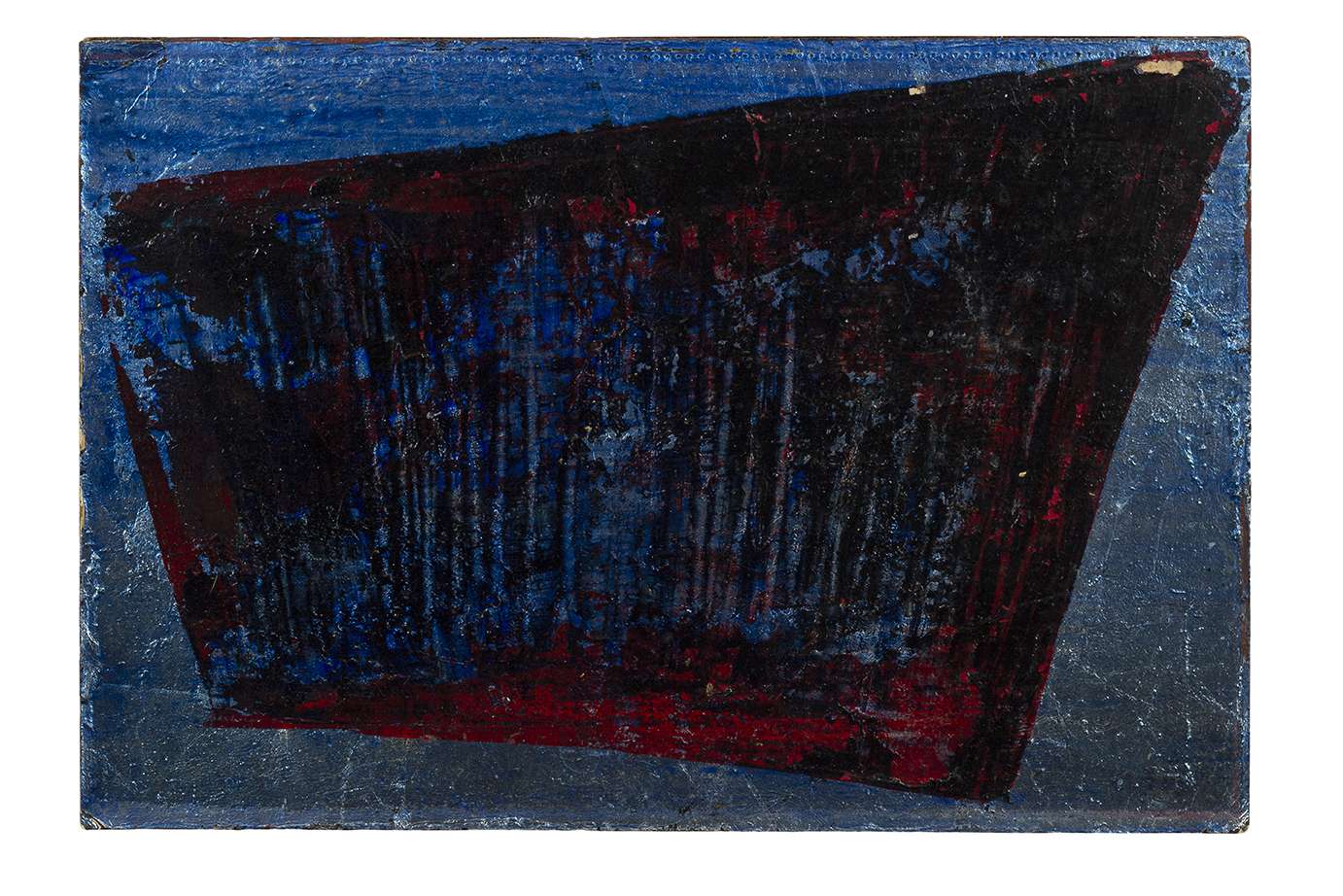
No. 16-1959 Boat, 1959
Fees include commission and taxes.
No. 16-1959 Boat, 1959
Tempera and metal leaf on cardboard, monogrammed and dated ‘AEB 1959’ in the lower right-hand corner, titled by the artist, dated, and numbered 296 on the reverse
12.5 x 19 cm
Private collection, Lyon area
This work is included in the catalogue raisonné of Anna-Eva Bergman’s work. We would like to thank the Hartung Bergman Foundation for the information provided on this work.
A leading figure in post-war painting, Anna-Eva Bergman (1909–1987), born in Stockholm and raised in Norway, trained at the Oslo Academy of Fine Arts and later at the Vienna School of Applied Arts. The artist began with a figurative style, characterised by a keen sense of observation, understated lines and subtle humour, influenced by Hans Hartung following their meeting in 1929. In the 1940s, she moved away from figuration to focus on line and rhythm, constructing her own dreamlike world.
In 1958, in a series of works created using tempera and metal leaf, Bergman employed her repertoire of forms—stone, moon, star, planet, mountain, stele, tree, grave, valley, ship, prow and mirror—in her painting for the first time. These archetypal forms, inspired by Scandinavian nature and the powerful northern light, would become central elements of Bergman’s work.
Work No. 16-1959 illustrates a defining period in the artist’s career: a textured blue background, a single form evoking a ship or a mountain, whilst the red adds mystery and intensity. The luminous surface, animated by a metallic sheen, would become the artist’s signature medium. The power of this work thus lies in its simplicity: a single, luminous and absolute form, embodying both her Nordic sensibility and the Parisian avant-garde.
Her works have been exhibited in numerous European institutions, notably in Italy, Germany and Spain, bearing witness to her critical and international acclaim. Her recent retrospectives, Becoming Anna-Eva Bergman at the National Museum in Oslo in 2024 and Voyage vers l’intérieur at the Musée d’Art Moderne in Paris in 2023, confirm her influence on modern abstraction. Just under half a century after her first Paris exhibition in 1977–1978, which already marked a significant milestone in her career.