
&w=3840&q=75)
&w=3840&q=75)
&w=3840&q=75)
&w=3840&q=75)
&w=3840&q=75)
&w=3840&q=75)
&w=3840&q=75)
&w=3840&q=75)


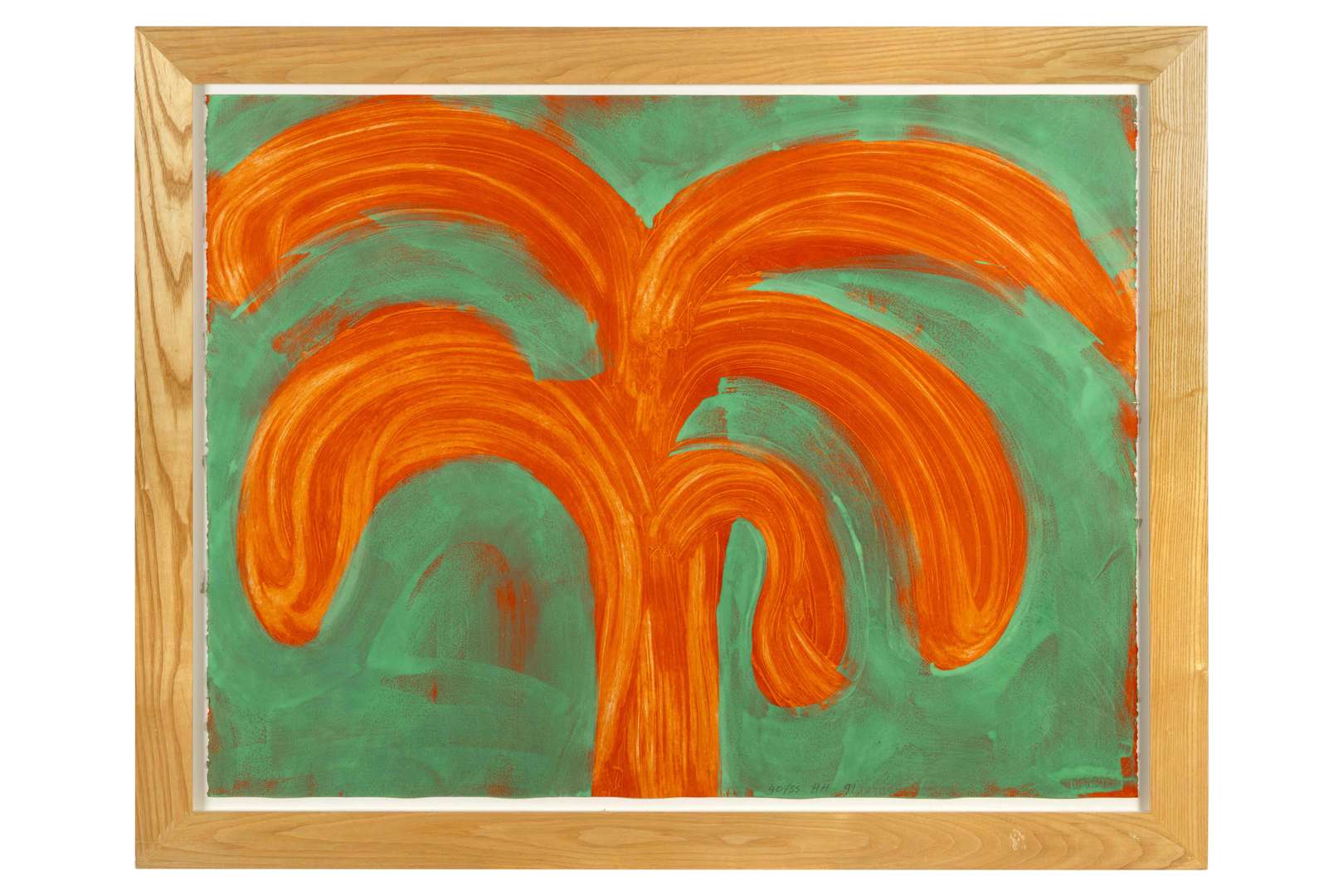
Indian Tree, 1991
Etching and carborundum on Arches paper, numbered 40/55, signed with the artist’s initials and dated ‘91’ in pencil in the lower right-hand corner
92 x 121 cm
Galerie Eric Dupont, Paris
Acquired from the gallery in 2015, then passed down within the family
Sir Howard Hodgkin is one of the most famous British artists of his generation. Although his work may appear abstract at first glance, it is deeply rooted in his memories, his travels, the people he has met, and the places that have left a lasting impression on him. The works created between 1977 and 2015 bear witness to these personal experiences, which recur throughout his work.
In 1990, the artist undertook several major works such as After Degas, Indian Tree, Mango and Moroccan Door, in which he continued this exploration of memory through colour and gesture. This image can thus be read as a metaphor for memory itself: the forms are never perfectly defined; they appear and then dissolve into the background. Nothing is fixed definitively. The work retains the emotional intensity of an experience whilst allowing its concrete details to fade away. This fleeting nature of memory is one of the major themes in Howard Hodgkin’s art.
Indian Tree recalls the large palm tree prints created by Hodgkin, inspired by the posters seen in the Paris metro in the 1950s and 1960s. His images are never mere abstract compositions; they are ‘depicted emotional situations’, distillations of memory, sensation and lived experience.
The print was produced using the carborundum technique. This process allows for a wide variety of textural and material effects in the print. Howard Hodgkin described this technique as “wonderfully liberating”, as it offered him great freedom of expression and allowed him to recapture, in the print, the spontaneity and energy of the painterly gesture.