
&w=3840&q=75)
&w=3840&q=75)
&w=3840&q=75)
&w=3840&q=75)
&w=3840&q=75)
&w=3840&q=75)
&w=3840&q=75)
&w=3840&q=75)


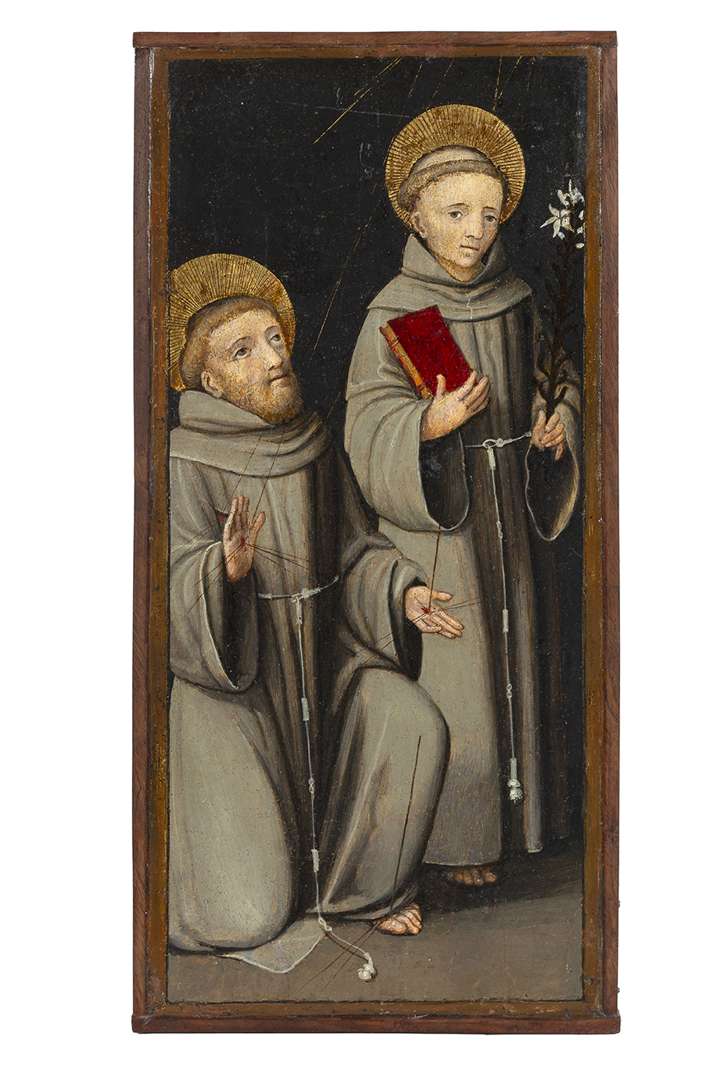
Master of Montemerano (Siena, c. 1470)
Saint Francis of Assisi and Saint Anthony of Padua
Saint Francis of Assisi and Saint Anthony of Padua
Egg tempera on wood panel (shutter from a triptych?)
34 x 15 cm - 13 3/8 x 5 7/8 in.
Saint Francis of Assisi and Saint Anthony of Padua, tempera on wood panel (shutter from a triptych?)
According to an old label on the back, from the collection of Pietro Accorsi (1891–1982), a leading Turin-based antique dealer of the 20th century; private collection, Italy.
This previously unpublished panel bears a resemblance to a Virgin of the Annunciation housed in the church of San Giorgio in Montemerano, Grosseto (Fig. 1). It is to this work, published by Carlo Alberto Nicolosi in the Rassegna d’arte in 1907, and subsequently reproduced in 1911 in La Montagna Maremmana (p. 38), that this artist owes his conventional name[1].
The geometric rendering of the two saints’ faces—characterised by broad foreheads, pointed chins and a nasal ridge drawn in line with the brow ridge—as well as the stylisation of the drapery, bear close resemblance to the Virgin of Montemerano. Similarly, the candour of their poses and gazes lends these figures the same air of serene impassivity as that which emanates from the Announced Virgin.
The body of work by this master, a provincial painter of the Sienese school, is limited to a small group of depictions of the Virgin and Child in which the influence of several Sienese artists active in the second half of the fifteenth century is evident, to varying degrees, notably Giovanni di Paolo, Sano di Pietro and, above all, Pellegrino di Mariano (see Cesare Brandi, Giovanni di Paolo, Florence, 1947, pp. 101–102, figs. 108–109)[2].
[1] Known as the Madona della Gattaiola, whose dimensions (215 x 175 cm) and traces of hinges suggest it was originally intended for a cabinet door or an organ.
[2] The Madonna and Child published by Brandi (op. cit., 1947, fig. 109), formerly in the Ramboux collection in Cologne, was sold at Christie’s in London on 4 July 1997, lot 348 as ‘Pellegrino di Mariano’ and as ‘Master of Montemerano’ at the Moretti Gallery in 2003. Another Madonna and Child, very similar to the latter, is attributed to a follower of Francesco Pesellino by Berenson, in ‘Quadri senza casa, Il Quattrocento fiorentino II’, Dedalo, 1932, 12, p. 682, ill.