
&w=3840&q=75)
&w=3840&q=75)
&w=3840&q=75)
&w=3840&q=75)
&w=3840&q=75)
&w=3840&q=75)
&w=3840&q=75)
&w=3840&q=75)


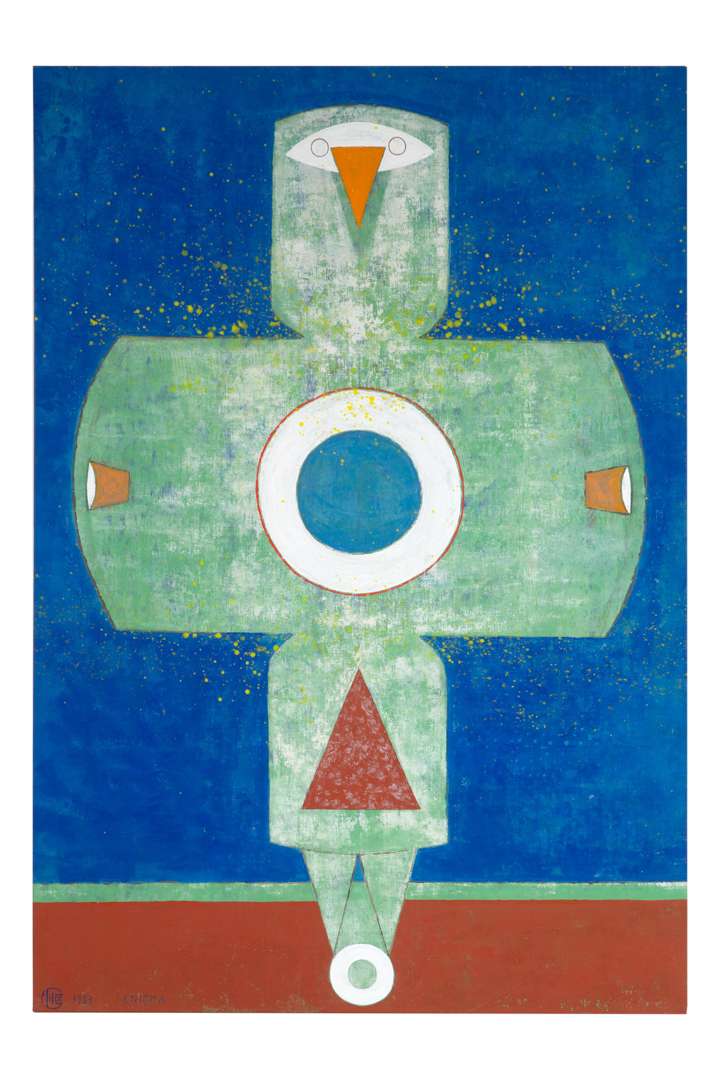
Françoise GILOT (1921–2023)
ENIGMA, 1983
Fees include commission and taxes.
ENIGMA, 1983
Acrylic on canvas, signed, dated and titled in the lower left corner
164 x 118 cm
Serge Panijel Gallery, Paris
Acquired from the gallery by the current owner
Françoise Gilot, Dina Vierny and Mel Yoakum, *Françoise Gilot: A Monograph 1940–2000*, 2000, illustrated in colour on pages 239 and 240.
Françoise Gilot, Emblèmes et symboles, 1984-2004, Galerie Serge Panijel, Paris, 29 avril - 29 mai 2004.
Françoise Gilot, Galerie de la Salamandre, Nîmes, 16 avril - 15 mai 2004.
Born in Neuilly-sur-Seine in 1921 and died in New York in 2023 at the age of 101, Françoise Gilot was an artist in search of freedom, whose destiny was constantly constrained, and who fought all her life against the restrictions imposed by men to leave her mark on her century.
Born to a mother who was a watercolour artist, Françoise Gilot nevertheless had her allowance cut off by her father when she enrolled at the Académie Julian with the firm intention of making a living from painting. It was at the age of 21 that she crossed paths with Pablo Picasso, then aged 61. She became his partner for around ten years and the mother of their children.
Depicted by her partner as the ‘Flower Woman’, Françoise Gilot was above all nicknamed ‘the woman who says no’ by the co-founder of Cubism — a remark she recounts in her book Living with Picasso (1964). For Picasso, there were “only two types of women: goddesses and doormats”. Following the publication of these writings, the creator of Guernica, furious, went so far as to refuse to see the children he had had with Françoise Gilot.
Her artistic practice, of remarkable intensity (it is said she painted for up to twelve hours a day), led Françoise Gilot to a style of painting of great vigour, both in her choice of colours and in her brushwork, where form and background merge.
The themes she explores on large-format, free-form canvases are very often imbued with the symbolism of freedom. A sailing boat, a shooting star, a galloping horse or, as here, a bird taking flight: these are all subjects whose totemic power she invokes to proclaim the freedom for which she has fought all her life.
Énigme, the canvas presented here, is a particularly telling example of this desire for freedom. Designed specifically without a frame and with no intention of being hung on a wall, the canvas is no longer a flat, two-dimensional surface, but a free-standing object, capable of being moved, of fluttering in the wind, of being unrolled or rolled up, laid flat, taking on forms other than the constrained regularity of a frame. Like an installation in a state of perpetual reinvention.
Dina Vierny, herself a muse of Aristide Maillol, who in 2000 wrote the foreword to the monograph dedicated to Françoise Gilot, speaks of her as an image of panache and courage. An image that came to her when Gilot took the decision to ‘leave the Picasso galaxy’, like a shooting star or a bird with immense wings.
Françoise Gilot (1921–2023), Full Moon, 1983, Acrylic on canvas, 248 x 208 cm, Françoise Gilot Collection, New York.