
&w=3840&q=75)
&w=3840&q=75)
&w=3840&q=75)
&w=3840&q=75)
&w=3840&q=75)
&w=3840&q=75)
&w=3840&q=75)
&w=3840&q=75)


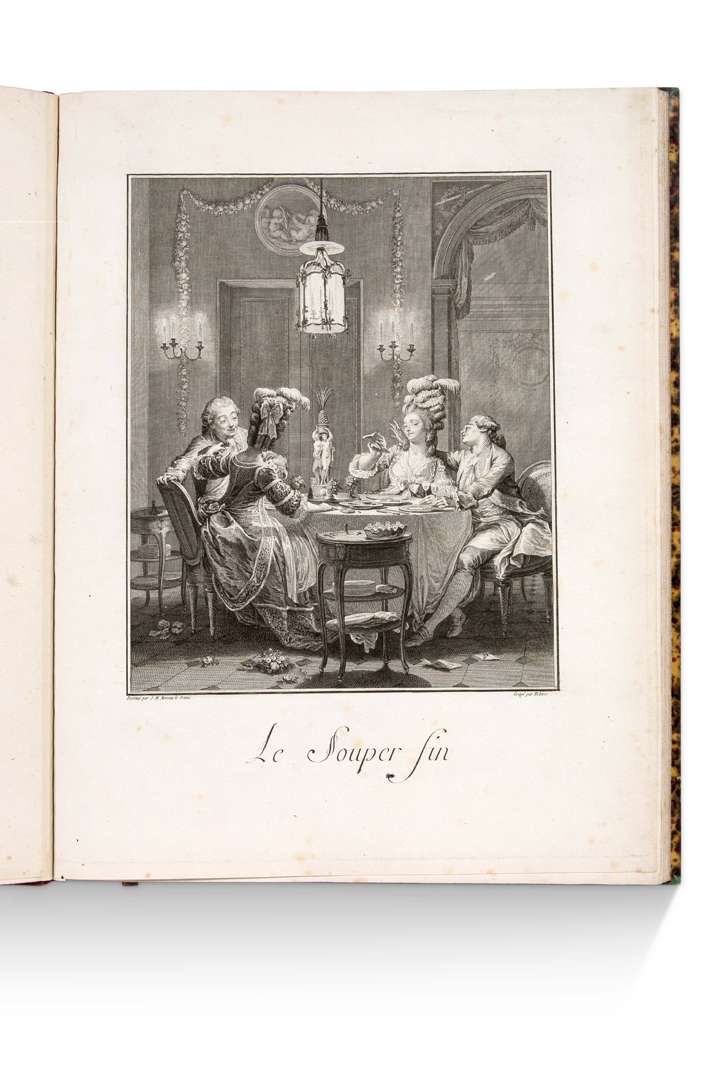
MOREAU THE YOUNGER (J.M. MOREAU, known as).
A series of engravings illustrating the history of fashion and costume in France during the eighteenth century. Year 1776. Volume 2.
Paris: Imprimerie de Prault, 1777.
Fees include commission and taxes.
A series of engravings illustrating the history of fashion and costume in France during the eighteenth century. Year 1776. Volume 2.
Paris: Imprimerie de Prault, 1777.
Folio (32.8 x 42.8 cm), framed title page and 26 black-and-white engravings. Red half-morocco with small green vellum corners from the 19th century, ribbed spine decorated with gold panels and fillets in the style of the period, gilt title, laid paper endpapers, covers highlighted with a triple gilt fillet (slight soiling from use on the binding, faint foxing, minor repairs to the edges of a few leaves, one plate (24) discoloured).
Folio edition of the first two instalments of this famous engraved suite (a third instalment was not published until 1783). Rare and highly sought-after. All plates are fine proofs and include the letter. 24 are by Moreau, 2 by Freudeberg, 11 engraved A.P.D.R., 24 signed, including “Moreau junior” on plate 19. The two sets contained only two sets of 12 prints. Jean-Henri Eberts (1726–1793), a banker, art dealer and collector of engravings, commissioned a collection of fashion plates depicting the life of a Parisian courtesan and her social circle, published in instalments with explanatory text (the edition featuring texts by Restif de la Bretonne was not published until 1789). He turned to the brilliant draughtsman and engraver, Moreau the Younger (1741–1814), a keen observer of Parisian society, for a work imbued with a ‘Rousseauist’ spirit, depicting the stages of motherhood or, at the height of the Anglomania craze, portraying the leisure pursuits of a petit maître. The Revolution caused these prints, flattering to the aristocracy, to be forgotten, and it was Edmond de Goncourt who rediscovered this magnificent series, which has since become indispensable to the history of fashion and manners. Titles: Yes and No. Leaving the Opera. The Fine Dinner. The Matinee. The Announcement of Pregnancy. The Precautions. I Accept the Happy… Do Not Be Afraid. It Is a Son, Sir. The Little Godfathers. The Horse Race. The Lord at His Farmer’s. The Delights of Motherhood. The Rendezvous at Marly. The Farewell. The Encounter in the Woods. The Lady of the Palace. The Rising. The Little Dressing. The Grand Dressing. The Game of Wisch. The Small Box. The Won Bet. The Surprise. The Perfect Accord. True Happiness. Enclosed: A large collection of engravings by MOREAU the Younger.
In loose sheets or beautifully bound in 19th-century red half-morocco with gilt corners, with gilt title, c. 1770–1805. -[VOLTAIRE]. [Plates from the Beaumarchais edition of Kehl]. Prints intended to illustrate the octavo editions of M. de Voltaire… Paris, Saugrain, [1784–1789 and 1803]. 2 vols. in-8 comprising 114 plates (including title and dedication) and 160 plates (discreet marginal restorations on some plates). 274 plates engraved with a burin after Moreau the Younger, including 46 portraits, forming the series of prints commissioned by the publisher Renouard. -[Abbé PREVOST]. Series of illustrations for Selected Works. 8vo. -IMBERT. Short Stories or Tales in Verse. Amsterdam, Paris, Delalain, 1774. 8vo, VIII-198-II pp., frontispiece, one engraved title page, and 4 engraved headpieces by Masquelier and Née after Moreau. -MOREAU THE YOUNGER. Set of 18 loose copperplate engravings for *Romans et Contes*. Set of 10 loose copperplate engravings for *La Henriade*. Set of 44 loose copperplate engravings. Set of 12 plates printed in bistre, loose, for La Fontaine’s fables.