
&w=3840&q=75)
&w=3840&q=75)
&w=3840&q=75)
&w=3840&q=75)
&w=3840&q=75)
&w=3840&q=75)
&w=3840&q=75)
&w=3840&q=75)


Charles de Secondat, Baron de La Brède et de Montesquieu (1689–1755)
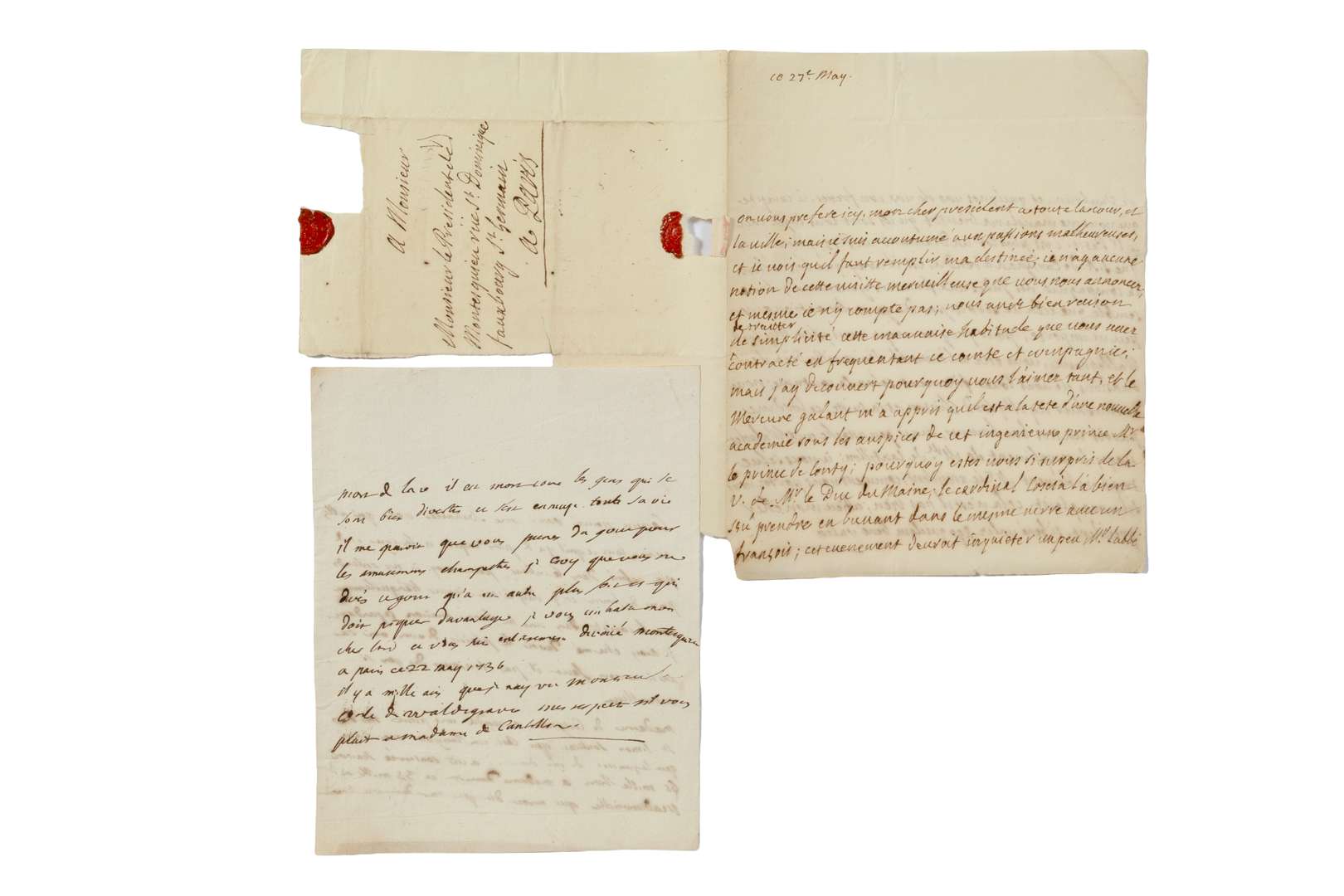
L.A.S. ‘Montesquieu’ (draft), Paris, 22 May 1736, [to Count François de Bulkeley]; 2 pages, folio.
Fees include commission and taxes.
L.A.S. ‘Montesquieu’ (draft), Paris, 22 May 1736, [to Count François de Bulkeley]; 2 pages, folio.
An amusing letter on current events. 73002
‘How could you wish me well, you who are about to have all that is most exquisite at court and most refined in the cabinet? As for me, I know nothing of such subtleties, and this evening I shall dine quietly with the Count [the Count de MATIGNON?] at a very fine establishment; nevertheless, I shall be delighted to have the pleasure of seeing you, for surely you do not always need such marvellous company. Madame de Carignan has returned a stone. Monsieur de St Simon maintains that it is a ingot [the Prince and Princess of Carignan had become very wealthy through Law’s scheme]. You know that Monsieur du Maine’s pension [the Duke of Maine died on 14 May] has been retained, namely 65,000 livres for Madame du Maine and 35,000 for Mademoiselle. Who would have thought that Mr du Maine would die of the plague? He died like people who have enjoyed themselves thoroughly and been bored all their lives. It seems to me that you are developing a taste for country amusements. I believe you owe this taste only to a stronger one, which must be even more stimulating’… Enclosed is a letter from the Count of Bulkeley to President Montesquieu in Paris, [Orléans, 27 May [1736] (2 pages in-4, address with red wax seal bearing a broken coat of arms), a witty reply to Montesquieu’s letter. “Here, my dear President, you are preferred to the whole court and the city; but I am accustomed to unhappy passions, and I see that I must fulfil my destiny”… He refers to the habits of the Duke of Maine, the “diamond” of the Princess of Carignan… “Is it true that the East India Company is to be handed over to the general farmers? It seems to me that this would not be to the shareholders’ liking”… Correspondence 1731–1746, nos. 441 and 442.