
&w=3840&q=75)
&w=3840&q=75)
&w=3840&q=75)
&w=3840&q=75)
&w=3840&q=75)
&w=3840&q=75)
&w=3840&q=75)
&w=3840&q=75)

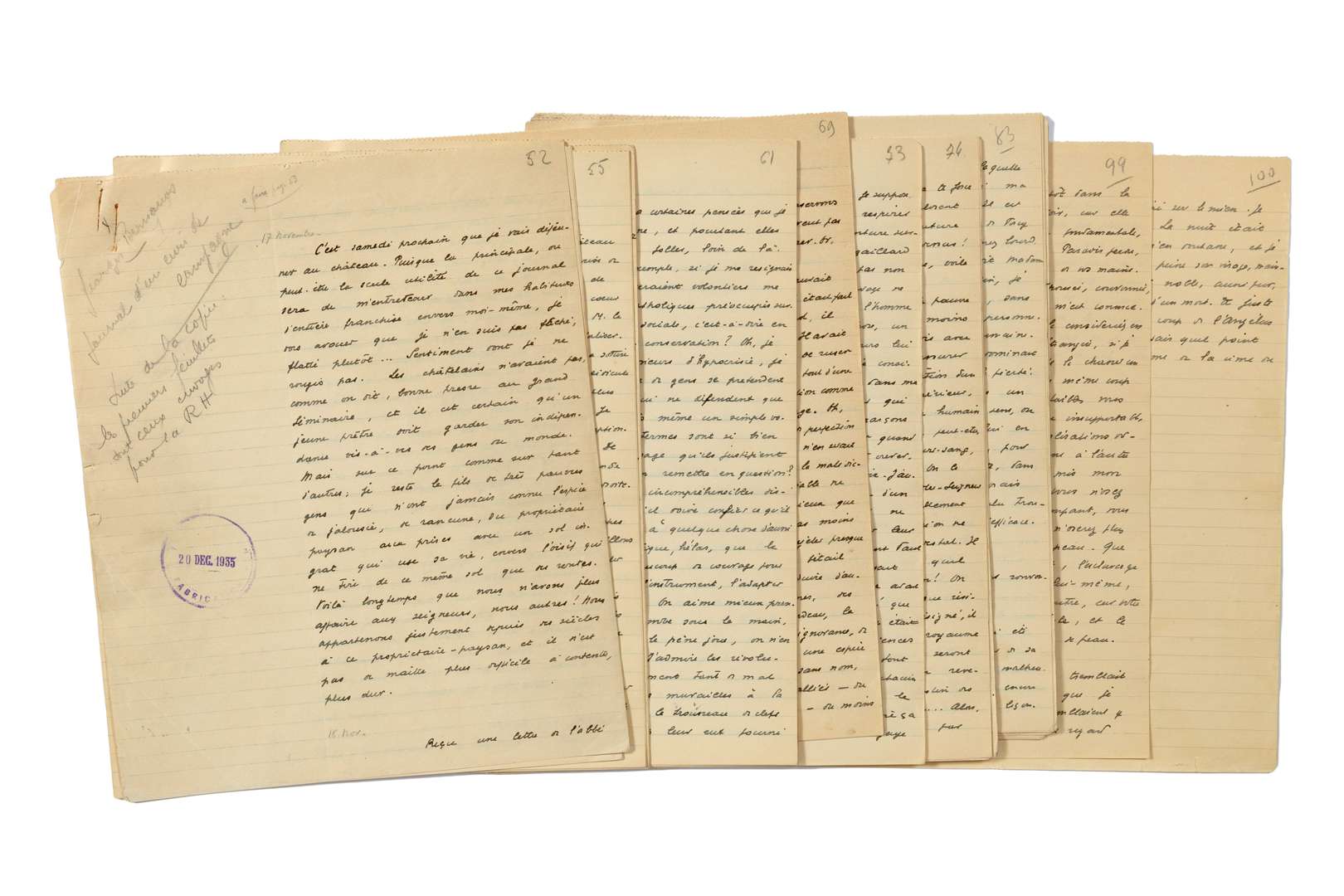
Georges Bernanos (1888–1948).
Autograph manuscript, [Diary of a Country Priest] (fragment), [1935]; 49 quires in-4, written on the front side only.
Fees include commission and taxes.
Autograph manuscript, [Diary of a Country Priest] (fragment), [1935]; 49 quires in-4, written on the front side only.
An important excerpt from Georges Bernanos’s masterpiece. The novel was published, with some omissions, in *La Revue hebdomadaire*, edited by François Le Grix, from 14 December 1935 to 22 February 1936, before appearing in bookshops published by Plon in March 1936. This manuscript was used for the printing of two issues of La Revue hebdomadaire: 21 December (pp. 318–331) and 28 December (pp. 446–457). It corresponds to pages 216 to 240 of Volume II of the Œuvres romanesques complètes published by the Bibliothèque de la Pléiade (2015). The work recounts the fate of a modest parish priest in Ambricourt, in northern France, his difficult relations with the local population, and his torments and questions regarding faith, poverty and social conditions. The final, deeply moving section describes his journey towards death, which is also a journey towards grace. The manuscript is a fair copy, carefully written in black or midnight blue ink on sheets of lined notepaper, with a wide margin on the left; it contains a few rare erasures and corrections. The original pagination, in pencil on the left, runs from 1 to 49; a second pagination, for the journal, has been added on the right, from 52 to 100, with a handwritten note in pencil on the first page: ‘Continuation of the copy: the first pages are those sent to RH’, along with the author’s name and the title; a manufacturer’s ink stamp is dated 20 December 1935. It should be noted that the manuscript bears eight dates in pencil for the ‘diary’ entries, which will not be included in the edition; they range from ‘17 November’ to ‘11 December’. The first entry is dated 17 November: “It is next Saturday that I am to have lunch at the château. Since the main, or perhaps the only, purpose of this journal will be to maintain my habit of complete frankness towards myself, I must confess that I am not displeased by this, rather flattered… ” The following entries include, in particular, a meditation on the Old World and the human condition (7 December). The final entry, dated 11 December, recounts the impassioned words of the parish priest of Torcy on faith, the human condition, modern society, misery and mercy, and concludes as follows: “His large hand trembled on my arms, and the tears I thought I saw in his eyes seemed to be gradually devoured by that gaze he kept fixed on mine. I could not weep. Night had fallen without my realising it, and I could barely make out his face, now motionless, as noble, as pure, as peaceful as that of a dead man. And just at that moment, the first toll of the Angelus rang out, coming from some dizzying point in the sky, as if from the summit of the evening.”