
&w=3840&q=75)
&w=3840&q=75)
&w=3840&q=75)
&w=3840&q=75)
&w=3840&q=75)
&w=3840&q=75)
&w=3840&q=75)
&w=3840&q=75)

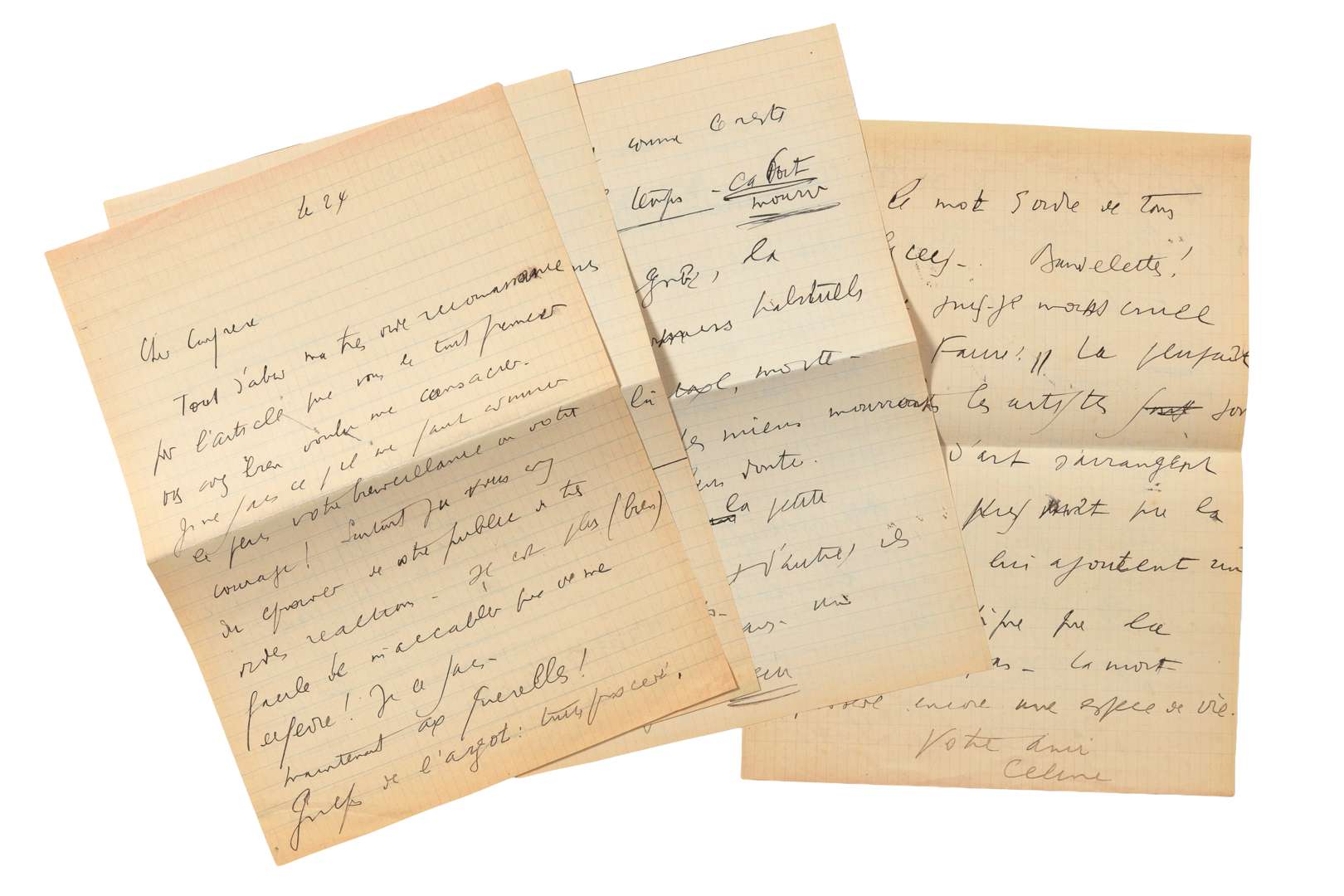
CÉLINE, Louis-Ferdinand (1894–1961).
L.A.S. ‘Celine’, 24 [May 1936], to a ‘dear colleague’ [André ROUSSEAUX]; 8 pages in-4 on 2 double-sheets of squared paper.
Fees include commission and taxes.
L.A.S. ‘Celine’, 24 [May 1936], to a ‘dear colleague’ [André ROUSSEAUX]; 8 pages in-4 on 2 double-sheets of squared paper.
A very fine and lengthy letter from Céline on her style and her conception of the novel. [*Mort à crédit* was published on 12 May 1936; André ROUSSEAUX (1896–1973) devoted part of his column ‘Propos du samedi’ in *Le Figaro* on 23 May to it, focusing mainly on the use of slang.] Céline thanks her colleague “for the article which you were the very first to kindly devote to me. I do not know what I should admire more: your kindness or your courage! Especially as you must have faced very strong reactions from your readership. It is far easier to overwhelm me than to defend me! I know that.” Then he moves on to the ‘quarrels’: ‘Grievances about slang: tricks, devices, manner, artifice, tedium, etc…! But no! I write as I speak, without artifice […] I go to great lengths to render ‘spoken language’ into ‘written language’, because paper does not capture speech well, but that is all. […] There’s no genius in that! It’s just condensation, that’s all. For my part, I find in this the only possible mode of expression through emotion. I don’t want to narrate, I want to make people FEEL. It’s impossible to do that with academic, everyday language, or fine style. – It is the tool of reports, of discussion, of letters, of preservation – but it is always a grimace and something frozen. I cannot read a novel written in classical language. These are DRAFTs of novels; they are never novels. All the work remains to be done; the emotional impact is missing. And that alone is what counts. In fact, this is so true that without camaraderie, coercion, complacency, and scarcity, we would have stopped reading them long ago! Their language is impossible; it is dead, as unreadable (in that emotional sense) as Latin. Why do I borrow so much from language, from ‘jargon’, from slang syntax? Why do I shape it myself if that is my need of the moment! […] this language dies quickly, so it has lived; it LIVES as long as I use it […] A language is like everything else: IT DIES ALL THE TIME. IT MUST DIE. We must resign ourselves to it; the language of conventional novels is dead, syntax, dead – all dead. Mine will die too, no doubt soon. But they will have had that slight edge over so many others; for a year, a month, a day, they will have LIVED. […] In all this quest for an absolute French there exists 43616
a silly, unbearable pretension to the eternity of a single form of writing: beautiful French! Beautiful style! The beautiful mummy! Bandages! Take no risks. Quick, turn it into a mummy! That is the watchword of all secondary schools”… Lettres (Pléiade), 36-28.