
&w=3840&q=75)
&w=3840&q=75)
&w=3840&q=75)
&w=3840&q=75)
&w=3840&q=75)
&w=3840&q=75)
&w=3840&q=75)
&w=3840&q=75)


Philipp von Lenard (1862–1947).
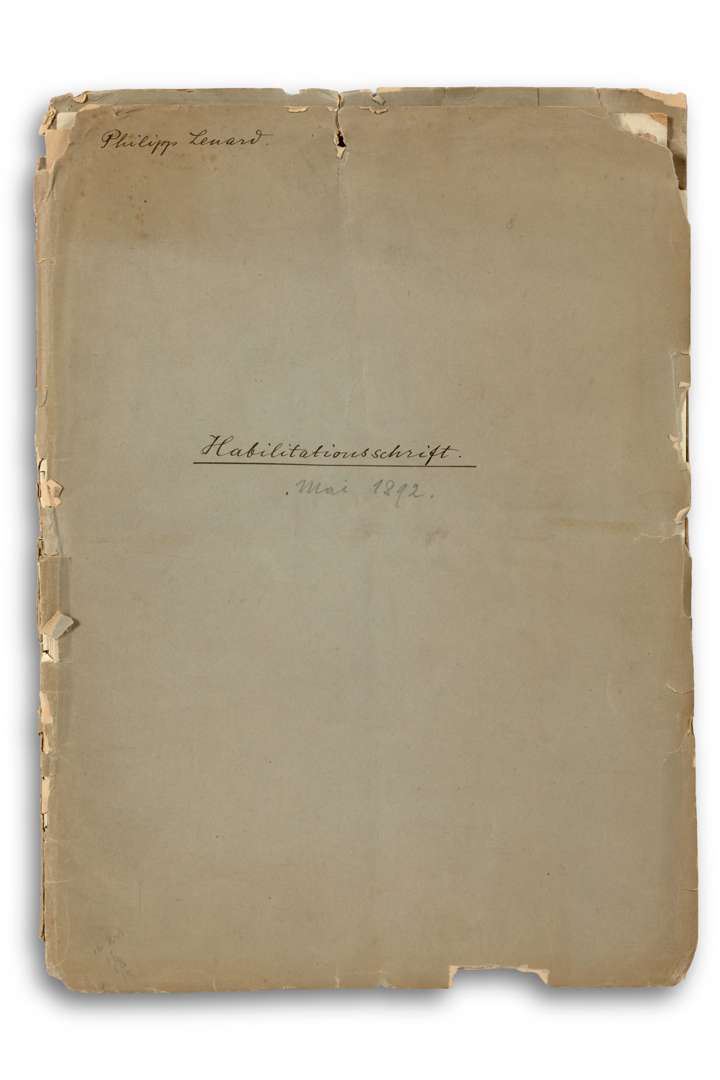
Autograph manuscript signed ‘Philipp Lenard, Dr. phil.’, *Über die Electricität der Wasserfälle*, 1892; title page and 58 pages in large quarto format, plus 2 photographic plates.
Fees include commission and taxes.
Autograph manuscript signed ‘Philipp Lenard, Dr. phil.’, *Über die Electricität der Wasserfälle*, 1892; title page and 58 pages in large quarto format, plus 2 photographic plates.
Habilitation thesis by the future winner of the 1905 Nobel Prize in Physics, on the electricity of waterfalls. Habilitation thesis submitted in May 1892 to qualify for the post of professor at the Faculty of Philosophy of the Rhenish Friedrich Wilhelm University of Bonn. It comprises numerous tables and two plates with photographs mounted on cardboard of experimental apparatus designed by Lenard. The manuscript, carefully transcribed onto lined paper, begins as follows: ‘It has long been known that waterfalls charge the air in their vicinity with negative electricity. This phenomenon, remarkable in itself and whose nature has not been fully elucidated, was of particular interest because the existence of contact electricity between gases and liquids had become highly probable for several reasons. If such electricity really exists, it seemed possible that it might manifest itself directly at large waterfalls, where extensive contact surfaces between water and air are subject to such rapid and manifold changes. Observations at waterfalls; the earth’s potential gradient has no influence. 1. On a journey to the regions of the Alps so rich in waterfalls, I was therefore equipped to make electrical observations. A paper by Messrs Elster and Geitel, published shortly beforehand, had further encouraged me in this regard. In that work, in connection with other investigations, the interesting fact is reported that negative electricity in the air is still detectable up to heights of 500 m above water surfaces, and it is tentatively suggested—as a welcome starting point for further observations—that the phenomenon might be explained as an effect of the Earth’s electric field. The key factor here would be the breaking up of the falling water masses into the finest droplets; under the influence of the normal, upwardly positive, Earth’s potential gradient, these carry a negative charge with them into the air, whilst the positive electricity goes to the Earth with the larger water masses. Translation: ‘It has long been known that waterfalls imbue the surrounding air with negative electricity. This phenomenon, remarkable in itself and whose nature is not fully understood, was of particular interest because the existence of contact electricity between gases and liquids had become highly probable for several reasons. If such electricity really exists, it seemed possible that it might manifest itself directly at large waterfalls, where the vast contact surfaces between water and air are subject to rapid and varied changes. Observations at waterfalls; the earth’s potential gradient is of no significance. 1. During a journey through the Alpine regions, which are rich in waterfalls, I therefore equipped myself for electrical observations. A work recently published by Messrs Elster and Geitel further encouraged me in this endeavour. In this work, amongst other findings, it is reported that negative electricity in the air is still detectable up to 500 m above the water’s surface, and this is presented as a promising starting point for further research. ’ The observations were used, as a hypothesis, to explain the phenomenon as an effect of the Earth’s electric field. The
, according to this theory, would be the fragmentation of falling water masses into extremely fine particles; these particles, under the influence of the normal, positive and upward Earth’s potential gradient, carry a negative charge into the air, whilst the positive charge returns to Earth with the larger water masses… And Lenard concludes that the lowering of the normal terrestrial potential gradient caused by torrential downpours, extending over hundreds of kilometres, and its increase due to ocean swells, can also be explained by our phenomenon… [Lenard was then an assistant to Heinrich Hertz in Bonn.] Publication: Philipp Lenard. Wissenschaftliche Abhandlungen, Diepholz 2003, Volume 4.