
&w=3840&q=75)
&w=3840&q=75)
&w=3840&q=75)
&w=3840&q=75)
&w=3840&q=75)
&w=3840&q=75)
&w=3840&q=75)
&w=3840&q=75)

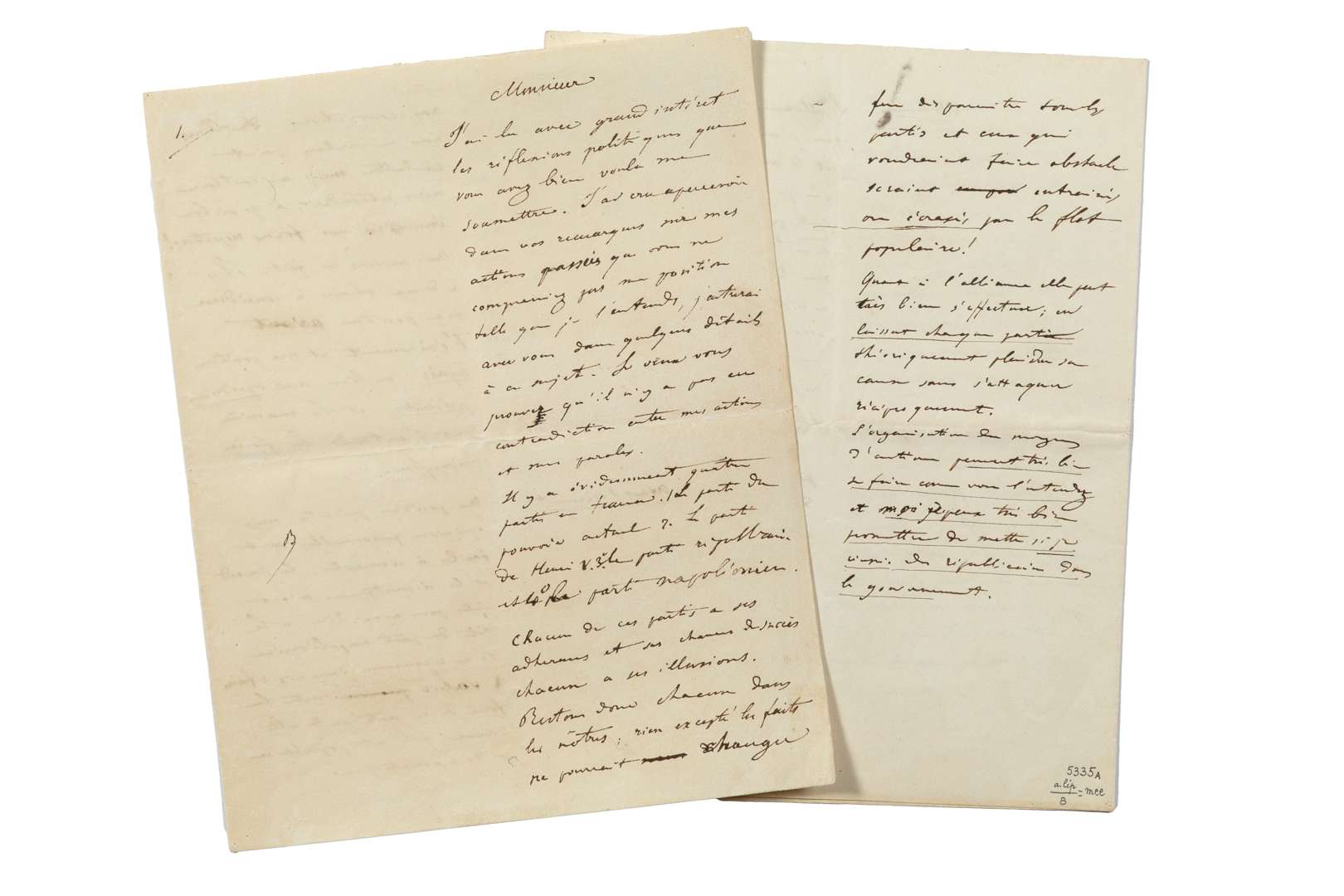
NAPOLEON III (1808–1873).
L.A., [London, April 1839, to Étienne CABET]; 8 pages, small quarto.
Fees include commission and taxes.
L.A., [London, April 1839, to Étienne CABET]; 8 pages, small quarto.
An important political letter from the future emperor to the communist theorist, setting out his views on the situation in France and on what his future course of action might be. [Following his failed attempt to incite the city of Strasbourg to rise up against the July Monarchy in 1836, Louis-Napoléon Bonaparte took refuge in England. There he rubbed shoulders with other opponents of Louis-Philippe’s regime, such as Étienne Cabet (1788–1856), convicted in 1834 for a press offence and a proponent of Christian communism.] The future Napoleon III read Cabet’s ‘political reflections’ with interest, and wished to explain his position to him and prove ‘that there was no contradiction between my actions and my words’. There are ‘four parties in France. 1. The party of the current government. 2. The party of Henri V. 3. The Republican party and 4. The Napoleonic party. […] Chance and circumstances 75093
have, so to speak, placed me at the head of the Napoleonic party. I shall never cease to assert, before the event [the fall of Louis-Philippe], the full strength of this party or this cause, which is popular and democratic’. Although many of the Republicans’ ideas ‘are opposed to, and even hostile towards, my own; I do not refuse their alliance, but not on condition that I silence my principles, my opinions, my political faith. I am willing to ally myself with them, but I wish to enjoy the same rights as they do and to assert my ideas, my sentiments, my banner. I shall never bring myself to silence opinions which I believe it is useful to propagate, convictions which are rooted in my heart as well as in my reason. [...] I shall always say that I PREFER THE EMPIRE to the republic’… After the event, it will be different… ‘I have recognised the principle of popular sovereignty; I shall submit to it. Let France establish the government that suits her; let her appoint whomever she sees fit as emperor or as president; I ask nothing for myself; to serve my country as a citizen and a soldier is my sole ambition, once the people have openly expressed their will. [...] With the nation free, I shall consider my mission complete and I might take less pleasure in sitting upon my throne than in enjoying my share of sovereignty amongst the crowd! ’ As for the ‘alliance with the Republican Party’, he has always sought it… ‘The organisation of the means of action may very well be carried out as you see fit, and I can very well promise to appoint Republicans to the government if I succeed’.