
&w=3840&q=75)
&w=3840&q=75)
&w=3840&q=75)
&w=3840&q=75)
&w=3840&q=75)
&w=3840&q=75)
&w=3840&q=75)
&w=3840&q=75)


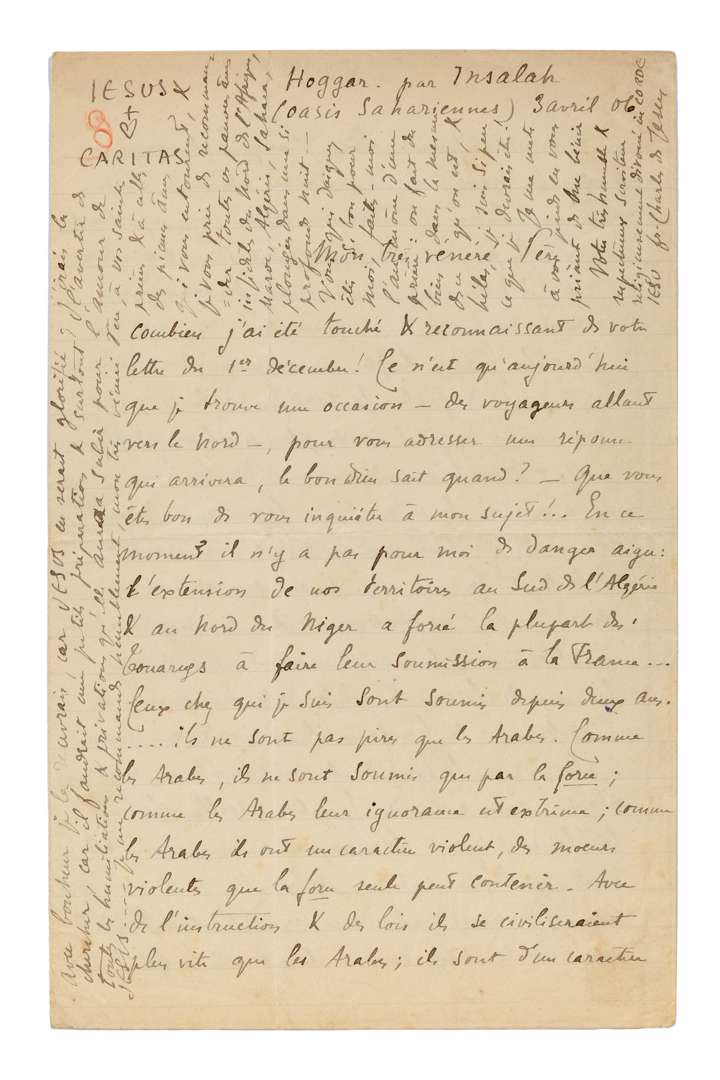
Charles de Foucauld (1858–1916).
L.A.S. ‘Fr. Charles de Jésus’, Hoggar via Insalah (Saharan oases), 3 April 1906, to ‘My Most Venerable Father’ [Charles GUÉRIN, Apostolic Prefect of the Sahara]; 4 pages in-8, filled with small, tight handwriting.
Fees include commission and taxes.
L.A.S. ‘Fr. Charles de Jésus’, Hoggar via Insalah (Saharan oases), 3 April 1906, to ‘My Most Venerable Father’ [Charles GUÉRIN, Apostolic Prefect of the Sahara]; 4 pages in-8, filled with small, tight handwriting.
A very fine letter from Father de Foucauld, who was on an evangelising mission among the Tuaregs in the Hoggar Mountains. He reassures his superior regarding his situation: ‘The expansion of our territories in southern Algeria and northern Niger has forced most of the Tuaregs to submit to France. Those among whom I am have been subjugated for two years... they are no worse than the Arabs. Like the Arabs, they are subjugated only by force; like the Arabs, their ignorance is extreme; like the Arabs, they have a violent temperament and violent customs that only force can restrain. With education and laws, they would become civilised more quickly than the Arabs; they are far less closed-minded, far more cheerful, and more curious than the Arabs. [...] they call us nothing but ‘the pagans’ (alas, this is often all too true!) and regard us as savages with barbaric and bloodthirsty customs; [...] they consider themselves the most civilised, the most perfect people in the world... How alike men are everywhere! [...] They are devout Muslims but without education or religious practice; they have an unbridled taste for pleasure: being exclusively nomadic, their lives consist of much leisure and little hard labour"... Foucauld elaborates on the distinctive characteristics of the Tuareg people: They are descendants of Shem, resembling the ancient Egyptians, slender, tall, very fair-skinned, possessing a strong sense of national pride, an ancient language to which they are deeply attached, and national customs that are very 75064
distinct and entirely different from Arab customs: they have adopted the faith of the Koran but not its laws, and have retained their castes and their customs. Their language is written in an ancient script that must derive from Phoenician [...] they have retained no ancient traditions, no history; they know nothing of their past... Have they ever been Christians? It is very difficult to say: certainly they had dealings with the Christians of the early centuries’…. Foucauld wishes first and foremost to impart Christian humility and gentleness to them: ‘what is needed is to enlighten their souls and soften their manners, to make them “gentle and humble” of heart; is humility not the truth, and is pride not the brother of ignorance? – We see this all too clearly in our poor country, which is falling back into barbarism: ignorance of fundamental truths breeds senseless pride, and a violence that is all too evident in our colonies and wherever the fear of the police does not restrain it. My work here is, alas, merely a work of preparation, of initial clearing: it is first of all to place JESUS among them […] it is also to place a prayer among them, the prayer of the Holy Church [...] it is then to show these ignorant people that Christians are not what they suppose: that we believe, love, hope: finally, it is to put souls at ease, to befriend them, to win them over"... Etc. Each page is surmounted by the Sacred Heart and the name of Jesus.