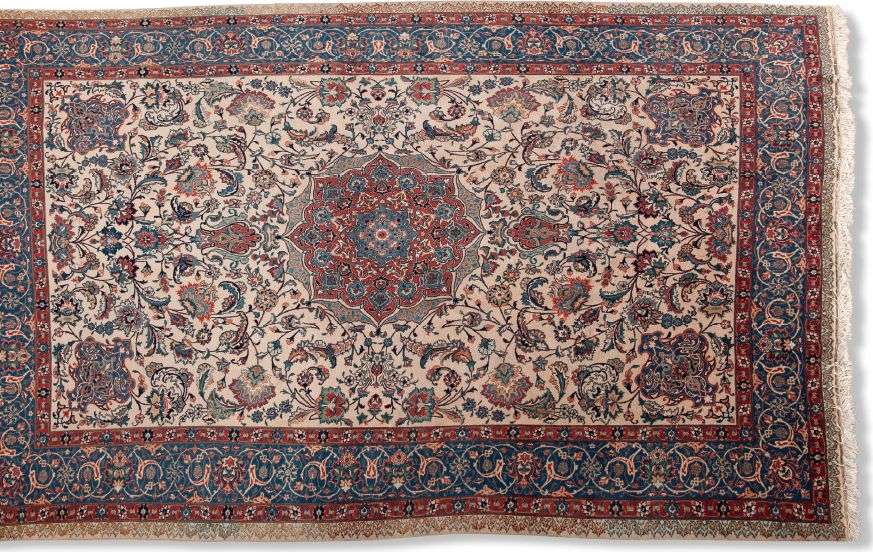
ISPAHAN CARPET (cotton warp and weft, "kurk" wool velvet) Central Persia, circa 1900-1920 2.97 x 1.96 m Good condition "The ancient capital of Sefevid Persia is one of the richest cities in monuments in all Iran. There is a Persian saying, Isfahan nesfe jaha, "Esfahan is the most beautiful city in the world" (...). Esfahan was founded in very old times. Its first name, Atran, was transformed into Gabian by the Achaemenids who made it the seat of an important satrapy. The city continued to play a major role under the Sefévides and Sassanides. (...). In the 18th century, when the court moved to Isfahan, in addition to palaces and mosques, "Kharkhaneh" were built, i. e. royal workshops that included warehouses and factories equipped to accommodate artists and craftsmen. Carpet factories occupied a large area and produced splendid floral design models, often made of silk and precious yarns. (...). The tradition of home weaving developed during the 18th and 19th centuries and its roots are so deep that it remains unchanged to this day. In each family, the women who stay at home have one or more looms on which they weave the carpets ordered by traders who provide them with the design and wool. (...). Esfahan rugs rarely have less than fourteen colours and three of them, characteristic, are still present: blue grey, ivory and red." This finely knotted carpet is adorned with a central red and blue rosette, extended at each end by a pendant on an ivory background enhanced with an elegant stylized polychrome floral decoration. A blue border with garlands of multicoloured flowers is framed by two counter-edges. Bibliography Sabahi T, "Splendours des tapis d'Orient", Ed. Atlas, Paris 1987, pp. 143-146.

&w=3840&q=75)
&w=3840&q=75)
&w=3840&q=75)
&w=3840&q=75)
&w=3840&q=75)
&w=3840&q=75)
&w=3840&q=75)
&w=3840&q=75)