
&w=3840&q=75)
&w=3840&q=75)
&w=3840&q=75)
&w=3840&q=75)
&w=3840&q=75)
&w=3840&q=75)
&w=3840&q=75)
&w=3840&q=75)

77
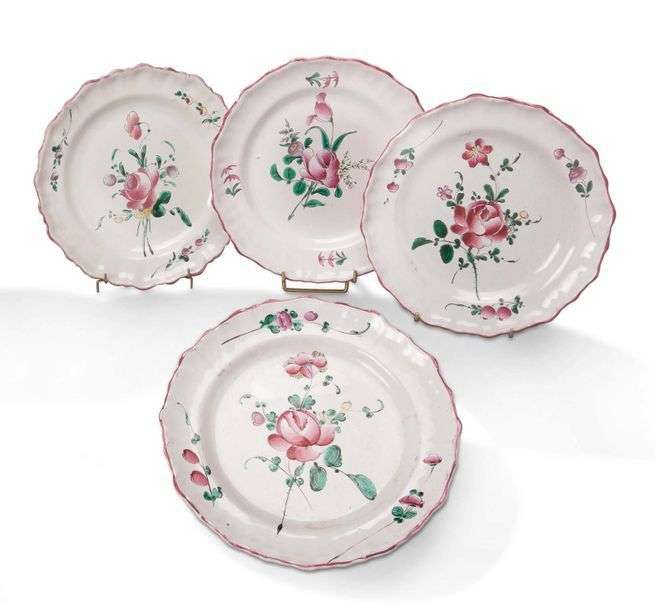
Moustiers fabrique de Ferrat
The item was sold for 234 €
Fees include commission and taxes.
Moustiers fabrique de Ferrat
Small Fire
Four faience plates decorated with polychrome roses.
18th century scroll edging Diam 24.5 cm
Known since the earliest antiquity, tin is one of the most ancient materials known. Extracted from an ore called "cassiterite", tin, from the Latin stannum (chemical symbol Sn) is a silver-grey metal, very malleable, whose melting temperature is low (232°C) used in alloy with other metals, such as lead, copper, antimony, bismuth or even zinc. Philippe Boucaud, in his book "Les Etains, Des origines au début du XIXe siècle" distinguishes three types of tin: fine tin, common tin and tin with a proportion of lead ranging from 30 to 40%.
Only the first two types are used for the production of food ponds.
Tin can be produced by hammering or casting before being decorated with engraving, repoussé or bossing.
The pieces we present to you are all from the same collection of a Lyon amateur.
And are mainly dedicated to domestic use. They include several categories of objects, some of which seem essential to the tin collector. The plate or dish known as the Cardinal's, for example, with a wide wing, was a great success throughout Europe until the 17th century. The iron pot is distinguished from the flat gourd by its bulbous belly and its screw cap topped with a flat openworked and cut-out grip.
From the 18th century onwards, this type of object became more decorative than utilitarian. The water pot, intended to serve table water, must be distinguished from the ewer for washing hands.
The helmet ewer abandoned from 1750 onwards was replaced by the baluster ewer, generally decorated with a frieze of gadroons. Every collection also contains the famous jugs, of which three types can be distinguished in France: shoulder, baluster and truncated cone. You can also admire the broth bowls, whose "hilly" and no longer curved lid appeared at the end of the 17th century.
Small Fire
Four faience plates decorated with polychrome roses.
18th century scroll edging Diam 24.5 cm
Known since the earliest antiquity, tin is one of the most ancient materials known. Extracted from an ore called "cassiterite", tin, from the Latin stannum (chemical symbol Sn) is a silver-grey metal, very malleable, whose melting temperature is low (232°C) used in alloy with other metals, such as lead, copper, antimony, bismuth or even zinc. Philippe Boucaud, in his book "Les Etains, Des origines au début du XIXe siècle" distinguishes three types of tin: fine tin, common tin and tin with a proportion of lead ranging from 30 to 40%.
Only the first two types are used for the production of food ponds.
Tin can be produced by hammering or casting before being decorated with engraving, repoussé or bossing.
The pieces we present to you are all from the same collection of a Lyon amateur.
And are mainly dedicated to domestic use. They include several categories of objects, some of which seem essential to the tin collector. The plate or dish known as the Cardinal's, for example, with a wide wing, was a great success throughout Europe until the 17th century. The iron pot is distinguished from the flat gourd by its bulbous belly and its screw cap topped with a flat openworked and cut-out grip.
From the 18th century onwards, this type of object became more decorative than utilitarian. The water pot, intended to serve table water, must be distinguished from the ewer for washing hands.
The helmet ewer abandoned from 1750 onwards was replaced by the baluster ewer, generally decorated with a frieze of gadroons. Every collection also contains the famous jugs, of which three types can be distinguished in France: shoulder, baluster and truncated cone. You can also admire the broth bowls, whose "hilly" and no longer curved lid appeared at the end of the 17th century.