
&w=3840&q=75)
&w=3840&q=75)
&w=3840&q=75)
&w=3840&q=75)
&w=3840&q=75)
&w=3840&q=75)
&w=3840&q=75)
&w=3840&q=75)


261
VIETNAM, CULTURE DE DONG SON 东山文化 铜鼓
The item was sold for 110 500 €
Fees include commission and taxes.
VIETNAM, CULTURE DE DONG SON 东山文化 铜鼓
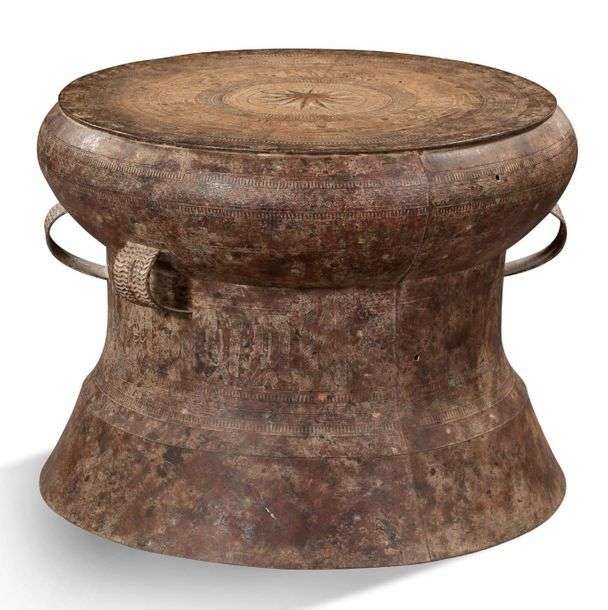
Large bronze rain drum consisting of a sound plate known as a tympanum fixed on a bulging part in the shape of a torus which narrows towards a cylindrical body widening into a truncated cone-shaped foot without bottom to allow the free exit of the sound waves, four handles connecting the upper part to the central body. The whole bears a decoration in slight relief or in hollow. The tympanum is decorated in the centre with a twelve-pointed star in relief - proof of the cult of the God of the Sun, the creator of life for the people of Lake Viêt. Around the star are friezes with geometric patterns radiating towards the outline and scenes of festive ceremonies depicting feathered figures dancing and bearing arms alternate with houses on stilts. Twelve birds (named Chim Lac in Vietnamese) flying counterclockwise. The case is decorated with four twisted handles and horizontal and vertical bands with geometric motifs and feathered figures. The foot has not been decorated.
The Dong Son culture, named after the village in northern Vietnam where the remains are located, is a prehistoric bronze culture from Indochina, dating from the early 1st millennium BC. Remarkable finds from this period included ritual objects, in particular bronze drums that appeared in the wider Red River basin, the production of which persisted until the 17th-18th century. Often found in the tombs of high-ranking figures, these drums were attributed to the power and wealth of their owners. This magnificent drum of curved cylindrical shape, characteristic of type "I" of the classification of Dôngsonian drums established in 1902 by Heger, is said to have belonged to the mayor of Hanoi and brought back to France following the immigration of his family in the 1950s.
Similar piece:
A very similar drum, known as the "Moulié drum", from Sông Dà and dated to the Dong Son II period, mid-1970.
Large bronze rain drum consisting of a sound plate known as a tympanum fixed on a bulging part in the shape of a torus which narrows towards a cylindrical body widening into a truncated cone-shaped foot without bottom to allow the free exit of the sound waves, four handles connecting the upper part to the central body. The whole bears a decoration in slight relief or in hollow. The tympanum is decorated in the centre with a twelve-pointed star in relief - proof of the cult of the God of the Sun, the creator of life for the people of Lake Viêt. Around the star are friezes with geometric patterns radiating towards the outline and scenes of festive ceremonies depicting feathered figures dancing and bearing arms alternate with houses on stilts. Twelve birds (named Chim Lac in Vietnamese) flying counterclockwise. The case is decorated with four twisted handles and horizontal and vertical bands with geometric motifs and feathered figures. The foot has not been decorated.
The Dong Son culture, named after the village in northern Vietnam where the remains are located, is a prehistoric bronze culture from Indochina, dating from the early 1st millennium BC. Remarkable finds from this period included ritual objects, in particular bronze drums that appeared in the wider Red River basin, the production of which persisted until the 17th-18th century. Often found in the tombs of high-ranking figures, these drums were attributed to the power and wealth of their owners. This magnificent drum of curved cylindrical shape, characteristic of type "I" of the classification of Dôngsonian drums established in 1902 by Heger, is said to have belonged to the mayor of Hanoi and brought back to France following the immigration of his family in the 1950s.
Similar piece:
A very similar drum, known as the "Moulié drum", from Sông Dà and dated to the Dong Son II period, mid-1970.