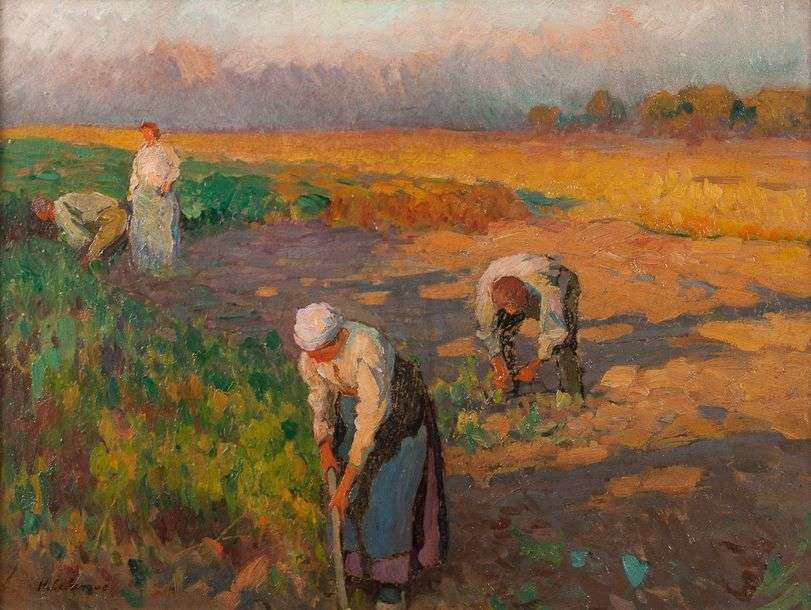
Henri Baptiste LEBASQUE (1865-1937) Oil on cardboard, signed lower left 12 5/8 x 17 1/4 in
Henri Lebasque was a post-impressionist artist from Champigné, where he was born in 1865. He studied at the Fine Arts school in Angers. In 1886 he moved to Paris, where he met leading modern artists like Pissarro and Renoir, who had a considerable influence on his painting. For nearly six years he worked unrelentingly on the fresco project for the Panthéon with Ferdinand Humbert, earning himself a considerable reputation. In the 1900s, after experimenting with Pointillism alongside Maximilien Luce and Paul Signac, he turned to another movement that deeply marked his work: Fauvism. The painting here is particularly interesting as a speaking illustration of the artist's pictorial and aesthetic explorations. Lebasque's work with light and colour is remarkable, and the Fauvist influence is recognisable in his warm palette. The opposition between oranges and yellows and cool colours, like the very pure green and purple shadows, immerses the viewer in the atmosphere of a summer evening. We can almost feel the air, heavy with the burning heat of the day, turning cooler with the approach of evening through his depiction of a sky mingling warm and cool shades, though they are never combined in the rest of the painting. The work inevitably makes us think of Millet's Glaneuses. Here Lebasque pay tribute to the painter of simple things and everyday reality while bringing a modern touch to a well-known subject. Though the construction is very similar, the Fauvist influence and the thick, visible touch inherited from his Pointillist period make it stand out as a unique composition. Here Lebasque reveals himself as part of both the line of great past masters and the new generation of 20th century artists.

&w=3840&q=75)
&w=3840&q=75)
&w=3840&q=75)
&w=3840&q=75)
&w=3840&q=75)
&w=3840&q=75)
&w=3840&q=75)
&w=3840&q=75)