
&w=3840&q=75)
&w=3840&q=75)
&w=3840&q=75)
&w=3840&q=75)
&w=3840&q=75)
&w=3840&q=75)
&w=3840&q=75)
&w=3840&q=75)


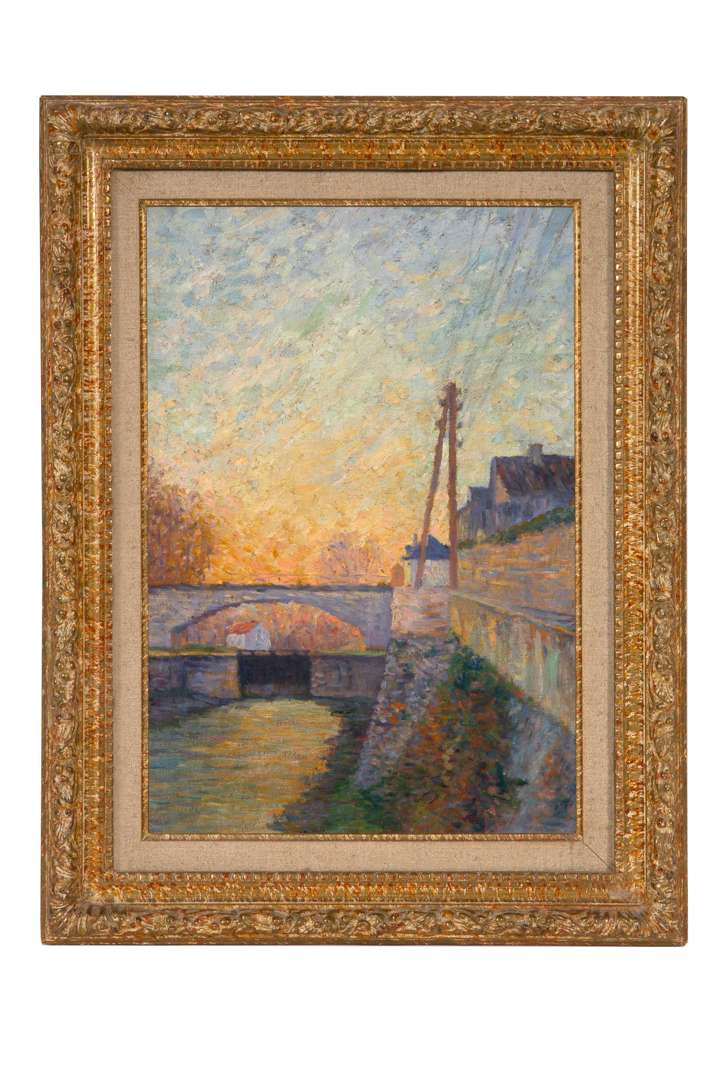
ALBERT DUBOIS-PILLET (1846–1890)
The canal, circa 1880–1883
Fees include commission and taxes.
The canal, circa 1880–1883
Oil on canvas
, unsigned
(Previously restored, with a patch on the reverse)
46 x 32 cm - 18 1/8 x 12 5/8 in.
Oil on canvas, unsigned
- Auction, Important Modern Paintings […], Me Bellier, Paris, Palais Galliera, 27 June 1968, lot 69
- Auction, Important Modern Paintings […], Loudmer-Poulain-Cornette de Saint-Cyr, Paris, Palais Galliera, 28 November 1971, lot 13
- Auction, Modern Paintings and Sculptures […], Loudmer-Poulain, Paris, Palais Galliera, 6 December 1975, lot 58
- Auction, Important Contemporary Paintings, Briest, Paris, Hôtel Drouot, 21 June 1984, lot 42 (titled L’écluse)
- Private collection, France (acquired at the previous sale and subsequently passed down through the family)
Patrick Offenstadt, Albert Dubois-Pillet, Catalogue raisonné, Paris: Galerie Offenstadt Publications, n.d. [after 2017], described and reproduced under no. 10, p. 29
“Albert Dubois, who in 1883 adopted the artist name Dubois-Pillet (adding his mother’s surname to his own), embarked on an artistic career late in life, having previously served in the military. After a few unsuccessful attempts, he was accepted by the jury at the Salon in 1877, with a still life entitled Un coin de table (cat. 79). Two years later, he was accepted again with Chrysanthèmes (cat. 80), a decidedly classical subject. A diligent painter, he took on commercial subjects, probably less to sell his paintings than to try his hand at genres favoured by Salon painters. But to make a name for himself in this milieu, it would have been better to be recommended by a master, as was the custom to indicate in the Salon catalogue. However, Dubois was self-taught and painted primarily to satisfy a passion. "[...] as I was nobody’s pupil, it did not suit my character to invent one," he confided in 1888. Not even Manet, who was awarded the Legion of Honour on his deathbed, and with whom Dubois is said to have been close around 1883. Could this possible encounter with Manet have prompted Albert Dubois to turn towards the light-coloured style of painting known as Impressionism? After the master’s death, having been rejected by the 1883 Salon, he joined the group of independent artists the following year, playing a significant role in its founding. Now known as Dubois-Pillet, he met a young generation of artists there. Whether it was Georges Seurat, who had a classical training, or Paul Signac, Dubois-Pillet shared with them the shock felt upon discovering Impressionist painting in the Parisian galleries in the years 1875–1880. Their models were Manet, Monet, Guillaumin, Pissarro... ’
Patrick Offenstadt, Albert Dubois-Pillet, Catalogue raisonné, Paris: Galerie Offenstadt Publications, n.d. [after 2017], p. 9
***
“A contemporary account, that of the painter J. Majola, states that Dubois-Pillet was a pupil of Manet. In that case, Dubois would have known Manet before his death on 30 April 1883. Be that as it may, around 1881 Dubois more or less imitated Manet; even if he did not know the man, he admired the painter.”
Roger Gounot, 1969
In his catalogue raisonné, Patrick Offenstadt notes that, until now, this work was known only from the black-and-white reproductions featured in the auction catalogues in which it appeared. He draws a parallel between it and a painting entitled *Le Pont Marie à Paris* (no. 11) on the basis of its geometric composition.