
&w=3840&q=75)
&w=3840&q=75)
&w=3840&q=75)
&w=3840&q=75)
&w=3840&q=75)
&w=3840&q=75)
&w=3840&q=75)
&w=3840&q=75)


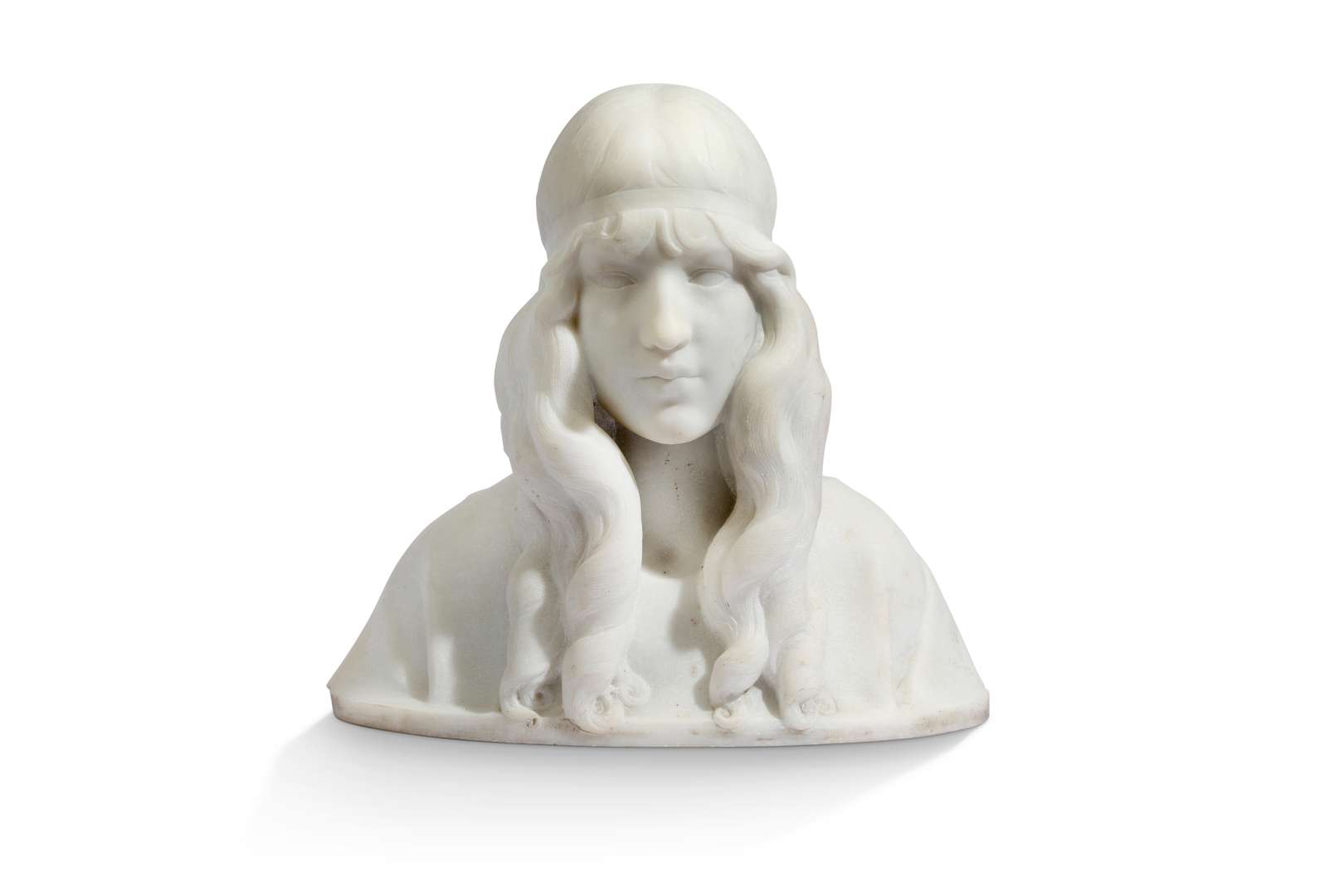
RICHARD GUINO (1890–1973)
Bust of Madeleine Souchal (1906–1991), c. 1921
Fees include commission and taxes.
Bust of Madeleine Souchal (1906–1991), c. 1921
White marble, direct
carving, signed on the ribbon
, wooden
stand 44 x 46 x 27 cm - 17 3/8 x 18 1/8 x 10 5/8 in.
This work is listed in the archives of the Guino Estate. A certificate of authenticity, dated 11 January 2024, will be provided to the purchaser.
White marble, direct carving, signed on the ribbon, wooden stand
Related work Richard Guino (1890–1973), Bust of Madeleine Souchal (1906–1991) [Portrait of Marie Pageix’s niece], c. 1921, terracotta, signed on the ribbon, 40.9 x 40.2 x 25.3 cm, private collection.
Accompanied by:
RICHARD GUINO (1890–1973)
Portrait of Madeleine Souchal (1906–1991), 1921
Charcoal and stump on paper
Signed and dated '1921' centre left
47 x 30.5 cm - 18 1/2 x 12 in.
This work is referenced in the archives of the Guino Estate. A certificate of authenticity, dated 11 January 2024, will be provided to the purchaser.
Black chalk and stump on paper, signed and dated '1921' middle left
AFTER RICHARD GUINO (1890–1973)
Portrait of Madeleine Souchal (1906–1991), 1921
Heliogravure [?] in black on paper
, signed and dated '1921' in the plate, centre left
22.5 x 14.5 cm - 8 7/8 x 5 3/4 in.
Heliogravure [?] in black on paper, signed and dated '1921' in the plate, centre left
Private collection, France (inherited from the model)
Richard Guino accorded a special place to marble during the formative years of his training, spent between Barcelona and Paris, even before his collaboration with Auguste Renoir. Several old photographs and studio archives bear witness to his early interest in direct carving and in the sensual qualities of this material, which he exploited in female figures characterised by simplified volumes and subtly modelled surfaces. Even before 1912, Guino produced several sculptures in marble or intended for casting in marble, including the Torso of a Nude Woman, now held at the Pushkin Museum in Moscow, formerly in the collection of Ivan Morozov. This use of marble, relatively rare in the artist’s early work, reveals Guino’s sculptural ambition and his place within the modern artistic explorations of the early 20th century, situated between Mediterranean heritage, a synthesis of forms, and decorative primitivism. The few known marble works from this period, often remaining in private hands or untraceable, now constitute particularly valuable testimonies to his early artistic explorations.
The Guino Estate holds several portraits of the woman who, until now, was known only as ‘Mrs Pageix’s niece’. Born Marie Robillon, she was the wife of Georges Pageix, one of Madeleine’s maternal uncles, a senior medical officer during the Great War, and the godmother of the eldest son of Richard Guino and Gabrielle Borzeix: Georges Guino.