
&w=3840&q=75)
&w=3840&q=75)
&w=3840&q=75)
&w=3840&q=75)
&w=3840&q=75)
&w=3840&q=75)
&w=3840&q=75)
&w=3840&q=75)


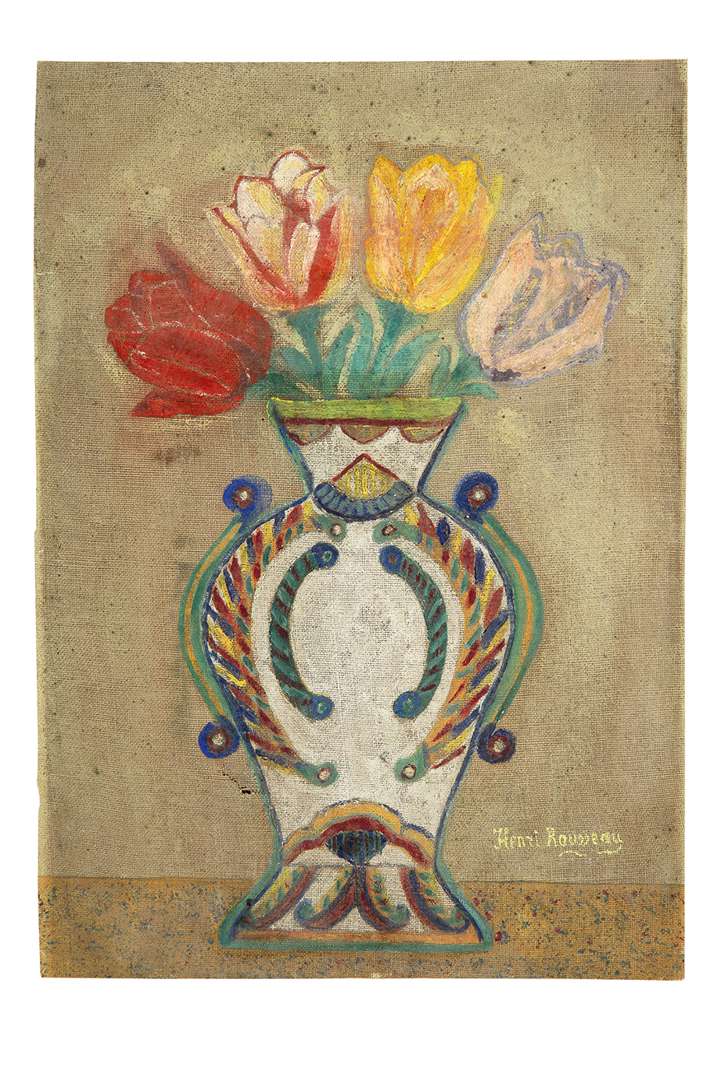
ATTRIBUTED TO HENRI ROUSSEAU (1844–1910)
Vase with four tulips
Fees include commission and taxes.
Vase with four tulips
Oil on unstretched
canvas, signed lower right
(small hole and signs of wear)
Unframed
36 x 25.5 cm – 14 1/8 x 10 in.
Oil on unstretched canvas, signed lower right
- Collection of Mr Fraysse, manager of a hotel in Saint-Germain-des-Prés, Paris (acquired around 1910–1915 from a shop in Montmartre)
- Private collection, France (inherited from the above)
Henry Certigny, *Le Douanier Rousseau in His Time: A Biography and Catalogue Raisonné*, Volume II, Tokyo: Bunkazai Kenkyujyo, 1984, described and reproduced under no. 212, pp. 430–431
In *Le Douanier Rousseau en son temps*, Henri Certigny methodically sets out the factors that led him to include *Vase with Four Tulips* in the second volume of his catalogue raisonné.
He begins by noting that the work comes from the collection assembled by a certain Fraysse, a Parisian art lover active in the early 20th century, who acquired the painting around 1910–1915 in a shop in Montmartre. Described as the manager of a hotel in Saint-Germain-des-Prés, he “was an art lover with eclectic tastes, for the collection he left upon his death, which occurred around 1922, included, amongst other works, a Vollon, a Diaz, two coloured pencils by Steinlen, a drawing by Friesz, one by Foujita, a gouache by Dinet, works by Zingg and even an unsigned stippled pastel. ’
The author then dwells on the signature affixed to the painting, as well as its ‘perfect state of cleanliness and preservation’. He specifies that the authenticity of the signature was confirmed by Raymond Trillat, a then-renowned graphologist, by comparison with the mark deposited by Henri Rousseau at the Police Headquarters. He further adds that the canvas, preserved under glass after being removed from its stretcher, would thus have escaped any restoration, which would explain its remarkable freshness.
Henri Certigny finally offers his analysis of the composition’s stylistic peculiarities: extreme simplification of forms, the lack of relief in the vase, the bold chromatic treatment of certain decorative motifs, and the rudimentary nature of the support. In his view, these characteristics would place the work in the final years of Le Douanier Rousseau’s career, around 1910, at a time when the artist, influenced by the Fauvist movement, was also working as a private tutor. He therefore puts forward the appealing hypothesis that the work was executed in an educational context, as a demonstration for pupils, which would explain the unusual spontaneity and simplicity of the composition.
Among Douanier Rousseau’s floral arrangements, our *Vase with Four Tulips* derives its uniqueness from the painter’s emphasis on the vessel rather than its contents. Flanked by handles adorned with circular motifs, it is adorned with a rich polychrome decoration reminiscent of the vase the artist gave in 1908 to Max Weber, the young American painter who had encouraged him to paint on ceramics. It was in André Metthey’s studio in Asnières-sur-Seine, and under the guidance of Ambroise Vollard, that Henri Rousseau would learn the art of painting on earthenware.