
&w=3840&q=75)
&w=3840&q=75)
&w=3840&q=75)
&w=3840&q=75)
&w=3840&q=75)
&w=3840&q=75)
&w=3840&q=75)
&w=3840&q=75)


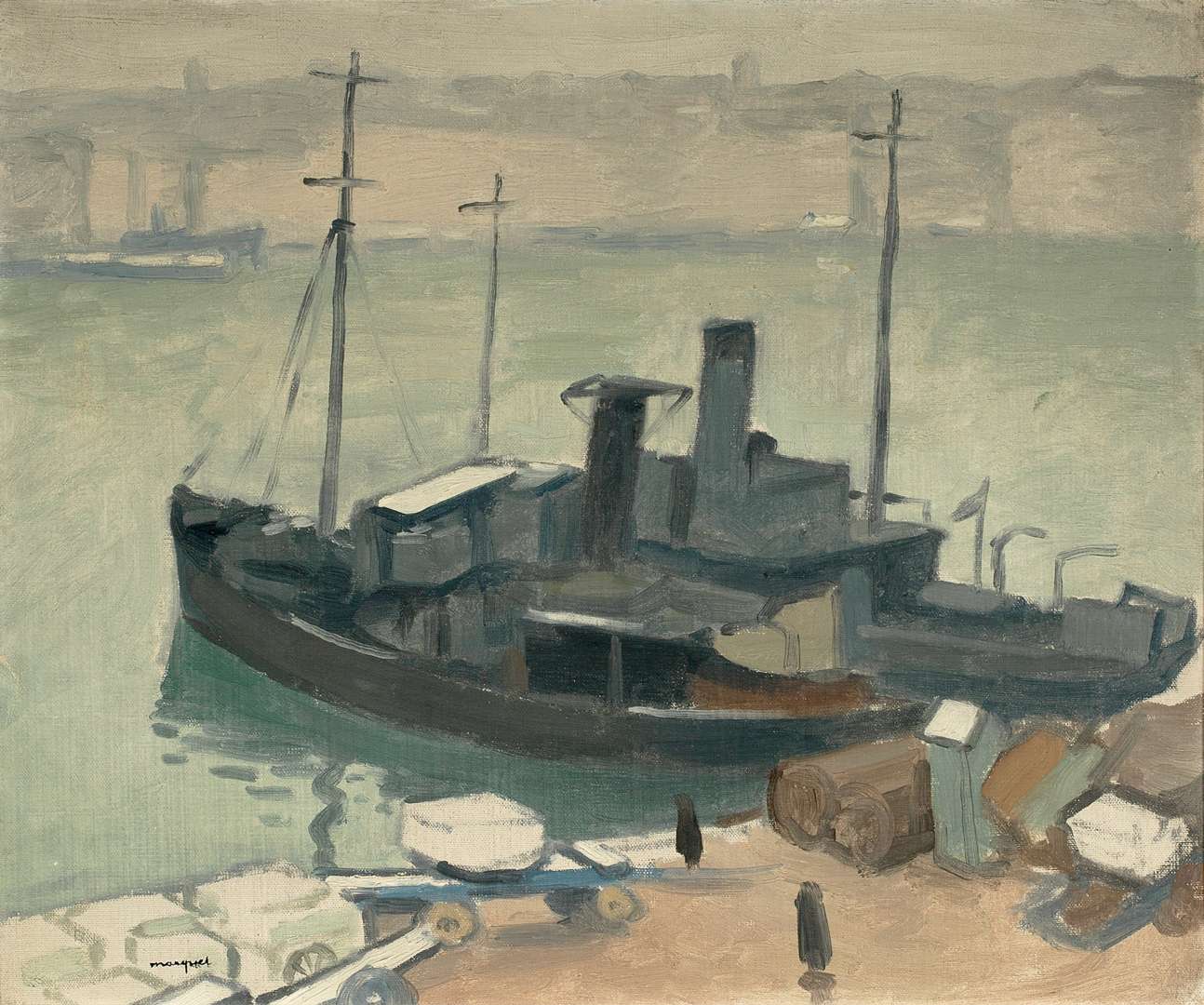
ALBERT MARQUET (1875–1947)
Two boats in Marseille or the Old Port, winter, Marseille, circa 1916–1918
Fees include commission and taxes.
Two boats in Marseille or the Old Port, winter, Marseille, circa 1916–1918
Oil on canvas
, signed lower left
(re-stretched and minor restoration carried out some time ago)
46 x 55 cm – 18 1/8 x 21 5/8 in.
A certificate from Mrs Marcelle Marquet, dated 13 July 1965, will be provided to the buyer.
This work will be included in the Albert Marquet Digital Catalogue Raisonné currently being prepared by the Wildenstein Plattner Institute. A certificate of inclusion will be provided to the buyer.
Oil on lined canvas, signed lower left
- Palazzoli Collection
- Marcelle Marquet Collection, France (acquired from the latter through Maurice Laffaille in 1963)
- Knoedler & Co Gallery, New York (on loan from the gallery in 1964)
- Marcelle Maquet Collection, France
- Private collection, Switzerland (acquired from the latter in 1965)
- Private collection, France
- Private collection, France (inherited)
George Besson, Marquet, Paris: Crés, 1929, reproduced on plate 33 (titled *Marseille. Rain* and dated 1916)
- Exposition A. Marquet (1875-1947), Genève, Galerie du Théâtre, 3 novembre-14 décembre 1967, n°15 (titré Marseille et daté 1920)
- Marquet, New York, Knoedler Galleries, 6-29 mai 1964, n°23 (titré Boat in Marseille ou Two Cargo Boats in Marseille)
- Albert Marquet : Peintre français, Montréal, Musée des Beaux-Arts, 10 janvier-2 février 1964 ; Ottawa, Galerie nationale, 13 février-8 mars 1964 et Québec, Musée des Beaux-Arts, 20 mars-8 avril 1964
“On 3 August 1914, the First World War broke out. Marquet had just sent Manguin a photograph showing the three of them—Matisse, Camoin and himself—on horseback in front of an airship. On the back of the postcard, he wrote: ‘As you can see from this card, we’ve just formed a squadron to defend France. I think you won’t hesitate for a moment to join us and that we’ll be the first to enter Berlin.” But the banter soon faded. Having been exempted from military service, Matisse and Marquet tried to take part in the conflict and went to consult the collector Marcel Sembat, then a Socialist MP. He replied: ‘Paint. No one in this field can replace you.’ Shortly before the Battle of the Marne, Marquet set off with Matisse for Collioure; but it was ultimately in Marseille that he settled for much of those war years. He had first visited the city in 1905 with Camoin, who had introduced him to the city’s red-light districts, notably Rue Bouterie, which he painted so often. Marquet initially lived in Louis Frésier’s studio, before renting Eugène Montfort’s on the Quai de Rive-Neuve, opposite the town hall. He depicted Marseille, just as he constantly did with Paris, in all seasons and under the most varied weather conditions. He always chose to paint landscapes in the prevailing weather conditions. During these war years, he painted a major series of views of the port of Marseille. He loved to immerse himself in this teeming life and the ceaseless comings and goings of the boats, which constantly altered the landscape. *The Port of Marseille*, circa 1916 (Cantini Museum, Marseille), was painted from the Hôtel Beauvau, where Matisse was staying. His focus was on colour contrasts and the development of a precise compositional structure. The silhouette of the transporter bridge, the surrounding architectural forms and the boats enabled him to structure his composition around a play of verticals and horizontals. In The Old Port of Marseille, 1916 (Larock-Granoff Collection, Paris), his attention is drawn to the presence of two boats at the quay. The luminous mass of the boat situated at the centre of the painting illuminates the entire composition. To ensure the eye is not distracted from this scene, he deliberately reduces all the surrounding details to the bare essentials. The houses are reduced to mere windowless rectangular blocks, and the quay in the foreground is left virtually deserted. In 1918, in Port of Marseille in the Mist (L’Annonciade, Saint-Tropez Museum), he sought to suggest, with a minimum of pictorial means, the harbour bathed in a muffled atmosphere. He seeks to convey the winter atmosphere where architectural forms, which blend into the fluidity of the paint, are simply evoked by a few lines and the modulation of broad planes. This subtlety of colour tones gives the painting its full poetic dimension. ’
Jean-Paul Monery, ‘Journal de bord dans le Midi’, in Albert Marquet, Itinéraires maritimes, exhibition catalogue, Paris, Musée national de la Marine, 15 October 2008–2 February 2009, Paris: Thalia Édition, 2008, pp. 104–105