
&w=3840&q=75)
&w=3840&q=75)
&w=3840&q=75)
&w=3840&q=75)
&w=3840&q=75)
&w=3840&q=75)
&w=3840&q=75)
&w=3840&q=75)


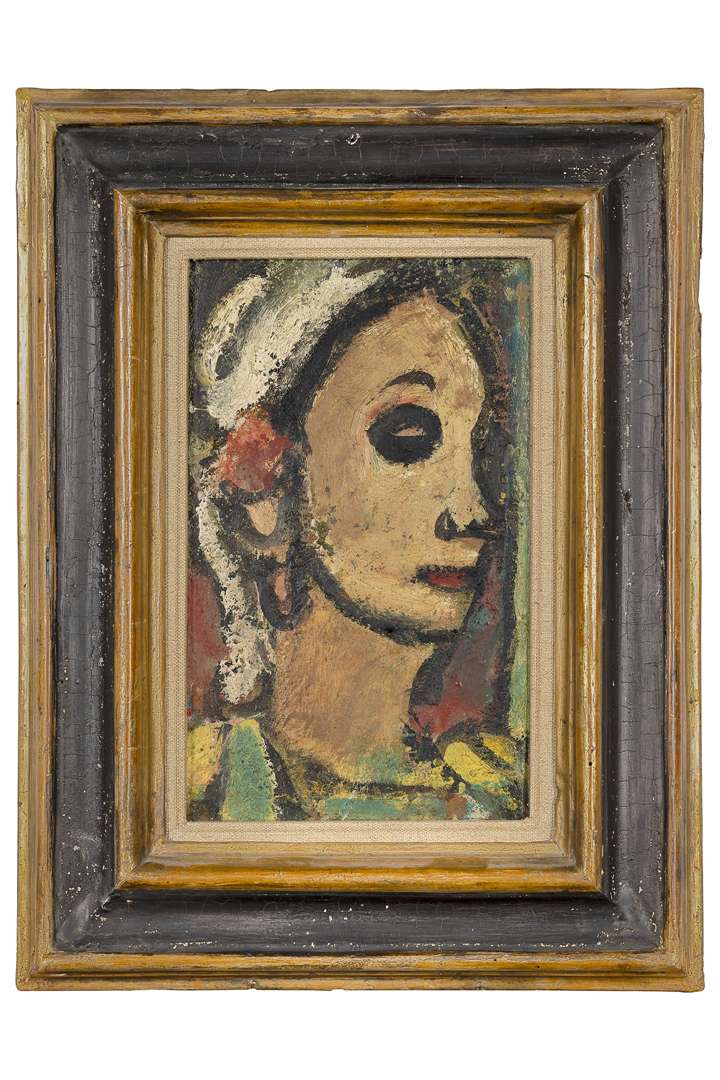
GEORGES ROUAULT (1871–1958)
Solange, 1935–1939
Fees include commission and taxes.
Solange, 1935–1939
Oil on paper mounted on canvas
Unsigned
Stamped ‘Atelier de/Georges Rouault’ [not Lugt] and inscribed ‘Isabelle Rouault’ on the reverse
28 x 17.5 cm - 11 x 6 7/8 in.
Oil on paper laid on canvas, unsigned, stamped with the ‘Atelier de/Georges Rouault’ mark and inscribed ‘Isabelle Rouault’ on the reverse
The artist’s family, France
- Olivier Nouaille and Olivier Rouault [catalogue compiled by], Rouault, L’œuvre peint, Volume III, Paris: Fondation Georges Rouault, 2021, described and reproduced under reference 2791, p. 183
- Georges Rouault, Visages, Ten studio studies reproduced as facsimiles, Paris: Daniel Jacomet and L’étoile filante, 1969, reproduced using the Jacomet process under no. 1
- Painters of Passion, Adventures in Color by Kandinsky, Rouault, and Their Contemporaries, Tokyo, Panasonic Shiodome Museum of Art, 17 octobre-20 décembre 2017, n°76
- Georges Rouault and the Expressionists, Painters of Passion, Miyagi, The Miyagi Museum of Art, 12 août-9 octobre 2017, n° inconnu
- Georges Rouault, Genève, Interart Galerie, 30 avril-2 juillet 2010, n° inconnu
- Rétrospective Georges Rouault (1871-1958), dans les collections privées françaises et étrangères, peintures et œuvres sur papier, Paris, Galerie Schmit, 16 avril-4 juillet 2008 (reprise 10 septembre-15 décembre 2008), n° inconnu
- Rouault, the painter who kept his spiritual liberty, Daejeon, Daejeon Museum of Art, 4 mai-27 août 2006, n° inconnu
“The abandonment of the ‘Girls’ and the ‘Bestiary
’: a decline in the number of ‘Types’, and, even more so, of the ‘Judges’; to these two developments are added two even more radical abandonments: that of the ‘Girls’ theme and that of the ‘Fantastic Bestiary’. After 1930, Rouault completely abandoned these two sources of inspiration
.” “And feminine grace itself sprang from his fingers” (Raïssa Maritain)
Can we say that he replaced the Girls with young girls? Some of the old artist’s most moving works between 1930 and 1950 do indeed depict female figures reduced to the head or shown as busts, from the front, or, more rarely, in profile, among which one cannot fail to mention some of his major works from this period: the Spanish figure entitled The Thousand and One Nights from 1942 (fig. 2288), the enigmatic Sibyl of Cumae from 1947 (fig. 2293), where the model is shown in profile, the gesture of her finger that seems to point to a flower, her eyes cast down in an intensely black socket, the overall colour scheme dominated by murky, mysterious greens—all this makes this figure a strange yet fitting embodiment of the famous Sibyl who had inspired Virgil and so many medieval artists before Michelangelo. While the Sibyl of Cumae is painted in unsettling greens, Veronica (fig. 2286) is rendered in very soft blues that convey hope all the more effectively. Viewed from the front, her large eyes wide open, her head covered by a veil adorned with a cross, her lips slightly parted, her expression melancholic and gentle, she is, alongside Saint Martha (fig. 2284), her contemporary, one of Rouault’s most famous depictions of a saint. Here he recaptures the spirit of Gothic art, where the highest spirituality is combined with a kind of familiarity and everyday truth. Note how this figure of a saint is the culmination of the poetic secular figures that Rouault had produced in great numbers from 1935 onwards. One of them, incidentally, was called Veronica. The cross on the veil, a more contemplative expression, the majesty arising from the framing of the head by a semicircular arch—a device also used for figures of Christ: nothing more is needed to immediately attain the most authentic spirituality. This achievement, which inspired Rouault to create one of his most successful stained-glass windows in the church on the Assy plateau in Haute-Savoie, is perhaps surpassed by the Saint Martha, which is a contemporary work. The composition of the frame and the bare background serve only to highlight the face, to which a slight tilt lends a familiarity not found to such a degree in the Veronica. The more nuanced, softer chromatic harmony enhances the impression of charm exuded by this figure.”
Bernard Dorival, Rouault, L’œuvre peint, Volume II, Monte Carlo: Éditions André Sauret, 1988, pp. 13–14