
&w=3840&q=75)
&w=3840&q=75)
&w=3840&q=75)
&w=3840&q=75)
&w=3840&q=75)
&w=3840&q=75)
&w=3840&q=75)
&w=3840&q=75)


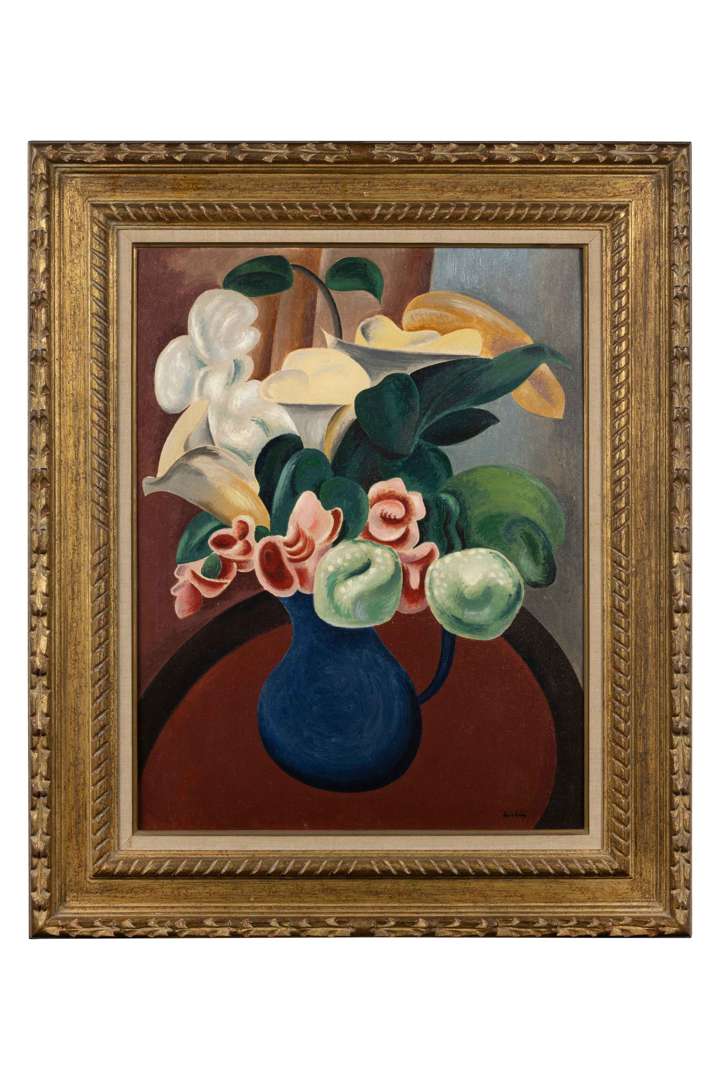
AUGUSTE HERBIN (1882–1960)
Roses, 1922
Fees include commission and taxes.
Roses, 1922
Oil on canvas
, signed lower right
, 65 x 50 cm – 25 5/8 x 19 3/4 in.
Oil on canvas, signed lower right
- Galerie L'Effort Moderne (Léonce Rosenberg), Paris, no. 475
- Auction, Modern Prints, Drawings, Watercolours, Gouaches, Pastels, Paintings, SCP Boscher-Gossart, Paris, Hôtel Drouot, 2 July 1980, lot 75
- Private collection, France (acquired at the previous sale and subsequently passed down through the family)
- Geneviève Claisse, *Herbin: A Catalogue Raisonné of the Paintings*, Lausanne: Les Éditions du Grand-Pont; Paris: La Bibliothèque des Arts, 1993, described and reproduced under no. 464, p. 361
- Anatole Jakowski, Auguste Herbin, Paris: Éditions Abstraction-Création, 1933, p. 43
“1922. Having followed a flawless artistic path that took him from Cubism to geometric abstraction, Herbin was a solitary painter. Collectors ignored him, the art world rejected him, and critics mentioned him only to disparage him. In issues 11–12 of the journal L’esprit nouveau, Maurice Raynal commented on the painting *The Armchair* (1920) in these terms: ‘We do not look at a painting with our backsides, unless Mr Jules Romains’ experiments on vision through the skin also work that way.’
Herbin was forty years old and wondered: was he not at a dead end? It was then that he decided to recharge his batteries. He set about it like a convalescent in rehabilitation. Throughout 1922 he painted three pictures a month, shifting from one style to another, in search of a new figurative approach. Four landscapes painted in Paris are meticulous and cold architectural compositions. A stay in the Loue Valley allowed him to rediscover old instincts: the rhythms, the free and sensitive brushwork, the joy of colours.
The series of six portraits painted during that year convey the same uncertainty.
Three are in the Cubist style (notably Mme H. in the blue dress), whilst the two portraits of the young girl with long hair return to a classical mode of expression.
This sense of disarray is also evident in some fourteen still lifes. Some are purist compositions in the same vein as Still Life with Fruit Bowl. These include: Fruit Basket, Still Life with White Pot, Still Life with Cauliflowers. Others, more numerous, are realist works (several floral arrangements and two still lifes: Fish, Scorsoneras).
Geneviève Claisse, Herbin, Catalogue raisonné de l’œuvre peint, Lausanne: Les Éditions du Grand-Pont; Paris: La Bibliothèque des Arts, 1993, p. 101
***
“In 1922, and in the years that followed, Herbin would adopt a cold realism, with a particularly dry brushwork, which he applied to traditional genres: landscapes, still lifes and figures. Although Herbin did not follow the same path as Piet Mondrian or Walter Dexel—with whom his development had hitherto shared many commonalities—and although he contributed in his own way to the ‘Return to Order’ prevailing in a certain section of Western art, Herbin nonetheless appeared out of step with Picasso, Derain, Gris, La Fresnaye, Carrà or Severini, who were at the origin of this movement.
Herbin would, however, also venture very far in this direction, when his paintings adopted the same palette and expressed the same sensibility as those of Othon Friesz or André Dunoyer de Segonzac (Path on the Sainte-Croix Hill in Cassis), or when he pushed the return to figuration to the point of stiffness (Boules Players, 1923) and sometimes even to naivety (Young Girl with Flowers, 1924).’
Serge Lemoine, ‘Preface’ in Geneviève Claisse, Herbin, Catalogue raisonné de l’œuvre peint, Lausanne: Les Éditions du Grand-Pont; Paris: La Bibliothèque des Arts, 1993, p. 12